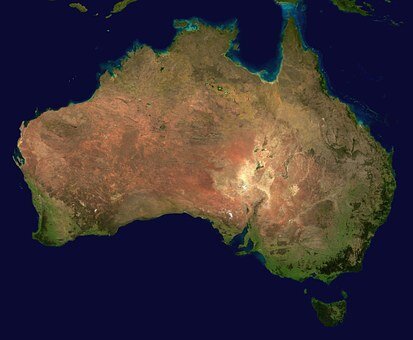
Australia is the smallest of the continents, entirely located in the southern hemisphere. The area is 7687 thousand km2. The unit of money is the Australian dollar. Australia is considered one of the economically developed countries of the United Nations. Australia is a federation of 6 states and 2 territories.
States: New South Wales, Victoria, Queensland, South Australia, Tasmania, Western Australia - and 2 territories: Northern Territory, Australian Capital Territory.
Australia is a member of the Constitutional Monarchy. The capital of Australia is Canberra. Australia is one of the most highly developed and rapidly developing countries in the world. It holds a strong position in the global market, is characterized by rapid growth in living standards. The system of relations between the states and the federal government is built on the model of the American constitution. The system of legislative power is based on the model of British parliamentarism. The powers of the federal parliament are defined in the Constitution of Australia adopted on January 1, 1901. The Parliament consists of two chambers: the House of Representatives (148 seats) and the Senate (76 seats). The Senate consists of 12 senators from each state for a term of 6 years and 2 from each territory for a term of 3 years. Five of the six states also have a bicameral system. Only in Queensland has the upper house been abolished since 1922, the Territories have a unicameral system.
As Australia is formally part of the Commonwealth, the Queen of Great Britain, represented by the Governor-General and six state governors, remains the head of state. The Governor-General is subject to the authority of the Australian armed forces and has the power to propose amendments to Australia's Constitution by referendum.
The head of the Australian Government is the Prime Minister, who is also the leader of the majority party in the Australian Parliament. The leading party in Australia is the Australian Labour Party (APL), formed in 1891. The party's policy is largely determined by the parliamentary faction. Since 1983, the parliamentary leader automatically becomes prime minister when the party wins elections. The Liberal Party of Australia, founded in 1944, represents the interests of a large bourgeoisie, the National (Agrarian) Party of Australia, founded in 1916, represents the interests of major landowners and pastoralists, forms a coalition with the Australian Labour Party, and there are many other parties in Australia (the Australian Democrats Party, the Nuclear Disarmament Party, the Rural Australia Party and others).
For its small size, this continent is sometimes referred to as an island continent. Geographical coordinates of the outermost points of the continent:
North - Cape York - 10 S, 143 E.
Yuzhnaya - Cape Wilson - 39 S, 146 E.
West - Cape Stip-Point - 26 SN, 113 E.
East - Cape Byron - 28 SN, 153 E.
History of creation.
The historical process of the country's formation and its modern parameters: a relatively small population, a huge territory, the richest raw materials, a high share of raw materials in exports, a powerful flow of foreign investment in the economy, as well as the presence of racial problems in society - all this allows us to classify Australia as a country of "migratory capitalism".
The man appeared in Australia 40 thousand years ago. These were aliens from South and Southeast Asia, the precursors of modern Aborigines. Having settled in the eastern part of Australia, people have penetrated into Tasmania. The fact that Tasmanians are descendants of ancient Australians is confirmed by recent archaeological finds on the island of Hunter in the Bass Strait.
Assumptions about the existence of the mysterious Terra incognita Australis - "Unknown southern land" to the south of the equator were expressed by ancient geographers. The vast land area in the southern hemisphere was depicted on maps in the 15th century, although its outlines did not resemble Australia. Some information about Australia's northern shores was available to the Portuguese as early as the 16th century, from Malay Islanders visiting the mainland's coastal waters to catch trepangs. However, until the 17th century none of the Europeans could see Australia with their own eyes.
The discovery of Australia has long been associated with the name of the English navigator James Cook. In fact, the first Europeans to visit the coasts of this continent and meet scattered Aboriginal tribes here were the Dutch: Willem Janssen in 1605 and Abel Tasman in 1642 crossed the Torres Strait and sailed along the coast of Cape York peninsula, while Tasman discovered the southwestern part of Tasmania, which he considered part of the continent. In 1606, the Spaniard Torres sailed the strait that separates New Guinea from the mainland.
to be continued in the next part https://zen.yandex.ru/media/id/5d6435c91e8e3f00adf4ec97/australia-part-2-5d9126d12beb4900b3038129