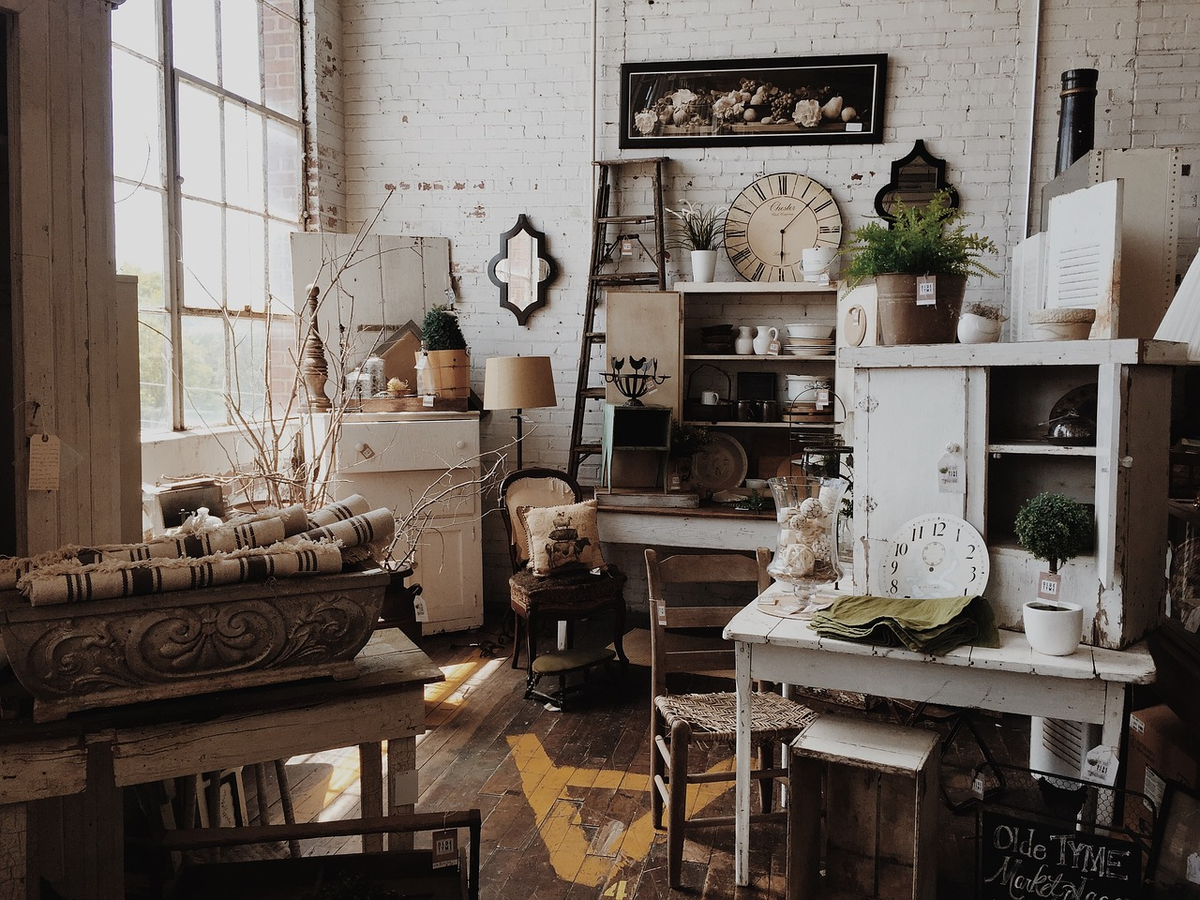
What is our relationship to the things that surround us? Which we buy, perhaps even every day, and call our own? Why is it so easy for us to give our love to so many things? Or do we not do that at all in the end?
From owning a lot
The first time I heard of the famous 10,000 object thesis in a philosophy lecture. According to my professor, 10,000 things can be found in every average industrial nation-modern household. 10,000 objects.
I remember going through the possessions of myself and Mr. Grünzeug in my mind in a flash - and coming to the fairly proud conclusion that over the years more than 10,000 items had certainly moved into our home. Satisfied, I leaned back and enjoyed the rest of the lecture (I don't remember exactly what it was about - shame on me).
When I think back today to this very moment - which, for whatever reason, has milled itself into my brain - a feeling of shame comes over me. For a long time I didn't really want to admit it to myself - and certainly not against the background of a development towards minimalism over the last year - but: Satisfaction was exactly the emotion that I linked with possessions, in whatever form, for a large part of my life.
From the hole that wants to be filled
For a long time, owning a lot meant a nebulous sense of security for me. You have to know: I come from a household where it's not normal for children to get pocket money and buy (or get) anything they want. I belonged to the teenagers with eternally old (and ugly) clothes, a more intentional than skillful care product equipment and an ancient children's room. Not that Mom didn't bother - but for various reasons, which I don't want to go into here, it couldn't be any different.
So I grew up with the always latent feeling of limited consumption. A lack. That's why celebrations that have dedicated themselves to this consumption (and with it: a hunger hole filling) were hotly desired and expected: Christmas and birthday as well as Easter and all other occasions when children are overwhelmed with useless bits and pieces degenerated into true gift battles. As a child, of course, you don't complain - on the contrary. You can't get enough of it.
I wanted...everything.
As I grew older, my demands increased - in every way. You wanted to please, in terms of clothing, equipment and at all. You had to keep up, pull along, somehow. And if the necessary means were not available, frustration was inevitable. Of course. The invisible competition between children and teenagers in this relationship is fatally brutal, less obvious than implicit.
To cut a long story short: I didn't go. Done. After my early move-out and with the first self-earned money on my account, I could hardly wait (one will guess it) to fill this hole that had grown bigger and bigger over the years: Konsum Auf Teufel komm' raus was the credo of the following years. I wanted...everything.
What exactly all this was, I still don't know. Clothes, cosmetics, books, decorative items, lifestyle articles (who actually introduced this highly strange consumer category, which doesn't assign its products any sense at all?) and what else could get in front of the radar of a teenager who had just let go of the consumer world, was bought.
Not that I earned much. But in contrast to the hunger branch of childhood, I felt like in paradise. And I behaved the same way. I over-eaten myself. On objects to be consumed. The more, the better.
Once a week the well-known drugstore chains were searched for cosmetics to be purchased and left again with a full bag. Here quickly three parts of the fashion Sweden, and this scarf looks great, what are these shoes? Never mind, I bought it. I want to have it. Will! Me! Have!
Much and cheap - the consumer dream?
It's obvious that you can't continue this for years without consequences (not only concerning your wallet): At the latest one year ago I realized slowly that I have a problem. A really concrete problem: Our apartment was overflowing with objects. Was slow, but sure, had become a temple of consumption - without me having noticed that correctly, could have noticed.
I was far too deeply involved in my search for the fulfillment that advertising had promised me through all these things lying around uselessly most of the year and locked away somewhere. I had been all too willing to bite, to swallow the bait of all advertising, always looking for the next bargain, the next source of satisfaction.
The majority of these parts were so eager and almost always thoughtless, sometimes even as if they had been acquired in intoxication - quite honestly - the purest scrap. They didn't deserve a better term, these things - both in terms of the final costs for me, as well as in terms of the manufacturing conditions (about which I certainly didn't think at all at the time) and the emotional value of the things (because this was not there). I had rubbed up my apartment.
"For a long time, I did not understand why"
Now not so terribly messy-like (please turn off the head cinema again!), but nevertheless: I had two cupboards full of cheap clothes (of which I never put on 85%), lots of cosmetics (who knows when you could still use them), endless books (well, I could still justify that to myself and others) and a lot of stuff that actually served no other purpose than to be there and give me a feeling of consumer power.
And I felt unhappy. Steady. For a long time, I did not understand why. I insanely thought that I still didn't have enough, that I still couldn't really keep up with what is being sold as a lifestyle in this country and that everyone was chasing after - me too.
And so I continued to buy. Heavens, until I understood where the real problem was, I had to move!
Because - who is surprised? - Our apartment became too small. We already lived in pairs on 45 square meters and now had to leave the actually much more comfortable 62 square meters - because we had too much stuff and simply didn't know where to put it. And most of it belonged to me.
And so we started looking for a new, bigger place to stay, which promised to be able to take our belongings reliably, to devour the prey of our consumer fury. We were certainly supported by the notion that one would "enlarge" oneself in the course of one's life, i.e. that it is quite normal to need more living space at some point. Especially when you're almost like a small family. Everyone thought it was quite normal. Nobody came up with the idea of telling me that maybe I just had too much stuff. But that would have solved our problem. But sometimes things are so simple only in retrospect.
From swimming against the current
And when we had found it, the suitable over 10,000-object swallowing-powerful thing of apartment, when I moved - when I had to take all these things seriously into my hands, look at them and transport them from A to B - it became clear to me where the real root of all evil lay. And I was not afraid to cancel the move (which I certainly would have done if it had worked so well).
The fact that you can become so strangers to yourself was a realization that shook me deeply. That was me? This collection of useless things? That was supposed to define me? I was stunned.
I already began to recognize what had to be done sooner or later in all radicalness - but that initially suppressed me and for the moment satisfied me with one of those half-hearted sorting actions that you carry out so alibi-like when you move. Part of it - a fresh breeze and all that.
Only after I had the outrageous luck to hear Bea Johnson (the loyal readers won't be able to hear it anymore) did the penny fall. But then really. You know the result.
Less is more
And even if minimalism and the whole theatre around it are now somehow mainstream again (finally a good mainstream!), I can only recommend it to you, the reflection process, which revolves around the question: What do I actually need?
In our case, it has led to the fact that we have at least halved our household - and are happier than ever before. Grounded, perhaps, is the right word. Our rooms are no longer full of nipples - "You can concentrate on the essentials," Mr. Grünzeug says quite rightly - we can breathe celebration because we are not crushed by so many objects that we actually only bought because we thought we couldn't do otherwise and we have more energy for the things that are really important to us. Because - quite honestly - being always on the lookout for new things to consume can drain a lot of our energy reserves in the long run.
Of course, I still have consumer wishes. In every area of life. And I don't think that's reprehensible either (at least I'm past this stage of blaming myself for that, too).
But I (and Mr. Grünzeug with me) approach these desires differently: Instead of satisfying them immediately, I wait. I write them down in a little booklet and wait. Usually for about two weeks. Then I look again and wonder if I still need the thing. If I believe that, then it stays on the list, maybe to be bought at some point. If it doesn't, it'll be painted immediately and without batting an eyelid.
And the items we choose are no longer (for producer and consumer) scrap cheap. We only want to buy what we really want - and scrap is usually not one of them. This saves us from spiffy flooding on dusty shelves.
And this dancing around the wish-items leads to the fact that the hole to be plugged is smaller, the hunger branch is overcome and I look at the things, which are allowed to move in with us, with different eyes: I hold them almost respectfully in my hand, feel them extensively (as kitschy as it may sound), look at them from all sides, think about where they come from and who made them and what place they may now take with us. I take this time.
The result: I love pretty much every item I own - from the fair fashion top to the ordinary coffee cup. It's mine and it feels good.