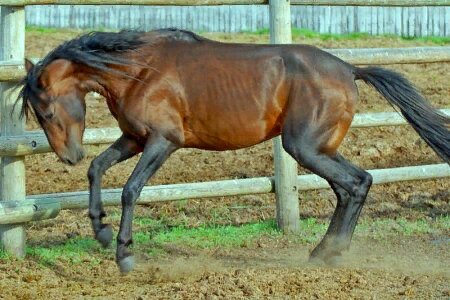
The Caspian breed is quite old, quite probably exceptionally old breed of Asia. The Egyptian and Persian relics of pre-Christian times, dating back to 1200-500 BC, show images of such tiny, graceful horses. This breed is probably a direct ancestor of Eastern breeds of horses, in which the number of both Arabic and, as a consequence, all non-heavy breeds of horses.
For a long time the Caspian horses were listed as extinct within thousands of years of Iran by Louise L. Firose is an American traveler. Just thanks to her, the Caspian horse wasn't closed for the new one and gained quite a wide popularity. At the moment, there are Caspian breed societies in the UK, Australia, New Zealand and the USA.
Until 1965, the Caspian horse was quite rare. Recognition of this breed is attributed to the American Louise Firose, who lived in Iran. In 1965, in Iran, near the Caspian Sea, was created an unusual invention: found 3 dozen small horses, the rise is not higher than a small pony, however, with all the features of a small horse. Not all of these horses have some insignificant anatomical differences in the structure of the bones from other breeds (for example, the structure of the skull bones, legs, hooves and folds).
The Caspian pony is probably considered to be a direct descendant of ancient horses that lived in this area for 3000 years BC. In Iran, bones were found that show the life of a rather similar small stallion here at this stage. Together with the Asian wild horse, the Caspian pony is considered to be one of the oldest breeds in the world.
The Caspian Pony has been mysteriously "lost" for almost all centuries. Later on, a painstaking breeding program aimed at its revival was launched. Prior to that, work with Caspian ponies was carried out at the Norouzabad horse farm in Iran, and also at the Caspian horse farm in Great Britain, founded in 1976. Among other things, it turned out to be better to make some features of these horses.
The Caspian horse is difficult to breed, as the mare of this breed does not ovulate in the direction of the year afterwards. In real time, the breed is still quite rare. There are a number of stud farms in England. Recently, the Caspian horse has been imported to Australia, New Zealand and the United States.
The horses of this breed are quite versatile and famous for their own jumps. They are quite enduring, fast and have a wonderful temperament. They have such kind and good-natured disposition that it is possible to entrust them to the guys. They have unusually hard hooves that do not need horseshoeshoes. Not paying attention to their personal small rise, the Caspian horse has beautiful natural movements: on the step, lynx and galloping it is as fast as a big horse. These horses are also successful on horse shows.
The height of the Caspian horse is 102-122 cm. The nest is grayish and reddish, and white marks on the head and legs are allowed. The Caspian horse has a short head with giant eyes and nostrils. The ears are rather short, the neck is elegant and exquisite, and the debt is highly planted. The legs are graceful, impermeable, with a strong bone. The hooves are strong, rounded, more similar to the hooves of a donkey than horses. The color is nesting, grayish, chestnut or dark. Puberty begins within 18 months.
The Caspian breed is no longer on the edge of extinction, but the population is still not very visible. In real time horses are bred in a number of stables in England, not to mention the fact that a number of horses have been exported to Australia, New Zealand and the United States.
Caspian horses are versatile, they are used as a saddle, for example, and in the harness. Not paying attention to their own miniaturization, they are quite fast, and what a wonderful jumpers. Their power and speed, which still delighted the Persian lord Darius, still make them the winners of the race. These horses are also perfect for children's equestrian sports, especially show jumping, they are hot, but they are also good at smooth gaiters.