You can never predict what it's like to leave your home planet. You look down on the ground and realize that you are not on it. It's breathtaking, it seems unrealistic. It feels like "we're no longer in Kansas, Toto, I've a feeling we're not in Kansas anymore". It's a combination of incredibly magical and incredibly prosaic. You may be too crowded, loud and uncomfortable at all. Space travel, at least available now, is not so spectacular. Although the view is what it takes!
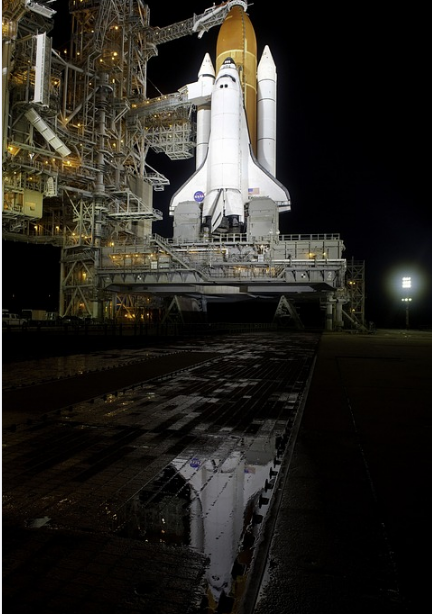
Everyone thinks that when you sit behind the launch pad on 7 million pounds of explosive rocket fuel, you will at least worry, but the truth is that you really have nothing to do in the shuttle. Many astronauts are just asleep. You're wearing your seatbelts like a bag of potatoes when thousands of checks are carried out before the launch. Sometimes they wake you up to say, "Reception" or "Loud and clear. But the launch itself is a completely different thing. From the surface of the Earth to the orbit in 8.5 minutes, accelerating all the time until you gain an orbital speed of 17.5 thousand miles per hour. This is a real race.
Then, when you have reached the orbit, it turns out that the weightlessness has its advantages. Without gravity, all the fluids in your body tend to the head. This is a good facelift. And your stomach becomes flat. You feel elongated because you stretch out a couple of inches. (I thought, "Oh, that's cool, I'll be taller," but of course everyone's getting taller.)
But weightlessness has its downside. Since all the fluids are pulling up, you always have an incredible headache. Your body compensates and loses about a liter of fluid in a couple of days - so you're actually "getting rid of" the headache. Sicknesses a lot of people. The only way out is to lose where the top is. Convince your visual system that the top is where the head is and the bottom where the legs are. When you understand this, you can move anywhere and anywhere, you get used to weightlessness. With each next flight, it happens faster and faster - your body remembers what it means to be in space. But it still takes a few days before your stomach is hungry again.
As a rule, I eat a little during the flight. It's not that I have a great appetite on Earth, just because of the lack of gravity and the movement of liquids, but because products have a different taste. I once brought a great chocolate with me, but in space it tasted like wax. This is disappointing. But they don't go to space for quality food. There is no way to cook anything in the shuttle or on ISS. The food for the astronauts is already cooked, then frozen and packed in vacuum bags, so you just add water and put it in the microwave, or it's thermostabilized like a dry army ration. Without a fridge, food is not fresh for a long time, so everything perishable - apples, oranges, grapefruits - we eat at the beginning of the mission.
The strangest thing in space - and one of the simplest things on Earth - a dream. In the shuttle you attach your sleeping bag to the wall, ceiling or floor, to whatever you want and climb inside. As in a campaign. The bags have holes for your hands, so you can buckle it up freely from the outside. Velcro around you makes you feel like you're in a cocoon. Then you fasten your head to a foam pillow, letting your neck relax. If you don't put your hands inside the bag, they will swim freely in front of you. And you just wake up in the morning, see something in front of you, "What? What is it?" and then you realize it's your hand.
In almost all my flights, I slept in the airlock on the middle deck. We didn't go out into outer space, you might say I had my own bedroom. Minuses? This is the coldest part of the shuttle, about 20 degrees. I always hid my hands inside the bag and put on about four layers of clothes. Sometimes I'd heat up a bag of food and take it with me like a hot-water bottle. For the last two nights of my final flight, I slept on the remote control right under the observation windows. The shuttle took the position that the Earth was right behind them. When I woke up, the whole world was right in front of my eyes, alone for me.
The most wonderful thing about my flights was how relaxed they were. The young astronauts are always so worried about their duties that it takes a few days before they stop to watch the sunrise, even though it happens 16 times a day in orbit. Shuttle flights are always very busy: experiments, daily duties, spacewalks, robot operations. This is an incredibly difficult job, in its own way tense. If you fail, it will be seen by many people watching you around the world. But I still think flying is relaxing. When you travel the world, you are always in touch. Everyone will find you if they want to. But if you are in space, you are really out of reach. Of course, you have to communicate with the Earth or check your mail, but you don't think about whether you've paid the bills or fed the dog. I feel like I'm stopping at the edge of the atmosphere. I was completely free from the Earth. But all these worries come back again, right after we got back. By the time I landed, I had a list of things to do in my head.
I never got sick in Space, but I never felt great coming back. When you're back on Earth, your inner ear, the organ that allows you to balance on Earth, that is, completely useless in space, becomes incredibly sensitive because of gravity. Your balancing skills are off and you have to learn to walk again. Sometimes I would turn my head and fall. The muscles you haven't used for weeks need to be shaped at least to walk, stand or lift things. Sometimes it takes weeks to get your feet back.
It was hard, it was exciting, it was scary and it was amazing. Of course, I would have gone back.