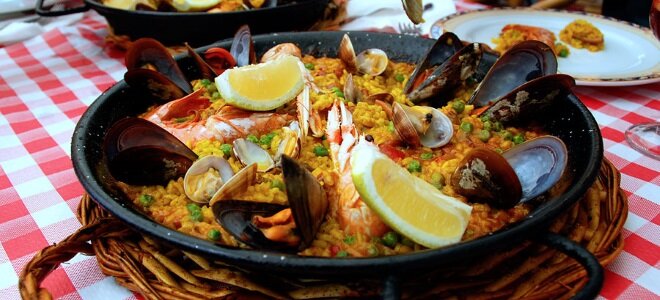
Paella is rightly called Spanish pilaf. In both paella and pilaf, rice languishes, saturated with fat, aromas of spices and fillers. True, unlike pilaf, paella is eaten with a fork.
The Spanish paella with Uzbek pilaf is related by a key role in folk customs, and, it can be said, in the fate of every Spaniard. It was the Spaniard, not the Spanish, since the preparation of paella was for a long time the prerogative of hot caballeros. Paellaire - a special frying pan with two handles, served not only as utensils, but as a kind of certificate of masculinity. Nobody entrusts the preparation of paella, this is the most important of the arts, to the snotty tortoise boy. And only when the boy's mustache grows, his shoulders grow stronger, and the behavior inherent in a solid floor appears, only then this newly baked macho will be handed to the paeller, as a pass into a real adult life, where he can sit on equal terms with adult men at the table, drink wine discussing football, women and politics. And most importantly - he will be entrusted with cooking paella. A paella pan is given to a man only once, and he is obliged to use it in such a way that he is not ashamed of salted rice and burnt seafood.
Story
Paella was invented in Valencia. The combination of fish, meat and seafood, to put it mildly, is not welcomed in European cuisine, so paella needed legendary explanations justifying such eclecticism. According to the first, not too honorable for the Spanish version, the dish was invented by the servants of the Moorish kings. All that remained after the feasts of the Arabs-conquerors: meat, fish and seafood - the hungry Spaniards collected and cooked with rice. Here the word paella comes from the Arabic word for the remnants. The second version, romantic, tells the story of a fisherman waiting for his beloved in the hut and experimenting with nothing to do in the kitchen. Everything that could be found in the pantry went into the pan, and the word paella in this case is produced from para ella, that is, for her. According to the third version, the recipe for paella is the fruit of municipal communal creativity. An important person arrived in a town near Valencia. In order to treat her properly, the residents laid a mountain of products that anyone had, poured indiscriminately into a large pan, mixed with rice, seasoned with saffron - it turned out delicious.