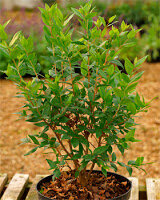
Nothing remarkable from the viewpoint of ordinary branches of the world store magic aroma and surprisingly rich history.
Legends, myths and beliefs associated with this plant have come from the depths of time. The ancient Greeks simply worshipped it. According to legend, Aphrodite, the goddess of love and beauty, admired the world.
Aphrodite's temples were surrounded by many myrtle shrubs, and during the annual holidays there, all the boys and girls present were decorated with myrtle wreaths.
Since then, the Europeans have had the custom of decorating the groom and bride with twigs of myrtle. And to this day in the bouquet of each bride of the British Royal House is necessarily present myrtle branch.
Such popularity of the myrtle is not accidental. In the bouquets of newlyweds myrtle was used not only as a decoration, but also as a protector. It was believed that this plant absorbs the energy of evil, anger, irritation, and if you rip off a small branch of the myrtle from the bush of the world, happiness, health and youth will remain with man for many years.
It should be noted that myrtle is a very valuable medicinal plant. It is a kind of natural antibiotic. Since ancient times it has been noticed that in those places where the myrtle grows, the air is filled not only with fragrance, but also with purity. Later it was established that the leaves of the myrtle secrete into the air special substances - phytoncides, which act destructively on pathogens.
What is it - a myrtle?
Myrtle is an evergreen shrub or a small tree with small leathery leaves with an oval shape. A closer look at the leaflets reveals numerous dark spots - these are glands filled with essential oils. Thanks to these glands, the plant emits an amazing aroma.
The myrtle blossoms in midsummer in small, very delicate and fragrant flowers of white or pink color. Numerous golden stamens located in several rows give the flowers a special charm.
The homeland of this beautiful plant is the Mediterranean, where it grows wild to the present day. It is widely cultivated in some countries of Western Europe, Crimea, North Caucasus, Asia Minor and North Africa. They also grow a common myrtle at home.
Healing power - what is it?
The healing properties of the ordinary myrtle are primarily due to the presence of essential oils in its leaves. They also contain a lot of other valuable substances - flavonoids, phytoncides, polyphenolic compounds, protein and tannins, resins. They increase a person's performance, endurance and ability to withstand prolonged stress.
Myrtle phytoncides are able to disinfect the air in the premises, to have a calming and at the same time tonic effect on people. In addition, scientists from the leaves of the myrtle were identified biologically active substances with high antibacterial activity. A special polyphenolic substance - myrtillin is recognized as a means of increasing immunity and is used to treat cancer.
Application in folk medicine
Leaves, fruits and young shoots of the common myrtle are used in folk medicine. Centuries-old experience of using this plant and modern research confirms its effectiveness in the treatment of such serious diseases as pneumonia, tuberculosis, diabetes mellitus.
Preparations made of leaves: infusions, potions, powders, ointments are successfully used to treat diseases of the upper respiratory tract, diseases of the gastrointestinal tract, various suppurations.
Tincture of myrtle leaves: put 1 part of the leaves in a glass jar, pour 5 parts of 70% alcohol, insist in a dark place for 5 days. Take 20-30 drops 3-4 times a day for 20 minutes before meals. This infusion can be invaluable in the treatment of such a formidable disease as tuberculosis, because it has a very high antibacterial activity and has a general strengthening effect on the body, increasing its resistance. It can also be used for inhalation of upper respiratory tract diseases.
Myrtle is very effective in the treatment of eye diseases. For this purpose, it is necessary to grind 5 myrtle leaves in a mortar, pour 1 tablespoon of boiling water, cool, strain and bury 2 drops in the eye. This treatment helps to stop the progressive loss of vision.
To improve immunity and prevent colds 3-4 times a day after a meal swallow, carefully chewed, 2-3 leaflets myrtle. Or you can prepare tea from shredded dry leaves of myrtle at the rate of 1 teaspoon of leaves per glass of boiling water. Insist on tea for 10-15 minutes, strain and drink on health.
We grow at home
Raising a myrtle at home is very useful. This helps to create a calm and harmonious environment in the house, as its biofield absorbs the negative energy of negative emotions: evil, irritation, resentment, anger. In addition, phytoncides are emitted into the air, which is fatal for all germs and viruses. This is why