Lifestyle
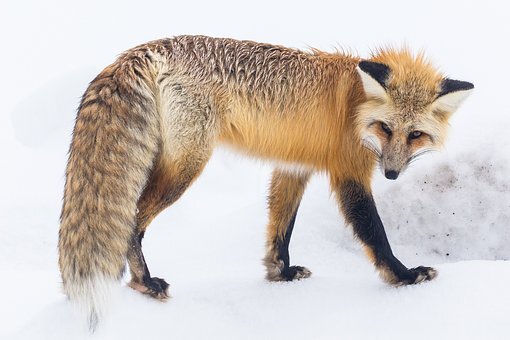
The fox walks cleanly, Siberian industrialists say, and it is fair to say: it puts its hind legs so carefully into the traces of the front that it falls almost into the nail.
The trace of the fox is like a string, and one can judge the dignity of the fox itself: the more gentle the trace, the kinder the fox is, and the more obvious the prints show the poor quality of the fox.
The trail of the male is round and clean, while the trail of the latter is oblong, narrow, pointy and not so clean, because the female almost always has snow in her hind legs or, as they say here, sketches.
It is remarkable that the better the fur of a fox, the faster it is on the run and the less tired it is when chasing, as the fox of the lower parting.
If a fox falls somewhere, it always walks one place, one path, especially in deep snow.
Fox day and night
During the day, she mostly rests, but at night, especially in the evening and morning dawn, she is constantly snooping. She sleeps tightly, curled up like a dog in a ring; at the same time, she is very easy to approach and can be found on the lair.
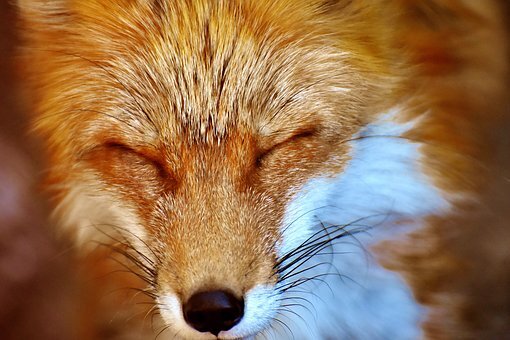
When the fox is not sleeping, but only resting, it lies mostly on the belly, stretching out its hind legs; in this position it usually guards birds, hares and other animals. In any case, the fox lies its head in the direction from which it came, in order to see the enemy looking for it on the trail, but jumps or jumps aside, as the hunters say, it does not make laughs, like a hare.
Sometimes she gets into the bushes and hides in them so cleverly that you will pass by that bush several times, and you won't see her until she pops out and always from the opposite side.
What does she eat in a hungry year
If necessary, the fox eats snakes, lizards, snails and other bastards, but the mouse is a tidbit for her. She catches them in the evenings, in the mornings and even during the day, especially in winter, when mice come out of their holes to warm themselves up with frosty rays of the sun.
Foxes and mice
In the middle of the day the fox is not afraid to run out to clean meadows and even steppes to get mice; he runs after them in all directions, listens to their squeaks, often sentry near their small holes, barely noticeable in the snow.
It is called a fox mice; it is not difficult to kill it at this time, here it guards itself, looks closely, listens to the squeak, catches a convenient moment to rush on the mouse, in short, is in such ecstasy, especially if the catch is successful, that does not pay attention to the rest!
Fox cubs
Foxes can be foxes in winter, especially in February. The female walks for nine weeks and mosques from 3 to 9 foxes, which will be born blind. In April and early May, they find young people whom their mother has been feeding with milk at first, and when they grow up, they bring them meat from some animal that she has killed during her excommunication from the hole.
When the foxes grow older and begin to mother, the fox brings them live birds and mice, which the foxes first play with, and then eat with greed.
It is difficult to determine how long a fox can live, but it is possible to suppose that the age of the fox is not more than 15 years, judging by her age, because she is two years old, and she is completely sweating, so that between the hunters is not called a puppy, but a mother of a fox.
Foxes in burrows
The foxes live in the burrows only in the summer, while they are being fed, and in the winter in the heat; at other times of the year they live like wolves in the woods and steppes. But during pregnancy the female lives more in the burrow and does not go out much.
The fox, having noticed that a man has visited her nest, immediately takes away the foxes if they are still small, or takes them away, if they are already big, to another place, at first not far from the burrow, to make sure that the man came to her burrow by accident, or with a bad plan.
And if he notices that the person was again near the hole the next day, he is taken away even further.
On the contrary, if she makes sure that no one was near her hole for a few days, the fox returns with the children and still settles in the old hole.
Foxes of different colours
Depending on the climate and place of residence, foxes come in different colors.
Yellow fox
Yellowish-grey, reddish in color, is the most common breed; here they are called nibs; their breasts and abdomens are almost white. The skins of these foxes are inexpensive and are sold on the spot from 1 ½ to 2 rubles.
Foxes with very reddish wool and a steel-grey abdomen are called fireworks and are valued here from 2 to 3 rubles; foxes, called crosses, make up a transition from ordinary fireworks to black-brown foxes; they are valued here 6, 8 and up to 12 rubles, depending on the quality of fur.
The black-brown fox
Black-brown foxes are of various advantages and are valued from 15 to 70 rubles and more per piece. Finally, there are completely black foxes, but they are very rare and very expensive.
The harsher the climate in which the foxes live, the thicker and fluffier the wool is; therefore, the climate has a great influence on the quality of fur, while the place of residence of the fox has no less influence on the color of its wool. It is the steppe foxes that are always whitish, while the forest foxes or, as they say, the ridge foxes are red.
to be continued in the next part