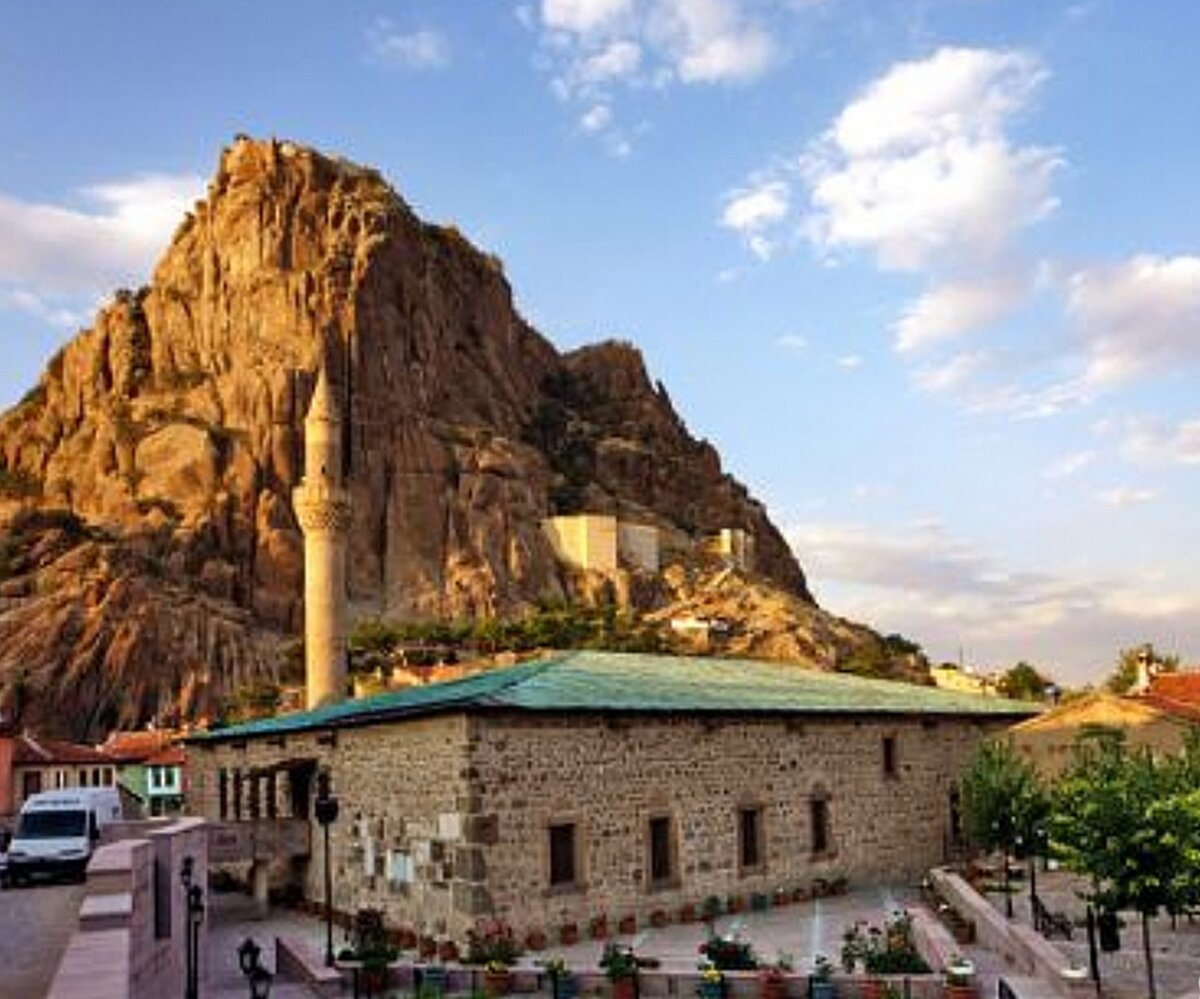
3) Turkish Domination In Afyonkarahisar :
a) Seljuk and principalities period:
After the victory of Malazgirt, the Byzantines did not recognize the treaty, the Great Turkish Sultan Alparslan, wanted the conquest of Anatolia from Kutalmışoğlu Süleyman Shah to the Aegean and Marmara. Suleyman Shah entered Anatolia at the head of the Turkish army as” commander-in-chief “and completed the conquest of Anatolia within a few years with the Raiders under the direction of such great commanders as” Artuk, Tutuk, Saltuk, Mengücek, Ebulkasım, and Atsız Bey".
1071-1243 Anadolu Selcuklu Turks as a political union were the period of strong. With the death of Sultan Sancar in 1157, the Great Seljuks came to an end and the great hakanlık crown passed to the West and to the Anatolian Seljuks. After the defeat suffered in the battle with the Mongols in Košedag in 1243, it lost its ability to be the most powerful state in the world, came under Mongol rule and was divided into principalities subject to Ilkhanids.
One of the first principalities established in Anatolia due to the Seljuks was the Shibata sons. Shibata Fahrettin Ali, the founder of this Principality, spent most of his life in Afyonkarahisar, where he counted the estate.
Until then, the city called “Karahisar” was called “Karahisar-ı Sahib” in its name. Afyonkarahisar remained the capital of this principality for a long time.(1265-1333) Shibata's replacement grandson Şemsettin Ahmet Bey was germiyanoğlu's son-in-law. After his death, his sons Nusrettin Ahmet and Muzafferüddin Ahmet Bey, one of the state Beys, went to the german Palace, where he was connected by ana. First, while Afyonkarahisar dominated the surrounding area, during the time of the shrinking beylik (1260-1428) the Sons of the State brain ruled in the city. German Bey II. Jacob was a friendly Ottoman friend. From 1390 to 1399 he resided in the Ottoman country of Uppsala. Testament by means of principality II. He left it to Murat, so Afyonkarahisar, which is in the german Principality, came under the rule of the Ottomans. (1428).
During this period, sultanandağı, Çay, Bolvadin, Sandıklı, Şuhut and especially because of the castle karahisar was given much importance, the castles were repaired or rebuilt; mosque, madrasa, Inn, caravanserai, Tomb, water road, such as monumental structures were built. 40 The Grand Mosque with wooden posts, The Stone Complex, the Shibata Caravanserai, the Ebheri, and Quraysh shrines are the most important structures among these. The book of logic written by Esirüddin Ebheri has been read all over the world.
The existence of Karamanoğulları, Hamitoğulları, and Eşrefoğulları was felt during the principalities period from time to time. He has worked in Bolvadin, Sultandağı, and Şuhut.
b) the Ottoman administration of Afyonkarahisar :
Afyonkarahisar passed to the Ottomans in 1390 during the reign of Beyazıt. After the Battle of Ankara(1402), the Germiyanoğulları regained possession of their former lands, although the last Germiyan Ruler II. Upon the death of Yakup Bey in 1429, these lands were taken under Ottoman rule again as per his will. XV. The Karamanoğulları, who knew the situation at a time when the Ottomans were dealing with the Crusaders in Rumelia towards the middle of the century, had raided to Kütahya, Karahisari and Hamid sides and destroyed these places. Afyonkarahisar coolest, who was very affected by such struggles between the Karamanoğulları and the Ottomans, was a member of the II. With the elimination of the Karamanoğulları of Mehmet, it was firmly under Ottoman rule.
XVII. from time to time, the region of Afyonkarahisar was also affected by the Jalali revolts that started in the century. Some time in 1833, II. The city passed into the hands of Ibrahim Pasha, the governor of Egypt, who was in a struggle with Mahmut and became a Sanjak of the Beylerbeyi of Anatolia during the period of Ottoman rule for more than five hundred years. Afyonkarahisar remained attached to Bursa until 1917, I. Towards the end of World War II there was independent mutasarrif.
XV. starting from the century, the Ottomans began to make their mark in culture, art, and constructions. Especially in Karahisar, urbanization was formed and kadılık, muhassillık, and mutasarriflik took the position of the administrative center. With Mehmet Semai (Sultan Divani), Mevlevism reached the highest level and announced the name of Karahisar to the world. In addition, people of culture and art such as Ahmet Karahisari, Şemsettin Karahisari were named after our city.
c) the place of Afyonkarahisar in the war of Independence:
Our province, which has written our name all over the world in gold letters, is a place that people want to take over every period due to its geographical location. For this reason, Afyonkarahisar has an important and distinguished place in the war of Independence.