The works of Julian Semenov, written in the genre of political detective, carry a charge of truth. They are written on the basis of genuine documents, personal memories of people such as Karl Wolf, the SS Obergruppenführer, who in the spring of 1945 held separate negotiations with Allen Dulles, a resident of the US Strategic Service in Bern (Switzerland). And, this allows us to relate to the work of Julian Semenov not as fiction, but as serious reading. This is also encouraged by the fact that in the works of Semenov along with fictional characters there are completely historical personalities. But back to the novel by Julian Semenovich "Auction", which takes place in the late 70 - early 80s of the XX century. The plot of it is quite simple.
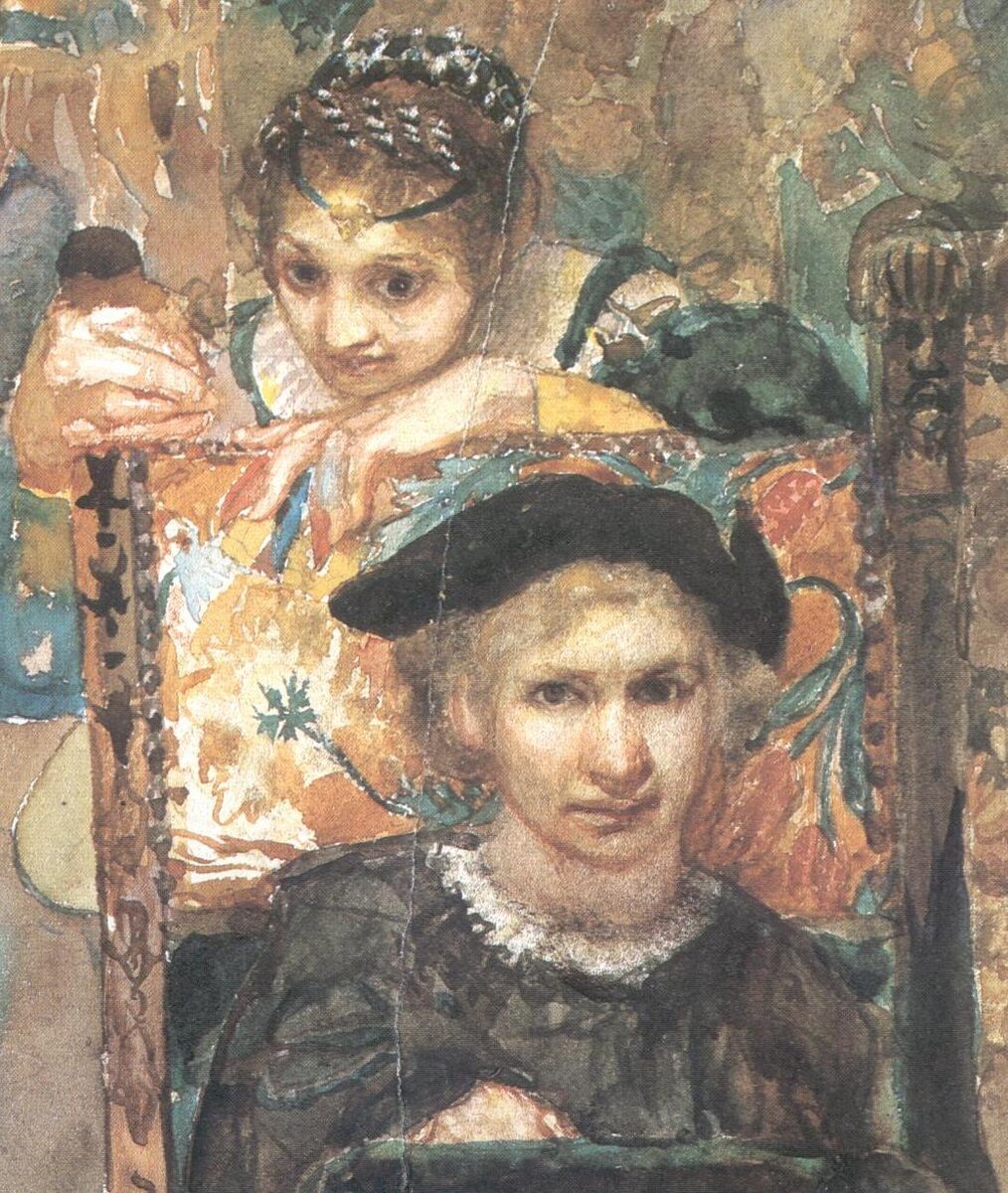
Soviet journalist Dmitry Stepanov, Russian aristocrat - Prince Rostopchin - an emigrant of the first wave and German historian Fritz Zolle are trying to return the picture of Mikhail Vrubel, which was stolen by the Nazis during the Great Patriotic War from a museum in Kiev. What kind of picture could Julian Semenov talk about, if we assume that he transferred real events to the novel. I decided to find out this question. Unfortunately, there were not many materials at my disposal. Nevertheless, I can assume that we could talk about one of the three paintings of the great Russian artist whom Mikhail Vrubel is.
The first of them is “Our Lady with the Baby”
The second - "Hamlet and Ophelia"
The third is a portrait of the artist’s son
Why exactly these pictures? Firstly: by the beginning of World War II, these paintings were in the museum of Kiev, and could be stolen by the Nazis. Secondly: in the novel, Julian Semenov gives some information about the painting with a stroke: oil; one hundred and seventy-three, and at the end of the novel - “look into the eyes of the baby,” Rostopchin said quietly. “Let's be silent with you and look into his eyes ...” And, in all these three pictures there are boys. However, I was not able to establish with accuracy which of them all the same is in the novel. So, this question remains open so far.
The Stepanova – Zolle – Rostopchina Alliance is opposed by agent of one of the leading US insurance companies, Jos Fall, a former employee of the Central Intelligence Agency. Why did the USA in the person of the CIA and insurance companies so zealously fight against cultural value not returning to the USSR. The fact is that most of the cultural property (paintings, sculptures, icons) stolen by the Nazis from museums of the Soviet Union, Poland, Hungary, Czechoslovakia and other countries of Eastern Europe, as well as Belgium, Holland, France, were hidden in the mines of Alt Aussee in Styria (Austria ) By agreement of Roosevelt, Churchill, and Stalin, signed in February 1945 during the Yalta Conference, this territory was part of the American occupation zone. In addition, according to the recollections of Karl Wolf, Allen Dulles put forward one of the main conditions for the start of separate negotiations, which would not have kept the Alt Aussee mines intact, which, upon Hitler's order, should have been blown up if the Anglo-American troops broke into Styria. As a result, the mines remained intact, and all cultural values, including those exported from the USSR, were in the hands of American intelligence agencies.
Two or three decades after the end of the war, paintings and other works of art that once belonged to museums of the Soviet Union and other countries of Eastern Europe began to appear at leading auctions in London, New York and Paris. To prove that the paintings and other cultural values put up for sale were stolen is a difficult task, even with the appropriate documents. Western insurance companies do exist so that collectors, who for the most part are very wealthy and influential, do not have problems with the law. Therefore, insurance agents of leading companies in the USA, Great Britain, France, Germany, tied to special services, are doing everything possible and impossible for auctions selling art and culture to take place, as they say, without a hitch. Thus, insurance agencies in this regard work very closely with intelligence services, which in turn receive extensive analytical and specific information from various research institutes.
And now there’s a little story about how the Nazis hid the treasures looted in Europe. At the end of 1944, bonuses of the then Germany gathered in Strasbourg: the Gestapo chief Ernest Kaltenbrunner, Adolf Eichmann, who was responsible for the extermination of Jews in concentration camps, Otto Skorzeny - specialist in sabotage and secret war, the kings of German industry and the aces of the financial world. This was the so-called "distribution meeting." Everything was decided quickly, accurately and clearly: to which of the participants in the meeting and what proportion of German capital is given to hide from the victorious allies. Not trifled, because the bill went to millions. However, not everything that was plundered was managed to be withdrawn from Germany to neutral countries. The masterpieces of world art, the archives of imperial security (RSHA), part of the gold reserves of Germany, it was decided to hide in specially equipped hiding places. One of these hiding places was equipped in Alt Aussee galleries. Protection, and in the event of the breakthrough of the Anglo-American forces in the Styrian region to destroy cultural property, was entrusted to Otto Skorzeny. The corresponding order could be given by three people - Hitler, Himmler and Kaltenbrunner. But, the most interesting thing is that none of this trinity gave such an order. Hitler was already dead by that time, but before that he had removed Himmler from power, having ordered him to be considered a traitor, since Hitler became aware of the separate negotiations that were conducted by Karl Wolf and Walter Schellenberg with Dulles on behalf of Himmler. As for Kaltenbrunner, he did not give the order to destroy the "Alpine Fortress", thereby trying to prove loyalty to the West. As a result, a specially created department of the CSS, for cultural values, became the owner of unique paintings, sculptures, jewelry. Subsequently, it was these values that began to be auctioned at various auctions.
So in the novel by Julian Semenov, the events of the past become the subject of research of the present. And today, no, no, and yes, the masterpieces of Russian and world art that were once stolen by the Nazis from museums in occupied countries are put up for auction. Their return is far from a solved problem, and in fact, according to the writer, only from Ukraine did the Nazis export three hundred and thirty thousand works of art. About the same number from Belarus and Russia. Until now, for example, the fate of the famous amber room is unknown. And, this is not the fiction of a novelist, but the facts of history. In this way, literature is closely intertwined with history, becoming the subject of research.