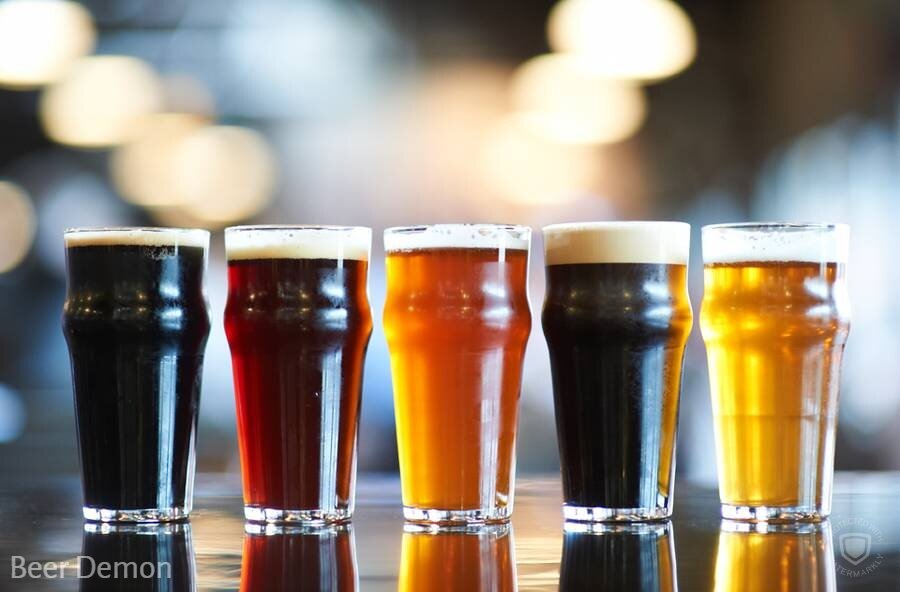
As a rule, an ordinary beer consumer in our country is used to dividing beer into 3 types: light, dark, and wheat. This is not to say that this is fundamentally wrong - the classification of varieties by color and the types of raw materials used have a place in existence (well, the truth is, then you can distinguish varieties much more than 3). Such "simplicity", as it seems to me, is due to a rather meager assortment of goods in general and, in particular, beer in the Soviet Union and in Russia in the 1990s and 2000s. At the moment, the situation, of course, is gradually changing for the better. You must understand that this means the mass consumption of the drink. Of course, connoisseurs and "taggers" have long been aware of the huge variety of beer varieties and styles.
Usually, beer is divided into several levels of gradation.
- Type (or Type) of beer by fermentation method
- Beer style by method of preparation and ingredients used
- Beer variety - here you can already highlight a specific recipe, brewing/fermentation procedure, taste profiles, aromatic and flavoring additives and other features of the drink
Types of beer
By the method of fermentation, the following types of beer can be distinguished - ale, lager, spontaneous fermentation, mixed (hybrid) type.
Such a gradation involves the separation of types by strain used in the production of yeast beer.
Ale is a top-fermented beer. In the production of this type of beer, yeast strains are used that rise to the surface of the wort and create a kind of “hat”. When they die, they fall to the bottom of the fermentation tank. The fermentation process of such yeast usually occurs at temperatures of 15-23 degrees, this is due to some of their "weakness" and "non-adaptability." So, at lower temperatures, their activity slows down, or they generally hibernate. A characteristic of ales is a complex taste profile due to the esters with which the yeast gives the drink. It can be bright, sometimes unexpected shades - fruits, berries, flowers, etc. A game with these shades allows the brewer to creatively realize when brewing ale, although this can result in the instability of the drink, the appearance of extra taste notes.
Lager - bottom-fermented beer. Strains of camp yeast "live" at the bottom of the fermentation tank. The process of fermentation occurs at low temperatures of 2-12 degrees. The development of this beer originates in 19th century Europe. Previously, it was impossible to mass-produce lagers. Since refrigerators were not invented. This type of beer has a light shade and transparency. Pure, dry taste, stability, nutrition are the features of lagers.
Beer spontaneous fermentation. Such beer is essentially "infected" with wild yeast from the environment. This in itself seems crazy. How so, infect beer? However, some masters know how to do it wisely, each time achieving the expected result. The Belgians have learned this craft. So there were varieties - gueuze and lambic. The essence of the method is to give an unfermented wort to get bacteria from the atmosphere or from berries/fruits added there. Beverages brewed using this method have interesting tastes, such as sour apples. Hay. Some types of gueuze, in general, may look more like champagne than beer.
Mixed types - these are types cooked using mixed technologies - for example, lagers, fermented at high temperatures, or vice versa, ales wandering at low temperatures to obtain subtle, unusual tastes.
Beer styles
Beer can be divided into specific styles according to a wide range of ingredients, taste, color of the finished product, and flavorings. Of these criteria, the following can be distinguished:
Alcohol content
- Bitterness. It is determined according to the IBU scale and is calculated on the basis of hops added to the wort - its weight, alpha-acid content, as well as the volume of hopped wort boiled during production. The higher the coefficient, the beer will be more bitter (here it refers to the hop bitterness)
- SRM color. This is a color scale in which each color is assigned a coefficient from the lightest to the darkest. This coefficient can also be calculated.
- Used grain. The classic option is beer, the production of which uses only barley malt (by the way, malt is a germinated grain of cereal crops, a sprout that has already formed the nutrients necessary for brewing). However, in the production of some styles of beer, wheat malt, and rye malt are also used. Also, grains can undergo heat treatment, as well as smoking and frying to achieve the necessary taste shades and color of the "body" inherent in some styles.
- Country of origin. Many styles of beer formed a diverse school of brewers. For example, English brewing is quite different from German, Belgian brewers also stand apart. Traditions have a very strong influence on the production and characteristics of beer, just as they influence the national cuisine.
Density Describes the proportion of dry matter contained in the wort. The high density of beer (the extract of the initial wort) makes the beer thick and dense.
- Flavoring additives. Additives in beer, like spices in a dish, can fill it with brighter flavors. Some of these additives, such as berries, fruits, lemon peel, coriander, added during the brewing process, make the drink sparkle with new flavors. Some styles of beer determine the additives used in the preparation process.
The most famous styles include the following
Stout - British dark ale, the production of which uses pre-fried barley malt. It has a low level of bitterness, high density and an average level of alcohol.
Examples - Guinness, Murphy's Irish Stout
Porter is a dark ale brewed with smoked barley malt. Moderate or high alcohol content, high density. Sometimes it has high bitterness, but not hop, but caused by smoked barley that enters the brain dump.
Examples - Baltic 6, Fuller’s London Porter
Pilsner, a Czech lager, has moderate hop bitterness caused by aromatic Czech hops such as Zhetetsk. It has a small percentage of alcohol and a light golden color.
Examples - Pilsner Urquell, Staropramen, Budweiser Budvar
Weizen - German light wheat ale. It has a high density, a small percentage of alcohol and an almost imperceptible hop bitterness. When preparing it, equal proportions of barley and wheat malt are usually used.
Examples - Franziskaner, Paulaner Weissbier
Indian Light Ale / Indian Pale Ale / IPA - light ale with high hop bitterness and, as a rule, high density. May have a medium to high percentage of alcohol.
Examples - Brewdog Punk IPA, Volkovsky IPA, Victory Arts Brew Red Machine IPA
White beer - Belgian light wheat ale, has a small percentage of alcohol, almost no hop bitterness. When cooking, barley and wheat malt are used, as well as some additives, such as orange peel, curacau, coriander, pepper.
Examples - Hoegaarden, Witte Parel
Scream, Rouge - Belgian lambics, which are used in the preparation of cherries... The alcohol content can be both low (Scream) and high (Rouge).
Examples - Mort Subite Kriek Lambic, Kasteel Rouge
_______________________________________________________________________________________
Also, there are many sub-styles, the formation of which caused such factors as - the localization of various styles of beer in non-native countries, the experiments of brewers, the replacement of ingredients (most often associated, again, with the localization of beer style).In general, for a more “correct” separation of beer, a special system was developed and introduced - the Beer Judge Certification Program, or BJCP for short. Since some parameters by which a particular beer brand can be evaluated can be perceived subjectively, such a system helps to classify impartially and attribute each beer to its own style and sub-style.
Now that you know what types and styles of beer are generally divided into all over the world, I hope that you will no longer divide this drink only into light and dark because each beer has its own taste, mood, and history.