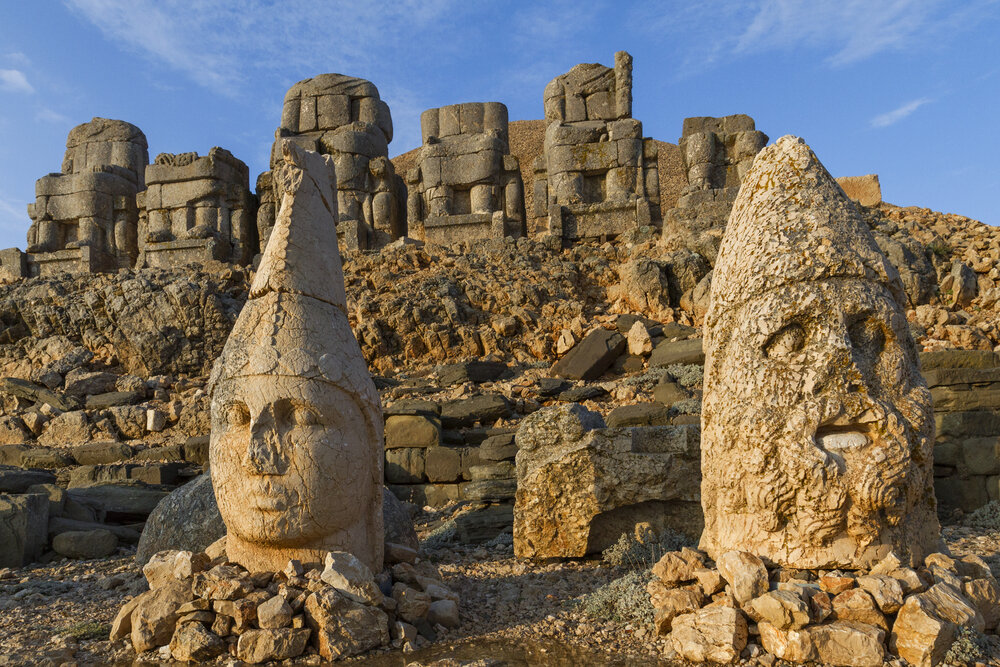
Adiyaman is one of the oldest known settlements in history. Adıyaman palanlı cave in the investigations of the history of the City M.He. It is understood to date back 40,000 years.
Again, historical findings in Samsat-Şereremuz Tepe M.he. 7th ed.Paleolithic until OOO, M.O. Neolithic to 5,000 years, M.He. 3.Chalcolithic to the Ooo years and M.O. Between 3.0 OO-1,200 years, it is understood that there were also Bronze Age periods. During this period, the region changed hands between the Hittites and the Mitannians and the fall of the Hittite State (m.He. 1,200) a dark period has begun. M.He. From 1.2 Oo to the founding of the Phrygian State, M.He. No written sources have been found regarding the period between 750 years. But; the Assyrian seals found in Samsat and inscriptions are written in Hittite hieroglyphics found in the village of Kahta Eskitaş indicate that the historical sequence in Anatolia continued in Adiyaman as well. During this period, the state of Kummuh, one of the late Hittite city-states, emerged with the collapse of the Hittite State in Adiyaman and its environs, reigned.
M.He. Although the region was under the Assyrian influence between the years 9OO-70O, Assyrians could not be fully dominant. 6. since the beginning of the century, the region is dominated by the Persians and the region is governed by the hands of the satrap (Governors). M.He. In 334, King Alexander The Great of Macedonia entered Anatolia, and the Persians lost their dominance. He. 1st. Selev-Koss of Macedon ruled in the region until the century. During the weakening of the Seleucid power, King Mithradetes l Kallinikos declared the independence of the Kingdom of Kommagene (m.He. 69).
The Kingdom of Commagene, whose capital was Samosata (Samsat), had its sovereignty m.S. It continued until 72, at which time the region passed into the hands of the Roman Empire, and Adiyaman to the province of Syria (Syria) of the Roman Empire, the 6th. He was attached as a legion. With the separation of the Roman Empire as Western and Eastern Rome in 395, Adiyaman joined the Eastern Roman Empire. Since the year 643, Islamic raids began, but Islamic domination was established with the Umayyads in 670. In 758, however, II came under the rule of Mansur Ibn-i Cavene, one of the Abbasid commanders. From Abbasid rule until 926, the reign of Hamdanüerin begins. In 958, the region again falls into the hands of the Byzantines.
Between the years 1114-1181, there are Turkish raids to the region. Between 1204-1298, the Anatolian Seljuks captured Samsat and its region. In 1230 and 1250, Mongol attacks are experienced. In 1298, the region and region passed into the hands of the Mamluks. In 1393 Adiyaman was plundered by Timurlenk.
During the Middle Ages, when there was great instability, Adiyaman changed hands between Byzantium, Umayyad, Abbasid, Anatolian Seljuks, Dulkadirogullan and finally joined the Ottoman lands in 1516 during the Iranian campaign of Yavuz Sultan Selim. Adiyaman, which joined the Ottoman territory, was initially attached to the Beylerbeylik of Maraş with a Sanjak headquartered in Samsat, while after Tanzimat it was attached to Malatya as an accident.
Adiyaman, which was in an accident position due to Malatya, was separated from Malatya by law No. 6418 on December 1, 1954, and became a detached province until the foundation of the Republic in 1954.
Chronology Of Adiyaman
- M.He. 40000-M.He. 7000 Paleolithic
- M.He. 7000-M.He. 5000 Neolithic
- M.He. 5000-M.He. 3000 Chalcolithic
- M.He. 3000-M.He. 1200 Hittites
- M.He. 1200-M.He. 750 Assyrians
- M.He. 750-M.He. 600 Phrygians
- M.He. 600-M.He. 334 Persians
- M.He. 334-M.He. 69 Macedonians
- M.He. 69-M.S. 72 Kingdom Of Commagene
- 72-395 Roman Empire
- 395-670 Eastern Rome (Byzantium))
- 670-758 Umayyads
- 758-926 Abbasids
- 926-958 Hamdanids
- 958 -1114 Byzantines
- 1114 -1204 Eyyubiler
- 1204 -1298 Anatolian Seljuks
- 1298 -1516 Mamluks
- 1516 -1923 Historical
Development Of Adiyaman In The Ottoman Empire
Archaeological excavations and surveys in and around Adiyaman have shown that the history of this place dates back to the Paleolithic period.
Adiyaman, which bears the traces of the cultural phase called The collecting and hunting period of the human world and is the cradle of great civilizations, has become an area of research that has kept the world's archaeologists busy for 100 years.
In the region, found in archaeological excavations in the Paleolithic (40,000), and Neolithic periods made of lighter stone, hand axes, diggers and piercing, made of Obsidian arrowheads, pieces of terracotta; made up of baked clay objects from the Chalcolithic period and early Bronze Age metal works; stone and baked clay artifacts from the Iron Age and the Hellenistic period, Roman period, lamps, various containers, statues and sculptures, and other ceramic types from the Byzantine Cube; Gold jewelry from the Abbasid period, the Seljuk and Ottoman period glazed ceramics, vases, glassworks; seals, rings, and bracelets, many archaeological artifacts, such as human and animal figures, Adiyaman and its surroundings reveals the historic riches.
The knowledge of the historical riches of Adiyaman and its surroundings has caused the region to be explored by many local and foreign scholars in the last hundred years.