Random space object # 9: a nebula of complex structure
Hello! You are on the channel SBlog. Thanks for reading me! Every positive and kind comment)
The article is subjective and expresses the personal opinion of the author.
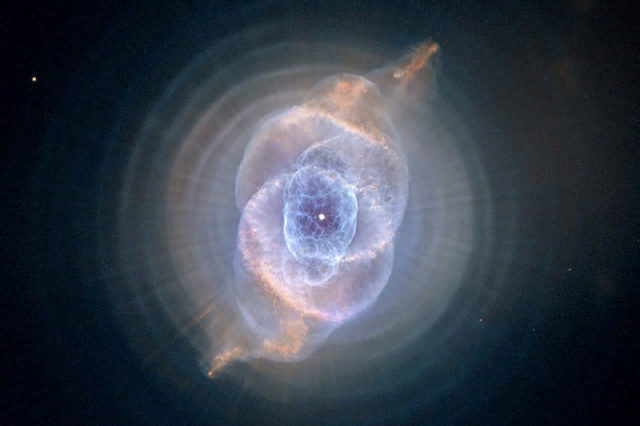
In 1786, astronomer William Herschel noticed in the constellation Draco a small blue-green speck, the size and color of the planet Uranus, which he discovered in 1781. A little earlier, the scientist proposed to call such objects planetary nebulae. In those days, the word "nebula" meant any fixed extended luminous astronomical objects in which it was impossible to see the individual stars. Later it turned out that some of the known nebulae are actually star clusters or galaxies, and some turned out to be clouds of gas and dust. Until now, the galaxy M 31 is sometimes called the Andromeda nebula. The object that Herschel saw was called Cat's Eye, or NGC 6543.
In the XIX century, the methods of spectrography were actively developed. In mid-nineteenth century astronomer William Huggins first time received spectrum planetary nebula, his choice fell precisely on Cat's Eye. Instead of a rainbow stripe with dark lines on the background, the scientist saw three bright colored lines on a completely dark background. This meant that the nebula was not made of stars but of luminous gases, a startling discovery.
Planetary nebulae — giant clouds of luminous gas — represent the final stage in the evolution of small stars less than ten times the mass of the Sun, scientists now believe. Stars shed their outer gas shells, which turn into planetary nebulae, and the exposed cores cool down and become white dwarfs. The mass of the star that gave birth to the Cat's Eye nebula after its death was five times that of the sun, and what is left of it is now in the center of the nebula and the mass is approximately equal to the Sun.
Cat's Eye is made up of extremely hot gas that is thought to result from the interaction of the fast stellar wind emitted by the nucleus with previously ejected material. Most likely, it was the stellar wind that "hollowed out" the inner bubble of the nebula — its bright Central part filled with hot gas. In addition to hydrogen and helium, the nebula contains a small number of heavier elements.
The interior of the nebula is surrounded by a series of concentric rings and a giant halo. How the nebula acquired such a complex and beautiful structure is not entirely clear. This material must have been ejected by the star before the formation of the nebula itself. If the Central part began to form about a thousand years ago, the concentric rings began to form about 15 thousand years ago. The complexity of the structure of planetary nebulae is usually explained by the fact that in its center there was a system of double stars. But evidence of the existence of a companion star in the Central star of Cat's Eye is not found.
And if your friends liked this small but interesting article, then support it, like it, subscribe to the channel, comment and just come back. Thank you for attention.