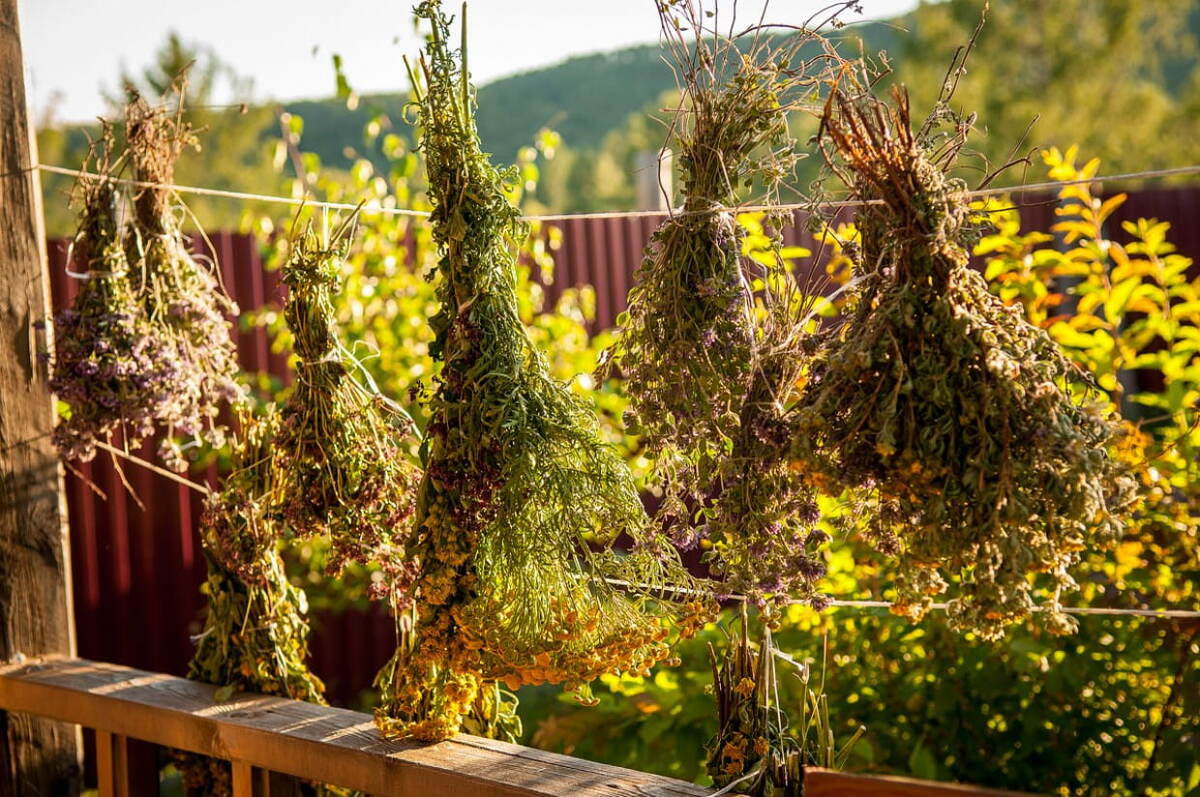
Medicinal plants are our faithful helpers in the fight against diseases and imperfections, giving us vigor and beauty. So the roots of the common burdock will cleanse the body of toxins, help with stomach diseases and strengthen the hair, wormwood will help with toothache, bearberry will relieve swelling and improve the condition of diseases of the genitourinary system. But for these plants had healing power, it is necessary to adhere to several rules, to know precisely what parts should be prepared and at what time to start collecting.
Before you start collecting herbs, you should remember a few important rules:
1. Grasses are collected in dry weather, at 10 - 11 am, when the dew has already descended;
2. Leaves and flowers are cut off with a knife or carefully cut off with the movement from top to bottom;
3. Grasses are dried in the shade, in a ventilated room, stored in glass jars, paper bags or cardboard boxes;
4. As a rule, 1 tbsp is taken for brewing a mixture of herbs per 1 cup of boiling water, after 15 minutes tea is ready.
Collecting medicinal herbs is a very useful activity, and also guarantees you a storehouse of vitamins for the winter period. To this process, it is important to approach correctly as each plant has a period of preparation. This is explained by the fact that at different times a particular herb contains the largest amount of nutrients and healing substances.
Collect the individual parts of the plant at the time when they contain the greatest amount of active ingredients. The accumulation of active substances is associated with a certain stage of development of plants. Calendar dates of collection are only indicative and can give deviations in one direction or another depending on the collection area and weather.
All above-ground parts of plants should be collected only in dry weather, in the middle of the day, when the plants are dew-dried. Underground parts of plants - roots, rhizomes can also be dug in wet weather, as they still have to be washed before drying.
Collection should be done with more care, avoiding the ingress of various impurities or other parts of the same plant into the collected material. The presence of impurities reduces the quality of raw materials and sometimes makes it completely unusable. It is not necessary to collect strongly dusty or something polluted plants and the plants damaged by insects, rust or fungal diseases.
To obtain quality raw materials, collectors must have the simplest collection equipment and know the collection methods.
Kidneys should be collected in early spring, in March and April, when they started to grow, swell but did not burst.
The bark is also harvested in spring, in April and May, during the juice movement: then it is well separated from the wood. To collect bark, you should have knives with very sharp ends, preferably made of stainless steel. For medical purposes, bark is collected only from young branches when it does not exceed a certain thickness; the bark of old branches and trunks is covered with a thick cork layer of dead tissue that does not contain active substances. If the branches are covered with lichens, the latter should be pre-cleaned from growing trees and shrubs.
Pay attention! If you make solid transverse incisions, you will do a lot of damage to the tree.
Leaves are harvested before or during blossoming when they are fully developed and will be the juiciest. The only exception is early blossoming plants that have leaves that develop later, such as mother and stepmother. Leaves should not be harvested long before blossoming: at this time they contain few active ingredients; also besides, the early collection of leaves will deplete the plant, as it produces an organic matter that feeds the plant and is stored there. The leaves are cut off by hand at the root, leaving a part of the leaves on the plant so as not to disturb its development.
Some of the less valuable leaves are harvested by cutting off the stems and then tearing off the leaves, sometimes the grass is dried along with the stems and then ripped off or wrapped. When collecting leaves such as nettles, they put on gloves to protect the hands from burns and blisters. After collecting leaves of plants containing strong substances, such as bleach, ink, it is necessary to wash hands thoroughly to avoid poisoning.
Leaves are collected in one piece, together with petioles, e.g. datura, sage, nettle, or only one leaf plate, without petiole; if the leaves have a coarse, juicy middle vein, it is recommended to remove it before drying; for this purpose, the leaf is folded in half over the vein and broken out or cut out with a knife. It is recommended to collect the leaves in low baskets and fold them tightly
How and where to dry the collected medicinal plants
Drying is a very important component of the process of preparation of raw materials, the quality of harvested medicinal plants depends on the correctness of its implementation. In most cases, drying should not be carried out under direct sunlight, because it destroys chlorophyll, essential oils, glycosides. Drying plants should be done by decomposing the raw materials in thin layers in the attic, on shelves, on laid paper, in a well-ventilated place.
The sun can be used to dry plants containing a large amount of tannins, as well as roots, rhizomes, and flowers of hawthorn, elderberries, white claws, and ivy-buds. The roots and rhizomes are washed (as quickly as possible) in a basket or net before drying and only the roots of some plants (e.g. burdock) are brushed off the ground and cut lengthwise before drying. Duration of drying on the average is 4-7 days at a temperature not exceeding 30-35 ° C. Plants containing ascorbic acid, dried at a temperature not exceeding 80-90 ° C, herbs containing glucosides (lily of the valley, mountains), dried at 50-60 ° C. Poisonous plants, as well as those with a strong smell should be dried separately.
How to properly store medicinal plants and herbs
Store medicinal plants in labeled paper bags, boxes (pre-lined inside paper), glass jars with lids. Flowers, inflorescences, grass are stored for one year, fruits, roots, rhizomes, and bark for two or more years. The storage room should be dry and cool.
How to prepare infusions, broths from medicinal plants
Medicinal plants are usually used in the form of broths and infusions, which are water extracts from medicinal raw materials. For the preparation of potions and infusions can not be used as dishes made of aluminum, you should use enameled dishes.
Broths and infusions are prepared in different ways, for example, the plant in a certain dose is brewed like tea, and do not boil, but only insist in a warm place for 15-20 minutes, or in the recipe is recommended to soak in cold water (usually about a day), in which it then boil. Broths keep in a cool place no more than a day.
In special cases, make infusions when the shredded plant insist in cold water for 6-8 hours, then the infusion is filtered and poured into glassware.
The medicinal plant, infuse on alcohol, is an infusion (in Latin tincture - tincture - tincture). Often at-home preparation of infusion alcohol is replaced by vodka, which is taken twice as much as alcohol if the recipe specifies alcohol. Usually, the medicinal plant is infused in a warm place for 7-10 days, and the infusion should be shaken occasionally. Before insisting on grass or root, they should be shredded. Ready tincture filtered and poured into a bottle of dark glass.
Extract from the plant, if there is no cooked in the pharmacy, is replaced by simple decoction, but condensed in a hot oven (oven) to half, evaporate the decoction in a closed container. To prepare the extract is necessary when using ethereal oil plants.
The powders are prepared by pushing the vegetable raw materials before they are turned into flour. Store the powder in a well-clogged container, and it is better to cook it immediately before use.
Ointments are cooked based on internal melted fat (pork, badger, etc.) or fresh unsalted butter. It is based on plant powder, extract, infusion or fresh juice. It is necessary to mix thoroughly for a long time until it hardens warming up before the base. The dosage is often 1:4, i.e. 1 part of the plant into 4 parts of the base (unless otherwise stated in the recipe).
Plants are prepared in good weather.
The time of collection depends on the herbs, flowers or trees themselves. Most types of medicinal raw materials are preferable to collect in the morning when they have dried up after the morning dew. Some herbs should not be placed in the same container, as this affects their healing properties. But, it is already a subtlety concerning certain species of plants used for medicinal purposes. Almost all medicinal crops are most useful from the moment of flowering to the formation of fruits. Therefore, this will be the optimal time for their preparation. If you need a stem, inflorescence, kidneys, branches, bark or leaves, you need to use cutting tools. They must be kept clean. It is not advisable to root out the whole plant for the sake of harvesting its flowers or leaves, and furthermore, this behavior is harmful to nature. When a root is needed, it should be carefully dug out with a shovel or with a knife, trying not to damage it. The roots must be washed before use. There are two ways of drying: natural and artificial. The first one is considered to be preferable, it is carried out using natural heat and air. Natural drying can be sunny and airy, produced under open sunlight, or air and shadow. The plants are usually dried in well-ventilated rooms, but not under direct sunlight. They are not washed before harvesting so that the purity of flowers, leaves, stems and other parts must be checked at the collection stage. Dusty or dirty specimens are not suitable. Artificial drying of plant components requires the use of special devices that drive dry, warm air in a certain container. For medicinal, therapeutic purposes, the following plant elements are prepared: grass bark leaves of flowers and inflorescences of kidney seeds For each category of phytosanitary raw materials there are specific features and rules of collection and preparation. Grass harvesting Grass is the terrestrial part of the plant and includes a stem, sometimes a blossoming top and leaves if any. Grasses are best harvested as they bloom, so you can't name a particular day of wild collection. The plant is neatly cut with a knife or scissors, less often with a sickle. The cutting point should be about 10 or 20 centimeters from the top. This depends on the height of the harvested herbaceous plant. Drying them should be done by placing a layer of 3-5 centimeters thick on paper or fabric. It is desirable from time to time to mix the raw materials. The ideal place for drying is a ventilated, shaded room, such as an attic or veranda.
Bark preparation
Basically, they prepare oak, alder, birch, willow and raspberry bark. It is best harvested in spring when the movement of juices inside the trunk is activated. At the same time, it is easiest to separate from the trunk. It is necessary to make neat cuts in the form of rings on young, cut down branches with a sharp knife. They are produced at a distance of 20-25 centimeters from each other. After that, the bark is removed from the branch, it looks like tubules or grooves. Dried bark, both in the attic and in the light, and stored in special containers with the appropriate inscriptions.
Leaf preparation
Leaves should be collected while the plant is blossoming. Although, for some species, such as medusa, yarrow or plantain, the blank is possible for the entire summer season. Leaves should be cut with scissors, or carefully picked by hand. Only healthy, undamaged, young, but fully developed leaves are suitable for the workpiece. Very dirty or pest-eaten raw materials are not suitable for harvesting. The leaves are dried in a thin layer. From time to time they should be tedded up. If dried correctly, they will not lose their appearance and will retain their green hue. Flower preparation Flowers should be collected while blossoming when the plants of this species bloom massively. Blossoming flowers should be carefully picked up or cut off with scissors. If the plant blossoms with inflorescences, the flowers are only harvested by cutting. Unbudded or immature flower buds are not suitable for drying, just like plants that are beginning to blossom. Ideal if the flower has just blossomed.
Fruit preparation
Medicinal fruits and berries are harvested after their full ripening. The exception is rosehip and some other fruits. It is advisable to wait for cool, dry weather. This is done in the morning or in the evenings to avoid damaging the raw materials. Unripe and dried berries and fruits that have been damaged by insects or birds are not suitable for drying. Take care not to damage the fruit. If this happens, the berry or fruit is not suitable for harvesting. Collect them without the stalks. The raw materials are not washed before drying and, if possible, are not transferred from one container to another. If they are vitamin fruits, they should not be dried in the sun.
Seed preparation
Seeds are harvested as well as fruits after they have ripened. The only exception is caraway and anise. Collection is optimal in cool, dry weather. Damaged or under-ripening seeds are not suitable for harvesting.
Kidney preparation
Kidneys are cut off in early spring as soon as they swell but do not yet begin to "peck" the leaves. To collect birch buds, young twigs are cut off, bundled and dried at a temperature of no more than 30 degrees Celsius. After complete drying, they are wrapped up and then passed through a large sieve to free the raw materials from bark or fragments of branches. Pine buds are placed on the branches in several pieces, they need to be cut with scissors along with pieces of twigs.
Storage rules for medicinal plants
The effectiveness of the collected medicinal components depends on the correctness of their preservation. Therefore, it is necessary to keep dried herbs, leaves, roots, buds, flowers, fruits and seeds in a dry, cool place, preferably at a temperature of 10-18 degrees and without odors. It is also important to make sure that dry plants are not damaged by pests. Depending on the storage conditions, phytosanitary raw materials can be divided into several categories: general storage of poisonous or potent essential oil plants. Seeds and fruits, as well as plants requiring special conservation conditions, should be included in a separate category. Store such raw materials in cloth or paper bags. Different types of plant components have their own shelf life. Leaves, herbs, and buds are stored for 1 to 2 years, and fruits can be preserved for 2-3 years. Rhizomes and bark are suitable for medicinal purposes not longer than 3 years from the moment of its preparation. After this time, the plant components gradually lose their usefulness. Correctly and in due time collected and prepared plants can serve as excellent means at treatment and preventive maintenance of many ailments.
Medicinal plant collection calendar
March
Kidneys: birch, pine.
Leaves: lingonberry.
Roots and rhizomes: elecampane tall, licorice.
April
Cora: oak, white willow, common Kalina.
Kidneys: birch, pine, black poplar.
Roots and rhizomes: marshmallow, Manchurian aralia, medicinal belladonna, snake mountaineer, high elecampane, Caucasian Dioscorea, ordinary ginseng, European hoof, licorice, upright fern, male fern.
Leaves: medicinal belladonna, lingonberry, common oleander, common bearberry.
Grass: belladonna medicinal.
Branches: horsetail ephedra.
Altai medicinal roots
May
Grass: thyme, violet tricolor, horsetail, lily of May, medical clinic, dandelion, shepherd's bag, plantain ordinary.
Roots and rhizomes: marshmallow, Aralia Manchuria, Diagelle, wheatgrass creeping, licorice, burdock big, ramson, dandelion medicinal, fern medicinal, male fern, peony dodging, horseradish.
Branches: marsh rosemary.
Leaves: bearded birch, cowberry, black elderberry, European hoof, nettle, ramson, mother and stepmother, common bearberry.
Kidneys: bearded birch, Siberian fir, ordinary pine, black poplar.
Flowers: red hawthorn, May lily of the valley, mother and stepmother, common cherry.
Fruits, seeds: red hawthorn, black elderberry, common cherry.
Bark: black elderberry, oak, common Kalina, brittle bark and alder-shaped.
Pine needles: Siberian fir, ordinary pine.
June
Grass: gorgeous flower, hammerlock, meadow geranium, bird mountaineer, sweet clover, ramson.
Flowers and inflorescences: mountain arnica, hawthorn red, black elder, cornflower blue, clover meadow, lily of the valley May, heart-shaped linden, mother and stepmother, dyeing furnace, chamomile fragrant, ramson.
Branches: marsh rosemary.
Leaves: barberry, foxglove, dicotyledon, nettle, mother and stepmother, medicinal balm, black bleached birch, bearded birch, common, common dope, forest strawberry, European hoof.
Kidneys: bearded birch, Siberian fir, ordinary pine.
Roots and rhizomes: common bolshevik, medicinal uncle, medicinal cavity, male fern, dodging peony, common horseradish.
Fruits and seeds: red hawthorn, black elderberry, forest strawberry, cherry.
Bark: black elderberry.
Pine needles: Siberian fir, ordinary pine.
Grass: St. John's wort, large celandine, bought a medicinal, Tavola, lily of May, parsnip sowing, shepherd's bag, bitter wormwood, motherwort, thyme crawling, caraway, tricolor violet, field horsetail, thyme, a series of triplets.
Leaves: plantain, bitter wormwood, dyeing furnace, blueberry, sage.
July
Grass: , marshy air, marsh rosemary, Tatar, belladonna medicinal, hammerlock, multivalent, field geranium, pepper and kidney mountaineer, British elecampane, sweet clover, oregano, St. John's wort with a hole in it, narrow-leafed boiling water, bought a medicine, dandelion, caustic purification, parsnip sowing, shepherd's bag, bitter wormwood, thyme, yarrow, field horsetail, a series of three-divisional, celandine large.
Shepherd's bag
Flowers and inflorescences: mountain arnica, immortal sandman, hawthorn red, cornflower blue, calendula medicinal, lime, forest mellower, mother and stepmother, chamomile fragrant, rosehip.
Leaves: barberry, whitefish black, medicinal belladonna, bearded birch, field loach, common dopey, wild strawberry, nettle, dicotyledon, mother and stepmother, medicinal lemon balm, mint, foxglove, plantain big. Wormwood is bitter, sage is medicinal.
Kidneys: bleached black, pine, birch bearded.
Roots and rhizomes: gorgeous, belladonna medicinal, bolshevik ordinary, field loach, angelica medicinal, burdock big, dandelion, fern medicinal, male fern, leaning peony, Rhodiola pink.
Fruits and seeds: hawthorn, blueberry, forest strawberry, common Kalina, flax, common juniper, caraway, cherry, blueberry, rose hips May.
Bark: common Kalina.
Augustus
Grass: marshy air, marsh lily, belladonna medicinal, coin cerebellum, meadow geranium, renal mountaineer, British elecampane, melon medicinal, oregano ordinary, Narrow-leaved boil, dandelion, shepherd's bag, big plantain, bitter wormwood, motherwort, common yarrow, tricolor violet, field horsetail, three-segment sequence, big celandine.
Roots and rhizomes: marshy air, marshy marshmallow, timeless, magnificent. Belladonna medicinal, Valeriana medicinal, field loach, angelica medicinal, cross, burdock big, dandelion, cavern medicinal, male fern, leaning peony, blue horseradish.
Fruits and seeds: Anise is common, timeless and magnificent, hawthorn is red, elderberry is black, blueberry, Kalina is common, coriander is sown, flax is sown, cumin, hop is common, cherry is common, blueberry, rosehip is May.
Hopefully, the tips outlined in this article will help you to collect invaluable medicinal raw materials.
Don't forget to thank nature for its gifts. This is how it will respond better to your cure requests, and the medicinal plants you have collected will be of maximum benefit.