Fourth stage: Ngorongoro Crater
At lunchtime, we enter the Ngorongoro Crater, which has been declared a UNESCO World Heritage Site. We have never been to an African park but we realize that being able to admire such a quantity of animals in the space of a few kilometers is unique: it looks like the garden of Eden. The safari car with the opening roof is very convenient for watching and photographing.
We even see the rhinoceros with a small one: few specimens remain in the wild but here it is almost certain to meet him. Some lionesses rest nearby with a sly air. "We want to see a male lion with a mane," the group invokes. One of us sings a Swahili prayer learned from the nuns when she was a child: the guides burst into uncontrollable laughter and we with them... finally the king of the savannah indulges, lying in a meadow.
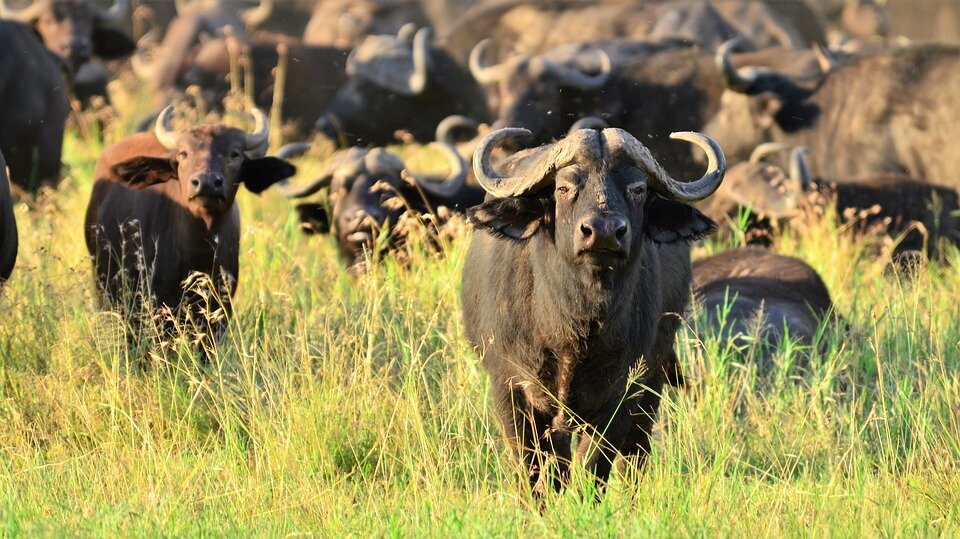
Arriving at the Rhino lodge (the cheapest on the edge of the Crater) a mongoose runs along the road and some water antelopes graze in the garden. The edge of the Crater is at an altitude of about 2000 m and in the evening it is cold, it easily rains because it is covered with forest. That evening it rains, we are happy to have accepted the advice to sleep in the lodge. It's still dry season, but this year, they tell us, the weather has done as it wanted and it has already rained a lot, it's all green.
Fifth stage: Ndutu, the migration
The clouds overlook us even the next day as we travel along the plateaus to the plain of Ndutu. Families of giraffes and groups of vultures delight our travel. It is February, the period in which the herds of migration after having walked to Kenya, return here and stop for a few months. Why? It is not difficult to understand: the green grass is not taller than a few centimeters, the flat and rocky ground creates endless plains where it is easy to see the predators and so the herbivores, wildebeests and zebras, have chosen it to make the little ones.
We sleep in a tented field (there are no cheaper solutions in Ndutu), it seems to be inside a movie! During the night it rains and at dawn, we leave to approach the herds. On the horizon the black line denounces thousands of animals but driving on that slippery ground is very difficult and our guide, after having shown us considerable skill, decides to go back. Twice we help other cars to get out of the quagmire. We admire a couple of cheetahs very close. What elegance nature has granted itself with these beautiful cats! They always hunt together, male and female. Now they yawn several times, probably have eaten and will go to enjoy the well-deserved rest.
Sixth stop: outside the tourist itineraries, on the border with Kenya
The next day we leave the busiest routes. We still travel across endless plains. The ostriches run alongside us perfectly coordinated and some stop to show us the dance of love, a twirling of feathers really agile and "soft". Towards the end of the plain, there are numerous hyenas, you can also see the holes in the ground that they use as dens.
When the reliefs begin we are there. The Masai who will take care of us is nearby, grazing his cows and meeting us smiling. He is very kind and helpful, he introduces us to his large family and takes us on a cliff to admire the view at sunset. It 's a beauty that leaves you breathless. We are out of the world!
The rains out of season have made the meadows bloom. The purple carpets, green acacias and free galloping zebras are an incredible sight. Our guide's wife goes to the village with the donkey and completes this almost bucolic landscape. Light ups and downs, streams, woods, herds, the village with the boys playing football... 8 hours walk to return to the plain, on the other side of the hill. In the distance, you can already see the Ol Donyo Lengai, the only active volcano in this part of the Rift Valley. It can be recognized by its perfect cone. The campsite, run by the nearby Masai village, is a simple clearing under the acacias.
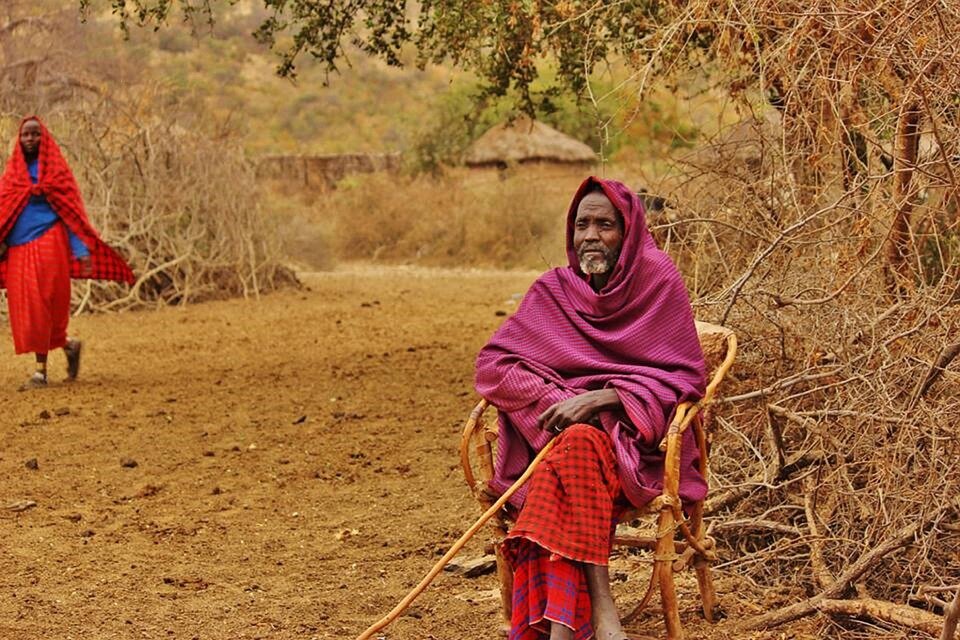
It's priceless to feel like you're part of the barrier-free savannah. We are welcomed by families of baboons who have lively discussions and, not to be missed, the Masai handicraft shop, 4 crossed woods but beautiful necklaces of beads and seeds. Women adorned to their ears and necks wait happily for their customers. They haven't been here in months!
At dawn, we leave on foot to enter the river gorge. Eagles and vultures nest on the high walls of pink rock, there are so many, still and in flight. Many herds of donkeys and cattle pass by us on the river bed and embroider the sandy bottom.
We reach the place where the Masai retire a few days a year, eating meat and natural medicines, to be stronger in body and spirit. On the way to Lake Natron, our guide asks a Sonjo woman to let us visit her hut. How dark it is! When our eyes have grown accustomed we realize that it is simple but very clean and tidy. We leave a small offer, it's customary.
to be continued in the next part...