Rice is the oldest and most common crop. Its grains, rich in amino acids, have excellent taste and are well assimilated by the body. The use of cereals is carried out in various areas of national economy
How does rice grow?
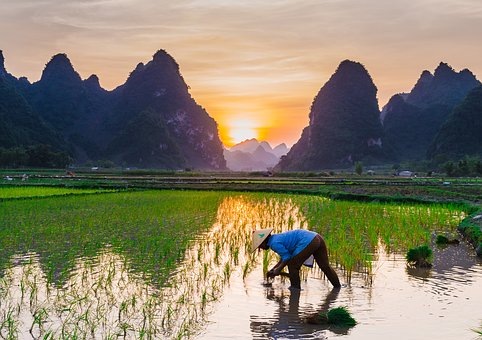
For a comfortable growth of this crop you need moistened soils. This tropical annual plant loves shade. An important condition for its growth is the water regime in the development phases. For example, when sprouting, the soil should be saturated with water. Further favorable conditions are such, when the field will be covered by a layer of water.
Where does it grow?
Rice is cultivated in tropical climates, but also in subtropics. At present, cereal grains are widespread in China, India, South America and Indonesia. In Asian countries, the crop is grown manually. America, for example, has invented a better method of sowing - from plane to field. Special flat fields flooded with water are the places where the cultivated rice grows. Drylands and plateaus are suitable for the cultivation of unpretentious varieties. There is a wild form of rice, the appearance of which differs from the usual white. It is found in the USA and Canada on numerous small lakes
Why does rice grow in water?
This crop is a plant that is not afraid of flooding. How does rice grow? The roots get oxygen supplied by the leaves that take it out of the air. Plants are fed with water and helped to cope with weeds, thus increasing yields. In order to create favorable conditions for comfortable rice growth, the flatlands are divided into plots with the help of rollers. Channels are formed, which are filled with water
Wild ancestors of rice are found in the tropical part of all continents, except Europe. Archaeological excavations in China and India, which uncovered remnants of earthenware with traces of rice, ancient rice fields with a system of irrigation channels, showed that the history of rice cultivation in these areas began about six or seven thousand years ago. However, the spread of rice in Asia was rather slow, and only by 500 BC did rice cultivation spread to large parts of India, China, Japan, Indonesia and Malaysia. As a result of prolonged cultivation in different parts of Asia, rice sowing has changed so much that it is now divided into three subspecies: Indian rice (O. indica), the most adapted to the humid and warm climate of Southeast Asia; Javanese rice (O. javanica), which is cultivated in the equatorial zone; and Japanese rice (O. japonica), adapted to the temperate climatic conditions of Japan, Northern China and Korea.
With the advent of Islam, rice has replaced barley, millet and wheat, becoming an affordable food and an integral part of Muslim culture. Large quantities of rice have been bred and consumed in countries included in the Arab Caliphate, where trade and economic relations between various countries located in a vast area from the shores of the Indian Ocean to the shores of the Red and Mediterranean Seas have been significantly developed. Having conquered southern Europe, the Arabs taught the people of Spain and Sicily not only to breed rice in sufficient quantities to provide themselves with food, but also to prepare nourishing and nutritious dishes from it. The popularity of rice in most European countries added crusades, of which returning knights will certainly carry a bag of Saracen grain.
Since when did the rice become known in Russia, perhaps, it is impossible to establish exactly, but there are documents testifying to the fact that by order of Tsar Ivan IV, after the accession of the Astrakhan Khanate to the Russian state, the Astrakhan voivode was ordered to begin breeding of Saracen wheat in the lower reaches of the Volga River in 1556. Whether or not this project was successful or not, it was not known, but since the accession of Astrakhan, a new era in history had begun for the Russian state, because Astrakhan had become an important trade and border crossing point of Russia, through which close economic and diplomatic ties were established with the closest neighbors of the Caspian Sea - the Eastern states. Through Astrakhan, among other goods, rice was brought from Persia, which gradually became commonplace among the various peoples inhabiting Russia.
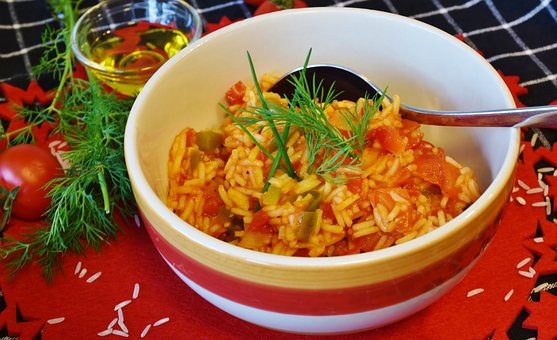
Most of the vitamins and minerals are almost completely removed from the aleuron layer and the germ of rice when it is polished.
Unsharpened rice is more important than more processed white polished rice. However, the fibre content of the raw rice groats will be higher.
Rice is not the main source of fiber in your diet, so if you like white rice, choose it. Or a mixture of polished and wild raw rice.
I'm talking about healthy people here! In other cases - on the recommendation of the attending physician.
A few important characteristics of rice groats:
- High starch content (up to 85%). The rice is quickly absorbed by the predominance of small starch pellets.
- Low fibre content
- Protein is deficient and limits leasing
- Not enough fat. Therefore, rice can be stored for a long time. 76% of rice fats are unsaturated LCDs, of which about 45% is linoleic acid.
- It contains few vitamins and minerals.
- Does not contain gluten.
For 100 g of dry product:
Caloric content of rice groats is 260-380 kcal;
Protein: 6.5-10 g;
Fats: 1-3 g;
Carbohydrates: 52-75 г.
The satiety of long polished rice will not give. Therefore I recommend to combine with protein (poultry, fish, meat) and fiber (vegetables). To not polished rice, such combinations, too, of course, will fit!
And as you probably already know, long-grain rice is much better in keeping with its shape and less boiled, almost does not stick together. Therefore, it is better to choose it for the second course. And if you want a tender porridge - it is better to choose a round-grained rice, although the long-grained can be boiled more powerfully and everything will be OK!
Quickly assimilated and quickly you want to eat. This is what is called "promoted metabolism". It's just that the body is used to complex carbohydrates, and carbohydrates like rice or potatoes are absorbed very quickly.