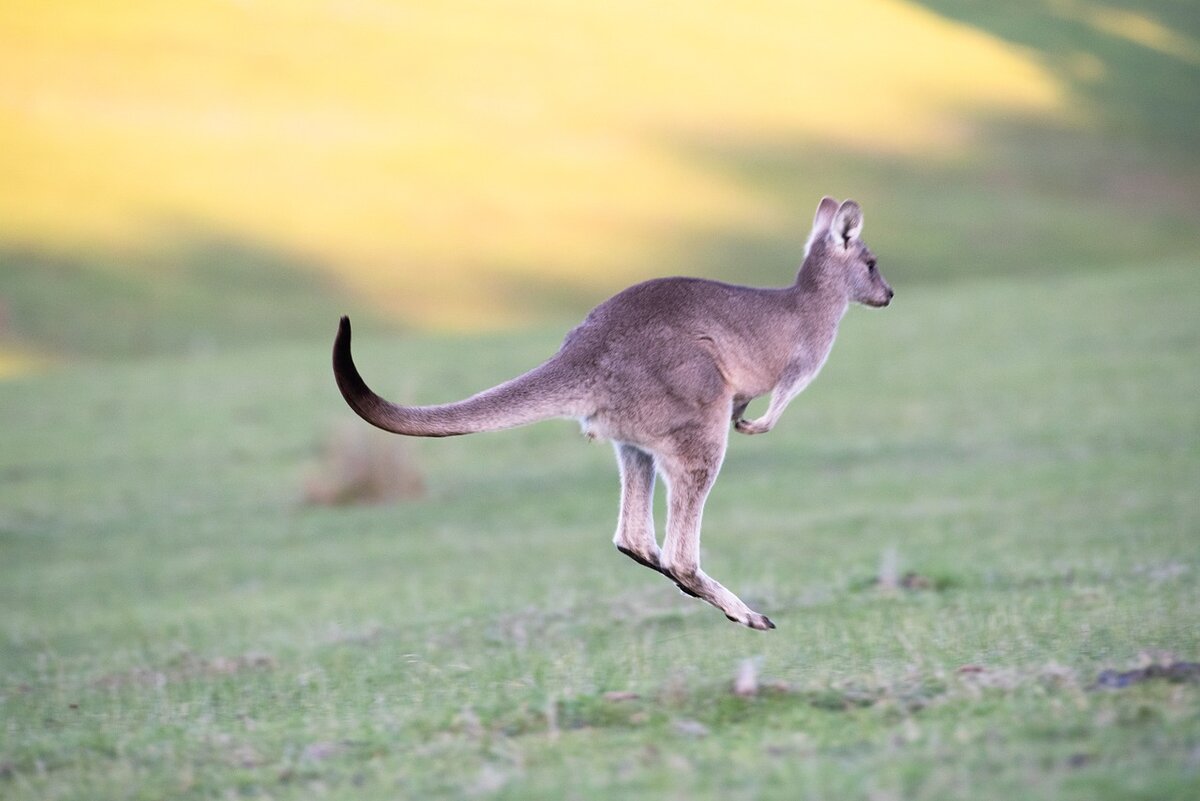
Australia has been an isolated mainland since the mid-Cretaceous period, some 40 million years ago. That's why Australia's animals are amazing: 80-90% of the species in every animal class are endemic, so they are not found anywhere else in the world. The beautiful world has made a selection of interesting Australian animals for you. Make sure they're unique, too.
Tasmanian devil or marsupial trait
Let's just say that the Tasmanian devil disappeared from the mainland about 600 years ago. Now it is located only on the island of Tasmania, 240 km south of the mainland.
The Tasmanian devil, or marsupial trait, is a predatory mammal from the Family of the Summers. He was nicknamed the devil for his black coloring, sharp teeth, aggressive disposition, and night screams. The Tasmanian devil is not a big, but rather dense beast. The body length is 50-80 cm, tail - 23-30 cm, weight not more than 12 kg.
Interesting features of the Tasmanian devil:
-This animal has a short and thick tail, where it accumulates fat reserves. Fat is used in times of starvation or illness.
-The Tasmanian devil has powerful jaws with sharp teeth: he bites the victim's skull or spine at once. He has the highest bite strength in mammals with respect to body weight.
-The main part of the diet is the scavenger. The Tasmanian devil does not squeal about dead fish, sheep, rabbits, and cows. He prefers rotten, wormy meat.
-The Tasmanian devil often beats away the prey of marsupial martens - small mammals (body length - 25-75 cm) from the Sumchatye family.
-The Tasmanian devil eats the whole prey with bones and skins, except for the large animals.
-The Tasmanian devil has a large "repertoire" of sounds that he makes at night: from quiet growling and "coughing" to piercing loud screams.
In 1941, these animals were on the verge of extinction, but their population was restored.
Lysovidnyi possum foxes us or bristle-tailed
The foxy possum is a mammal from the Cuscus family. This is a small animal: body length from 32 to 58 cm, tail length from 24 to 40 cm, weight - 1.2-4.5 kg.
Interesting features of foxy possum:
-This animal lives on trees, rarely leaves them and is quite lazy. Feeds on fruits, berries, fruits, can eat small birds or invertebrates - in general, everything that can be found on trees.
-The foxy possum only moves with its tail: it doesn't make a single movement unless it gets its tail caught on a branch beforehand.
-Females have only 1 calf, which they take care of for a long time - 9 months. First, the female carries it in her abdominal bag. When the calf grows out of the bag, it moves to the mother's back.
-Lysovidnye possums quickly adapt to the content in captivity and do not try to escape. Animals in captivity are peaceful, do not bite, but are so lazy that visitors to zoos do not particularly welcome them: they are considered boring.
Sugar marsupial flag, sugar marsupial possum, dwarf marsupial flag or short head flying squirrel
Sugar marsupial flyer is a mammal from the family of Marsupial flyers. It is a small animal that looks like a squirrel. Its body length is 15-21 cm, its weight is 95-170 g. Active at night. They eat mainly eucalyptus and acacia juice, nectar and fruit, insects and small invertebrates.
Interesting features of sugar flyers:
These animals are called flying lethargy because of their eardrum. The membrane runs along the body on both sides, from the fifth toes of the front legs to the fifth toes of the hind legs. It is used by animals to move in air currents. The direction is adjusted with the tail and tines. In this way, they plan to reach 50 meters or more.
Flyers have a long, thin tail. They twist it with a spring and thus carry objects: small fruits, twigs to build a nest.
If the food is not enough, the flyers fall into a state close to lethargic sleep. They can spend up to 23 hours a day in this condition. So they save energy.
Flying animals are very social animals. They live as families and protect their territory together. To determine where they are, social grooming is used: an alpha male marks his scent of everyone in his pack.
Short wombat, naked wombat or Tasmanian wombat
Shorthair wombat is a marsupial mammal, a member of the Wombat family. Wombats are herbivorous animals: they eat shoots, mosses, mushrooms, and berries. The animals are quite large: 70-130 cm long, weighing from 20 to 45 kg. Active at night.
Interesting features of wombats:
-Ancient wombats were larger than their contemporaries. For example, the extinct Phascolonus Gigas weighed 200 kg.
-Wombats dig residential caves with sharp claws on their feet. These caves can be part of a tunnel system about 20 meters long and up to 3.5 meters deep.
-The back of the wombat is very strong and hard due to thick skin, cartilage and bones. On the back of the pelvis, there is a shield. In case of danger, the wombat turns back and blocks the entrance to its dwelling, and the hardback of the body reflects the attack. If the enemy penetrates the cave, the wombat tries to press it against the wall and then strangle it with a shield.
-Because of the structure of the anus, the wombat feces are cubed.
-Wombats take a long time to digest food: up to 14 days. This slow metabolism is very effective.
-Wombats need very little water: about 22 ml per kg of body weight. Less mammals consume only camels.
Wooden kangaroos
Tree kangaroos are marsupials from the Kangaroo family. They are mainly found in mountainous areas but are also found in the plains. They are much smaller than the giant kangaroos, which have already become Australia's "business card". The length of tree kangaroos is 1.3-1.8 m and they weigh from 5 to 18 kg. They lead a nightlife.
Interesting features of wood kangaroos:
-Wooden kangaroos have short hind legs with flat soles. This helps them jump from tree to tree and move around in rocky terrain. They have long, curved claws on their feet that cling to the trunks of the trees.
-Tree kangaroos jump up to 9 meters and can jump down from a height of 18 meters.
-Females have only one calf (with rare exceptions). Mom wears it in her bag for about a year.
What unites these animals
Australia's isolation and harsh climate are the main reasons for the continent's unique fauna. Animals in Australia have adapted to these conditions as follows
Most animals are active at night and resting during the day as the climate is very hot.
They move in a special way: they run quickly, move with the help of trees, and plan from height. It helps to hide from enemies.
They have a similar color to the environment. Flyers are grayish in color of eucalyptus trunks, wombats are brown, similar in color to the soil in which they dig houses.