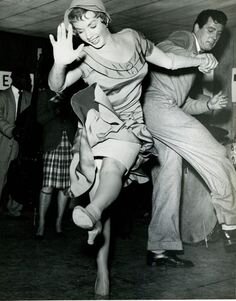
While the United Kingdom, on the verge of the 50s and 60s, is actively developing its rhythm and blues and rock and roll, the United States, on the contrary, there's a certain decline in interest in rock'n'roll, a shift of attention to something more relaxed, available. The fact is that even in its heyday rock'n'roll, despite the noisy popularity and odiousness, was the destiny of a rather limited part of both performers and fans. Even among teenagers, especially whites, not everyone risked going against the will of their parents and public opinion. However, rock'n'roll caused the older generations to feel panicky.
American entrepreneurs, who saw in the rock 'n' roll huge opportunities for big business, began to do everything to attract the attention of the widest possible range of consumers: radio listeners, viewers, buyers of records, visitors to dancing and concerts. To do this, it took some changes like the music and the image of the hero performer. By a strange coincidence, the main stars, rock'n'roll pioneers, had almost simultaneously left the stage: Carl Perkins and Jean-Vincent were traumatized in car accidents, Jerry Lee Lewis and Chuck Berry were caught in scandalous stories related to violation of morality and law, tragically died Buddy Holly and Eddie Cochrane, hit the religion of Little Richard, went to Europe to serve in the army of Elvis Presley. Their place was also taken by seemingly rock'n'roll boys: Paul Anka, Bobby Rydell, Frankie Avalon, Fabian, Bobby Wee, Ricky Nelson, and others. In terms of musical form, what they were doing was like rock'n'roll: the same harmony, melody and rhythmic basis. But by the energy message, by the aesthetics
⦁ It was a completely different art. Outwardly everything was smoothed out here: hair, clothes, manner of moving, nothing irritates, the theme of songs is reoriented from youth problems to love lyrics and everyday romance, disappeared acutely rhythmic, irritating "scat" (b-bop-a-Lula, tutti-frutti, etc.). Rock'n'roll loses its spontaneity, aggressiveness, and unpredictability. Having become the property of fashion-conscious people who do not take any risks and entered the sphere of big business, rock'n'roll was bought "at the root" and thus defeated. On its basis a new phenomenon has blossomed, a typical example of mass culture - "pop". If the music of rock'n'roll pioneers was inspired in its desire to express at least some ideas, to shock the average person, to break through the wall of prohibitions, then pop music of the early 60's can be safely called soulless. It was a product, cynically packed in a rock'n'roll wrapper and designed only for commercial success: in the expression of one critic, "pop" became "deodorant from sweat rock'n'roll".
The popularization of this kind of music played a significant role in the TV show "American Bandstand" from Philadelphia, daily focused attention to 20 million young viewers. Its creator Dick Clarke consciously formed a "sugar" version of rock 'n' roll, selecting the appropriate stars and repertoire. In addition to the presentation of new songs and interviews with performers in the program learned to dance youth. It was with the help of "American Bandstand" that the twist gained popularity, which replaced the rock 'n' roll when the song by Hank Bellard "Twist" was performed by Negro singer Chubby Checker, who offered a version of the new dance. The reason for the success of the twist was in its democracy and accessibility because rock 'n' roll has not become a mass dance. Rich in acrobatic tricks, he required a long training of two partners, good physical shape, agility, talent. Usually amid rock 'n' roll in dancing, at the "balls" danced only a few pairs, the rest of the audience mainly empathized, standing around and dancing on the spot. Twist became available to almost everyone, clever and awkward, young and not young. It could dance alone or adjust to any partner, to dance badly, as long as it looks like. But the real masters were also famous, first of all, Chubby Checker himself, imitating whom, many inexperienced dancers were injured (in the peak of twist hobbies in hospitals got a lot of people with dislocated ankles, knee or hip joints).
After extinctionChubby Checker's interest in the twist was trying to artificially repeat his success by inventing new dances - but to no avail. Later, there were splashes of interest in new, especially imposed dances, such as "Limbo", "Hitchhikle", "The Monkey", "Bug", "Pony", "Frug", "Watusi", "Hully Gully", "Jerk", "Boogaloo", but none of them could surpass the success of the twist.