Application of the Law of Mechanics to Rotational motion
First, it should be noted that there are two different types of rotational motion:
1) Rotation of the body, which is not caused by the rotation of the surrounding ether — this is the most common and familiar type of rotation. In this case, the ether does not rotate with the body, and the ether is not the main reason for the rotation of the body.
In this situation, parts of the body have accelerations relative to the ether and therefore forces are applied to the body from the ether, this is the centrifugal force, which has the same nature as inertia. The accelerations are directed from the centre of rotation of the body to its periphery, and since parts of the body cannot move freely with the ether, these parts of the body experience forces coinciding with the accelerations of the ether.
Here it is important to understand that for this type of rotational motion, accelerations exist even if the rotation occurs at a constant angular velocity, and these accelerations occur due to the difference in linear velocities and directions of motion of parts of the body relative to the ether.
The rotation of the body in the stationary surrounding ether will be discussed in more detail in the next Chapter.
2) The ether rotates the Rotating body. This situation is typical for the axial rotation of celestial bodies with gravity, such as the Earth or other planets and stars. In those circumstances, the ether rotates synchronously with the body, the body is free in its movement, and there are no relative accelerations between the parts of the body and the ether. With changes in the speed of rotation of the ether, the body follows them without inertia, that is, without internal stress and centrifugal force. Of course, this is an idealized situation describing in principle the behaviour of the body in the rotating ether from the point of view of the Law of Mechanics. This situation is only approximately fulfilled in the real world.
In practice, planets and stars do not move completely freely in their axial rotation, since the rotation of the ether does not perfectly coincide with the rotation of all parts of the rotating body. Some effects of such imperfectness will be discussed in the section devoted to tides. But conditions for synchronous rotation with ether can exist on the surface of the celestial body, or close to its surface.
Let’s take a closer look at this second type of rotational motion. The main factor determining the direction of rotation of all planets is the direction of rotation of the Sun. Solar gravity causes a spiral motion (vortex) of the ether, the direction of which will coincide with the direction of rotation of the subsequent etheric vortices of the planets. We will consider in more details the mechanism providing such coincidences later, but for now will only note that this simple mechanism only approximately determines the initial direction of rotation and orientation of the axes of rotation of the planets.
The self-rotation of the planet increases with the growth of the planet and the strengthening of the planet’s gravity. The axis of rotation of the planet over time can change its orientation due to any external factors; especially at the boundaries of the solar system, where the influence of the Sun is weaker and, at the same time, external influences are relatively stronger.
The planets’ own gravity has a rotational component. Since the planet rotates, its gravitational layer (the layer in which the ether turns into substance) also rotates. The rotation of this absorber of ether will cause the rotation of the ether flow, which is forced to follow the “moving target”.
It is easy to see that the rotation of the spherical surface absorbing the ether with uniform intensity creates a differential rotation of the ether at different latitudes. In general, the flow of ether will create a figure of the rotational shape coaxial with the axis of rotation of the planet.
The polar regions of the planet will absorb ether from a relatively larger (per unit of the surface of the sphere) volume of the surrounding space compared to areas at low latitudes, and especially at the equator.
Thus, at the equator of a rotating planet or star, the ether has a maximum speed. The linear velocity of the equator is much higher than the linear velocity of the poles, so if we assume the equality of the absorption capacity for any point of the sphere, then the unit surface of the rotating sphere near the equator accounts for a smaller amount of available ambient ether. Therefore, to ensure the absorption of ether equal to the poles, the higher ether’s speed in the area of the equator is required.
Once started, the rotation will accelerate itself due to the positive feedback mechanism. Until it reaches the speed limit.
The speed of rotation is limited by the effect of differential rotation, as the polar regions of the planet slow down rotation. The stars and planets have a solid core, through which two differently rotating regions are connected together: fast and slow. The resulting rotation is set somewhere in the middle, forming a distorted shape of the planet (flattened), due to the interaction of two forces.
The Mechanism Of Rotation Of The Sun, Tachocline
Let’s see how we can apply this model to analyze the rotation of matter inside our Sun, based on the data of helioseismology obtained by the National Solar Observatory NSF (NSF’S National Solar Observatory). The description of the graph says:
“Time-averaged rotation rates, plotted as a function of radius at different latitudes within the Sun. The tachocline — a region where the rotation rate changes from differential rotation in the convection zone to nearly solid-body rotation in the interior, is evident near the base of the convection zone, determined to be at radius 0.71 R (where R is the overall solar radius).” (Image courtesy NSF’S National Solar Observatory)
Our comments on the chart are shown in blue.
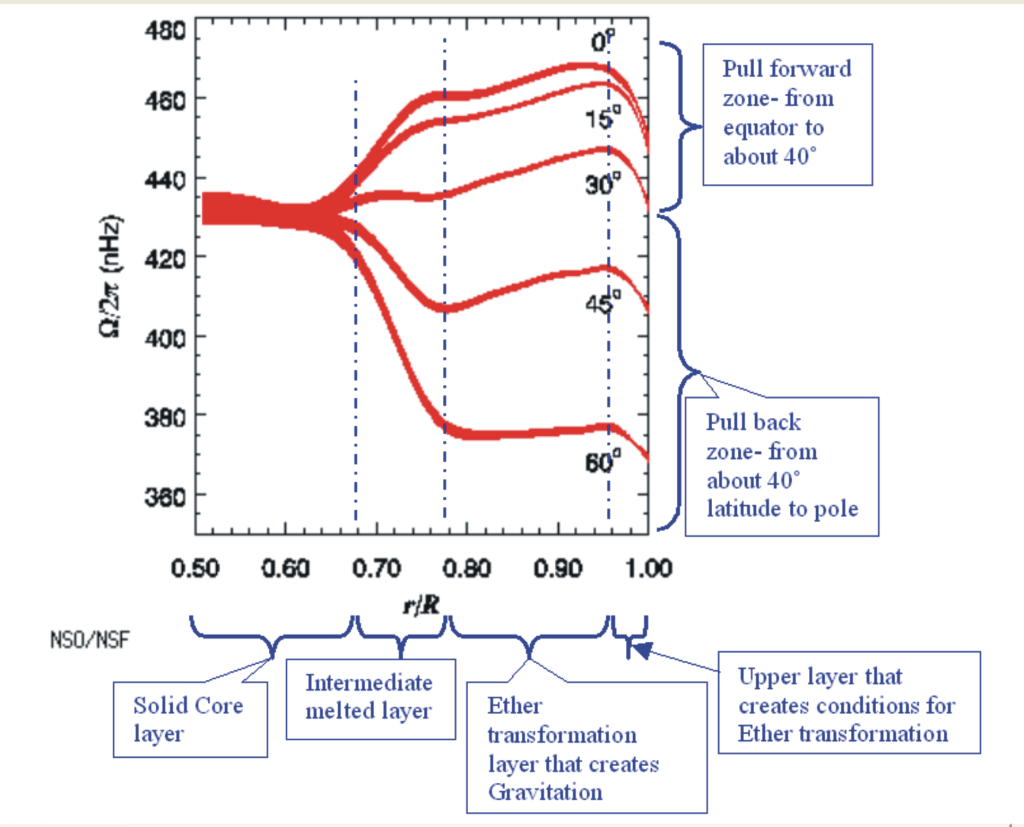
The Sun has two functionally different zones depending on the latitude: above and below about 40 degrees.
— Accelerating zone (from the equator to 40 degrees) — pulling forward, in this zone the angular velocities are higher than the angular velocity of the core - this zone provides the acceleration of the entire system.
— Braking zone (from 40 to pole) — pulling back, in this zone the angular velocities are lower than the angular velocity of the core, this zone provides deceleration, braking, and as a result stabilization of the entire system.
Along with this, there are four functionally different layers in the depth of the Sun:
The upper layer – in which the ether continues to accelerate on its way to the underlying layer.
— In this layer we see only an increase in the angular velocity in all cases. This increase in angular velocity is caused by the ether, which is still accelerating, catching up with the next, faster rotating – absorbing layer.
— We see that the acceleration of substance in this layer exists at all latitudes (deceleration in this layer is not observed at any latitude)
— The level of acceleration depends on the latitude – the closer to the equator, the greater the angular acceleration.
— The values of angular velocities on the surface of the Sun – the points of intersection of the graphs with the right coordinate axis (r/R=1.00) have values very close to the actual angular velocity of the ether entering the Sun, because the liquid upper layer is almost free in its rotational motion.
The transformation layer is the real engine of the whole system (as well as the Solar System in general).
Since this layer is liquid, it is also quite free in its rotation.
We see that the angular velocity has a maximum at the beginning of this layer for all latitudes. This maximum means the beginning of the process of converting the ether into a substance. As the ether turns into a substance, the density of the ether gradually decreases, and the ether needs to penetrate deeper into the layers of matter with higher pressure to turn into a substance. This is a self-regulating process – at a certain depth, a balance is established, and the density of the ether decreases to a level at which the ether ceases to turn into a substance at a given pressure of the surrounding substance.
This boundary of the minimum ether density is represented by an additional sublayer, which we do not distinguish as a separate layer because it has different sizes at different latitudes; and because this sublayer does not have sharply distinctive functionality. This sublayer is represented by horizontal sections connecting the transformational and intermediate layers, and is most representative at the equator. At this depth, all the ether that could be converted into matter has already been expended, and the pressure of the ether has stabilized at some level that is less than the pressure required to compress into substance, and is equal to the entire space inside the Sun below the transforming layer. This space includes the core and the intermediate molten layer; in this space there is no gravity, since there is no acceleration of the ether.
The intermediate molten layer, or the so-called tachocline – it connects the liquid upper layers with the solid core. It works as a liquid friction “clutch” in the acceleration zone, and as a friction brake in the stopping zone. We see that with increasing depth, the angular velocity in the accelerating zone decreases in this layer, and the angular velocity in the braking zone increases. Two main sources of energy contribute to the melting of the material of this layer – the heat coming from the upper layers, and the heat generated inside the tachocline itself due to the mutual friction between the core and the braking and accelerating zones.
A solid core is the foundation of the entire system. The core works as a support, providing a base for all the upper layers and thus conditions for accelerating (actually deceleration) the ether flowing from all sides through the solar substance. We see that the angular velocity in this layer is approximately constant, as it should be for a solid.
Another observation is that the size of the layers depends on the latitude, this can be explained as a result of the dependence of the critical acceleration of the ether on the latitude, and the equatorial swelling (here we are talking about the linear acceleration of the ether in the direction of the centre of the Sun, not the rotational acceleration). In general, this dependence is very simple: the critical pressure and acceleration of the ether are achieved earlier at the equator and the inflow of ether is consumed faster than at high latitudes.
As we can see, the rotation of the Sun is provided by a balanced mechanism that uses both positive feedback and stabilizing braking. The presence of such a mechanism allows us to explain the reasons for periodic changes in the speed of rotation of the Sun and various vortex structures with periods of oscillation from 5 minutes to 22 years. Such periodic oscillations can be harmonics and subharmonics resulting from the operation of feedbacks in the mechanism of rotation of the sun in response to any changes in external conditions.
*
The mechanism we have described also creates structures that extend far beyond the surface of stars and planets — such majestic structures as the solar system and Saturn’s rings.
To understand how differential rotation works outside the gravitating body, we can analyze the behaviour of the ether in the upper layer of the Sun. The upper layer closely reflects the movement of the ether, since this layer is free in its rotational motion, and can be subject to rotational accelerations of the ether, because the substance in this layer is liquid.
From our analysis of the upper layer, we concluded that the equator has an increased angular acceleration. This effect creates an equatorial bulge on the surface of the Sun; and this structure continues beyond the Sun. The acceleration gradient gradually decreases with distance from the Sun.
This difference of accelerations creates a constant “thrust” (“draft”) in the direction of the Equatorial plane of the Sun, and similarly, to the Equatorial planes of the planets. This effect is most obvious for gas giants, each of which has a system of rings, of which the most representative belongs to Saturn.
Saturn’s Rings! – what other evidence is needed for the fact that universal gravity, as an internal universal property inherent by substance — is a fiction?
Here it makes sense to once again compare the Law of Mechanics with Newton’s hypothesis of universal gravitation. The law of Mechanics not only rejects the hypothesis of the inherent property of substance to attract another substance, the Law of Mechanics rejects the idea that gravity always acts on the shortest line between bodies. The law of Mechanics considers gravity as a stream of ether having a vortex nature of motion. At a distance from the planets, this translates into the orbital motion of satellites, especially in the equatorial plane. And at close distances from the planets, the gravitational vortex of the ether has a synchronous rotation with the planet and a significant radial component, which gives the impression of a steep fall of bodies for the observer rotating along with the surface. We will consider in more detail the features of the motion of the gravitational vortex depending on the distance from the planets and stars in the sections devoted to the age of celestial bodies and the evolution of stars.
And ending with this Chapter, one more remark. The mechanism of the Solar System proposed by the Law of Mechanics returns us to the similarity of the mechanism of orbital rotation of the planets by Ptolemy. The idea of the motion of the celestial spheres to which the planets are attached has existed since ancient times, was then rejected, and is proposed now again, in a modified form.