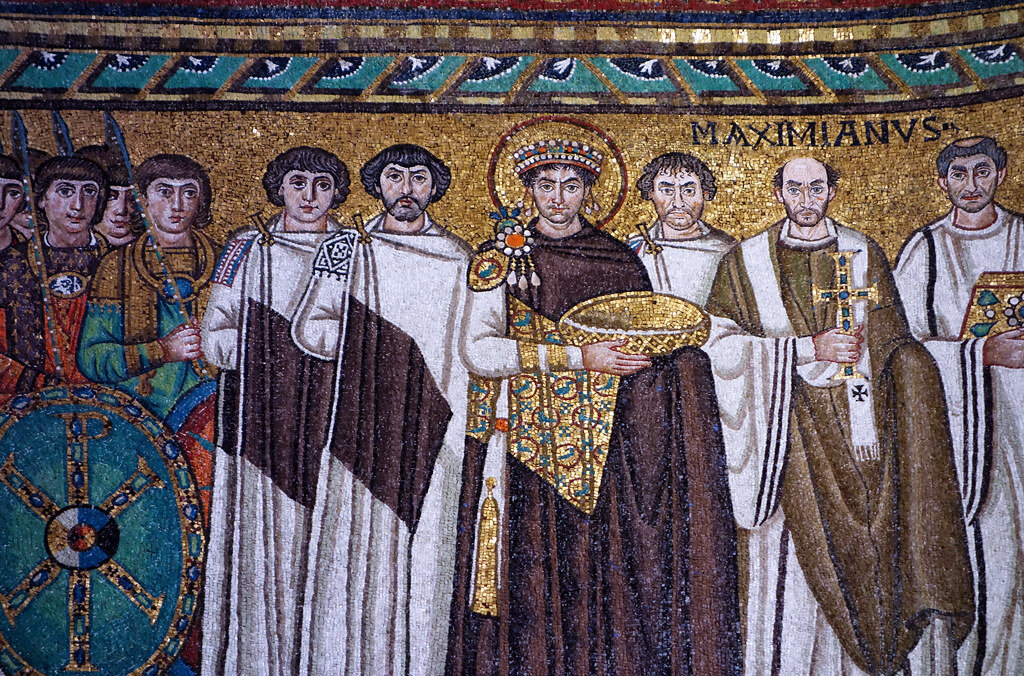
The fate of Byzantium still excites the minds in Russia. Those who think about the past and future of their own country, sooner or later inevitably turn to the ancient Eastern Empire - in search of answers to various questions, in an attempt to build analogies, in an effort to see in its experience the pros and cons that would be consonant with today's Russia , perhaps, would help in its movement along the historical path. The reason is clear - very much connects us to this “titanic” who has long sunk into oblivion of history, we got a lot from there, and echoes of a lively connection with Constantinople still sound today - recall at least the recent church dispute about Ukraine between the Orthodox patriarchates of Constantinople and Moscow .
The great Orthodox empire, the heiress of antique tradition and at the same time eastern mysticism, an extraordinary symbiosis of Greco-Roman and Judeo-Christian, began so brilliantly (with the triumphal gains of Justinian, who almost realized his dream of reconstructing the Roman Empire), and so sadly ended his days, nevertheless less than a millennium lasting in the historical arena! What was it really like? The empire of the Greeks or still the Romans - as it called itself? Christian East or Eastern Christianity - what should be the main emphasis in this phrase? The golden bridge between the West and the East (as Marx beautifully called it) or the eternally attacked stronghold that defended Christian Europe from the eastern hordes, and received instead the gratitude from this Europe the rout of 1204?
According to the tradition that has developed in historical science, Byzantium is customary to consider in the context of medieval history - with reservations about the late genesis of Byzantine feudalism and its significant differences from Western European counterparts. In this regard, the history of Byzantium is always clearly separated from the history of Rome - for this they even came up with a purely scientific name for this state: after all, Byzantium itself never called itself Byzantium! But is this really so? After all, Byzantium is not just the direct heiress of the Roman Empire (with all its institutions, attributes, forms, ideology, etc.), but a direct continuation of Rome, the connection with which is completely indissoluble. If someone started explaining to a Byzantine of any age that he was not a Roman, but a citizen of some new power, which only inherited something from the greatness of the great empire of the Mediterranean, I’m afraid he would not even understand what was being said.
But the history of Byzantium must be considered not only as a logical and indissoluble continuation of Roman history, developing in the context of a new era and new socio-economic conditions (Middle Ages), but much broader - as the last act of the great antique civilization, which had several large periods in its development. And then its originality and its unusualness will not dissonant with the usual schemes of feudalism - the last antique policy, lost in the ocean of the barbarian Middle Ages, casually plowed the expanses of an alien reality until it finally sank like Atlantis, leaving behind a myth that has been nourished by people for more than half a millennium once fell under the spell of this incredible phenomenon.
What, in theatrical language, is this for acts of antique epic drama?
The first act of ancient civilization is classical Greece from ancient times to Alexander the Great, with its myths, great philosophy, soft, “commercial” colonization of the Mediterranean, slave democracy, the primacy of republicanism.
The second is Hellenism: non-profit, and the military-political and ideological expansion of the then European civilization (which was Greek - then there simply wasn’t any other in Europe) to the East. Alexander the Great began this process, crossing antiquity with the incredible wealth of the East - the diverse civilizations of the Semites and Iranians. As a result of this, an extraordinary type of Eastern Mediterranean mentality and, more broadly, civilization began to emerge, which in many ways today lies at the basis of the differences between the Eastern Christian peoples, both from their Western “brothers in Christ” and from all other non-Christian East.
The third is Roman: a new force came into the Hellenistic world from the West, new blood, crude but tenacious, enslaving the Eastern Mediterranean, but also giving it a new life. Rome was not a stranger to either Greece or the Eastern Mediterranean: Greek civilization has long flourished in Italy, and the legendary Aeneas came from Troy - both Hellenic and Semitic, therefore, had a considerable influence on the great policy on the Tiber. The harmonious interpenetration, the coexistence of Greek and Roman is amazing, but also quite natural.
The fourth is Byzantine: the slow withering of antiquity, impregnated by the East in general and Judeo-Christianity in particular, its last outburst surrounded not only by hostile tribes, cultures, a hostile mentality, but even a hostile time. Antiquity in the barbarian Middle Ages: of course, it could not remain the same as it was in the Hellenistic era or in the Roman era, it was forced to change, adapt, learn something new, albeit sometimes completely foreign to it, but right up to its very last days, despite the school of feudalism and the colossal influences of Arabs and Franks, Byzantium, in fact, remained an antique policy. The appeal of its intellectuals at the end of its history to the images and patterns of Hellenism is not accidental - this is not only the search for a new identity in the conditions of lost imperial greatness and power, but also the insight of its past, its origins, which actually never disappeared from the Byzantine context .
A huge historical path has been traveled by antique civilization, its greatness has determined the face of Europe until today. Its homeland - Greece - after 1453 never rose to the same level and did not have the value that it acquired in the era of antiquity, especially early. Strictly speaking, and throughout antiquity, the role of Greece itself was unequal: its significance is undeniable before the era of Alexander; during the Hellenistic, Roman and Byzantine periods, the Greek lands proper were largely peripheral, socio-economic, political, ideological, cultural and religious centers were already in other lands (Alexandria, Rome, Constantinople, etc.). Nevertheless, Greece in these periods was understood as the mother of antiquity, they have never forgotten about this. Almost four hundred year old Ottoman rule humbled Greece incredibly, in addition, interrupting, for a long time, the continuity in the development of antiquity, which, with all metamorphoses and influences, has always been a phenomenon of Greek origin. The independent Greek state restored in the 1820s can hardly pretend to continue the antique tradition: the interrupted continuity and the crushing of the people, their ideology, which are no longer inspired by great thoughts, have an effect. The last of them - enosis - was defeated and failed to inflame the Greeks with something extraordinary, historically significant.
Sacha Storojev