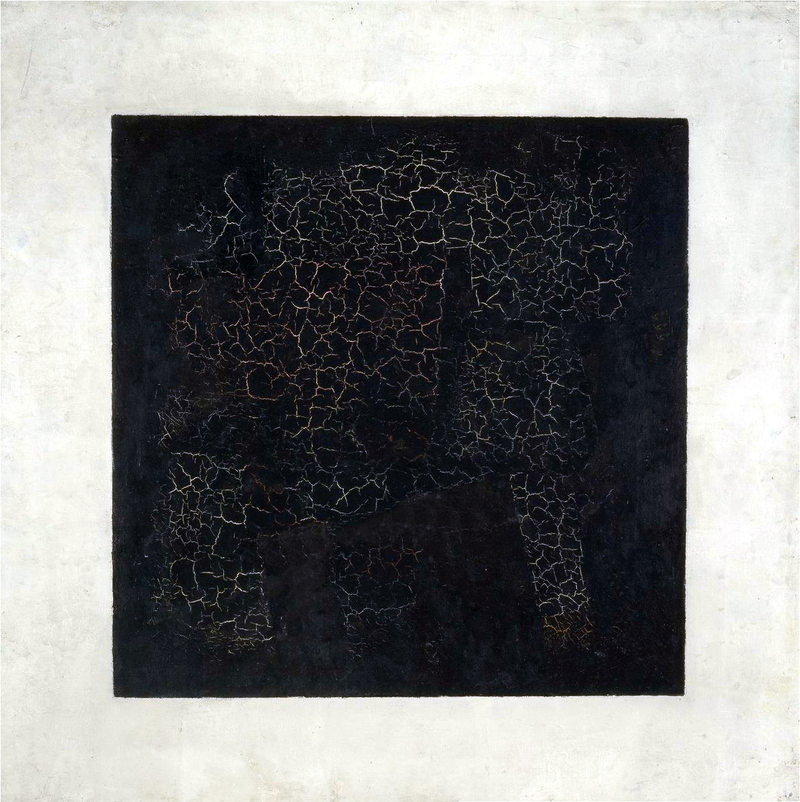
The mystery of "Black Square" by Kazimir Malevich
By Jury Romanov, Egor Romanov and Boris Romanov
It is well known, Malevich exhibited his first Black Square, now at the Tretyakov Gallery in Moscow, at the Last Futurist Exhibition 0,10 in Petrograd in 1915. A black square placed against the sun appeared for the first time in the 1913 scenery designs for the Futurist opera Victory over the Sun. The second Black Square was painted around 1923. Some believe that the third Black Square (also at the Tretyakov Gallery) was painted in 1929 for Malevich's solo exhibition, because of the poor condition of the 1915 square. One more Black Square, the smallest and probably the last, may have been intended as a diptych together with the Red Square (though of smaller size) for the exhibition Artists of the RSFSR: 15 Years, held in Leningrad (1932).
"Black Square" — foresight of "pixel"?
Many people still think "Black Square" by Malevich just meaningless PR. However, many others have tried to understand the meaning of the image. "Black Square" yet in 1916 was named an "icon of the avant-garde" (Andreeva E. Yu. Kazimir Malevich. Black square. — St. Petersburg. "Arka", 2010). However, the question remains: whether Malevich himself had put some additional meaning in this his job, or he "just" created this "icon"? Or maybe it was a spontaneous artist prediction about something that was unknown to people early XX century?
December 4, 2013 one of the Russian federal TV channels (5th) in the plot of the 100th anniversary of the history of "Black Square" by Kazimir Malevich showed an interview with a Russian artist Yuri Romanov.ru/news/78615/ . He believes that this "icon of the avant-garde" was actually foresight modern virtual world with its fundamental minimal element — pixel. Well, the interview with Yuri Romanov was filmed over an hour, and in TV story fit only two minutes (or even less) — but it usually is what happens on television.
We should tell a bit more about this version of solving the mystery of "Black Square" .
Association with the pixel did not appear spontaneously, but based on the study of texts by Kazimir Malevich. Yuri Romanov writes about the following excerpts from Malevich's texts in support of this hypothesis :
1. Malevich's short text under one of the lithographic reproductions "Black Square" reads:
"It is built in the fifth (saving) measurement as a basis on which to develop all forms of creative efforts of inventions and the arts."
(Vitebsk, 15 November 1919)
2 . The theses articles Malevich ( Materials for the book " International Art" ) reads:
"Humanity is just the brush, chisel and hammer , which always builds a global picture . But till now there is not such art, which would show it on own screen, and so that human would be able to see the total amount of all his labor in the global picture . I am going to built this screen . This screen should have an idea . But to cover the presentation of the World Creativity paintings, it is necessary to invent some symbols which would be a guide of the adequate nature of the living world. "
K. Malevich , April- May 1919 (http://kazimirmalevich.ru/t5_1_3_7 — in Russian)
Probably, the full Malevich's text contain also other evidences in favor for the version of his "anticipation" of modern virtual world (and pixels), but yet just even only these quotations enough for proof this.
Let us now tell a little more about the history of a discovering and presentations of this version.
Version History "Black square = Pixel"
Authors — artists, father and son Romanov, Yuri — member of Artists Union of Germany; Egor — university graduate Bauhaus in Weimar.
Needless discovery of a "secret" of "Black Square" Yuri and Yegor have made about March 21, 2003. Interestingly, that the same days (March 22, 2003) a sunrise over Japan was unique (unusually): "square sun" rose on the horizon — a unique optical phenomenon caused by the refraction of sunlight in the atmosphere that day. This was reported by many media and news agencies around the world.
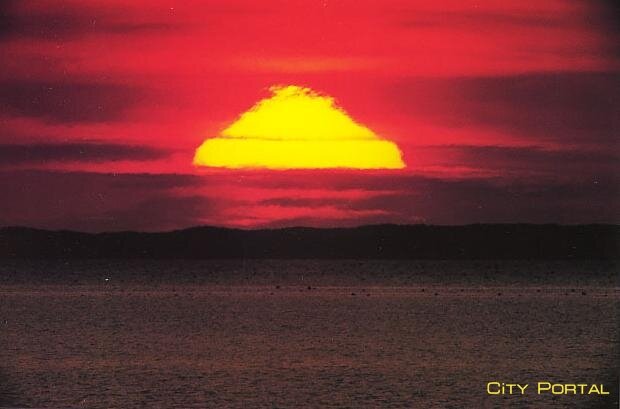
September 19, 2006 in Weimar (Germany), during the week of an international culture, there took place the presentation of the art project "Victory of the Sun" (a manifesto, the object "Black Pixels" and the movie "Victory of the Sun"). This project revealed various aspects of an enigma of "Black Square" by Kazimir Malevich.
Continuing the tradition of the Russian avant-garde, Yuri Romanov promotes new artistic direction — Abrogativizm (from Lat . Abrogatio — Cancel ) — Abrogativizm reveals and develops the new art direction by overcoming ( catharsis ) an enigma of "Black Square" by Malevich . I recall that Yuri Romanov treats this mystery ( black square ) as "involuntary" (spontaneous) foresight Malevich appearance of "Pixel" — the black square, which has become the fundamental minimal element of modern virtual world — the world of computers and television ( TV screens and computers). Yuri Romanov believes that Casimir Malevich was wrong in that "black square" is the foundation of wildlife. It lies at the foundation of modern virtual world, but not the world of wildlife .
10-12 November 2006 presentation of "The victory of the Sun" was held in Erfurt — it took place at the exhibition of German artists in Kunstmesse. The very name of the project ("Victory of the Sun") is contrasted against the name (title) of the opera "Victory over the Sun" — opera, theatrical performance, which was associated with the creation of "Black Square" by Malevich.
Now, after this preface, it is appropriate to remind readers about the history of this "icon of avant-garde", and about its critical reception — for those readers who are not very familiar with this story.
About Kazimir Malevich and his "Black Square"
Black Square was unveiled at the "Last Futurist Exhibition of paintings of 0.10 (zero to ten )" , which opened in Petrograd 19th (or 17th ) December 1915 . Malevich showed there figurative paintings and announced the coming of a "new pictorial realism " ( " Suprematism" ) . The term " Suprematism" (from the Latin . Supremus, « the highest , or overcoming ") Malevich introduced as a symbol of the highest and last stage of the art, the essence of which lies in going beyond traditional boundaries , beyond the visible ( intelligible ) world — into Nothing, into the Absolute. According to Malevich, only this way can save the world, — the world which lost integrity and are on the verge of death.
In addition to this I quote excerpts from three articles on Malevich's Black Square: from the article of art-critic, from the article of famous artist, and from the article of Russian priest — in chronological order.
It is not understanding till now a grim revelation?
Below I publish excerpts from the article correspondent of the newspaper "Izvestia" Olga Kabanova — about exhibition "Black Square" by Malevich in New York's Solomon R. Guggenheim Museum (13 May 2003):
May 13, 2003. In New York's Solomon R. Guggenheim Museum opened an exhibition "Kazimir Malevich. Suprematism"
"Black rectangle, black cross and black circle — these three classical Malevich's compositions meet viewers who go up to the famous ramp of the classical building Solomon Guggenheim Museum. This museum was built by the ingenious design of Frank Lloyd Wright and its viewing is amazing even for prepared spectator. But when after these three simple geometric shapes Malevich you see also a black square, it just rolls on you a horror. Over the past decade and a half paintings of Malevich showed many times, and I've seen these pictures before, but I confess that never in his exhibitions I have not experienced such serious feelings. Just blow some gloom. <...> Exhibition curator Matthew Trattt, saying the opening speech, spoke at length, as in his childhood he first saw a book on Russian avant-garde ... Director Thomas Krens in his opening remarks, long and monotonous, as sexton, thanked everyone who participated in the creation of the exhibition, but in the end he suddenly confessed that he wanted to make it — just such — since a time when he began working at the museum.
Such personal intonation in formal business speeches are understandable. It is a fact that the grim geometric poetry of Malevich's painting, or an epitaph, or painful prerevolutionary prophecy — whatever you call it — it's all too much effect on those who are facing with it. Nothing, absolute zero, the abyss, which would indicate Malevich in his "Black Square" — all of it hurts even for people with underdeveloped imagination. And among those who are engaged in the art, such people are almost absent ...
The main black marks in the history of world art — circle, square, cross and rectangle which are depicted in black and white by Malevich's hand — compiled together, they produce a powerful effect. They gape before the audience as dug grave, as a sign of the inevitable. It had to prove the exhibition "Kazimir Malevich. Suprematism "at the Solomon R. Guggenheim Museum." And proved.
Artificially inflated fetish and secret of the artist's psyche?
From an interview with famous Russian artist Mikhail Shemyakin radio "Freedom" (journalist Tatyana Voltskaya, December 1, 2005):
<<Mikhail Shemyakin: ... I brought the materials of my institute, these materials show where the shoe pinches with the square. Very rare and curious thing I managed to get in France, this black square by Gustave Dore, he represents the history of Russia, which is lost in antiquity and in the mists of time. He called it "The Twilight Russian history." Cartoons of the square of Malevich.
Tatiana Voltskaya: What caricature on Malevich square can be drawn ?
Mikhail Shemyakin: Caricature Vladimir Zimakova is the transformation of one of the famous Francisko Goya etchings series of " Kaprichios ." This deathly plate that crushes people who are trying not to fall into the pit called "When at last they will go away? ". That's just this deathly plate turned into a huge square of Malevich , which presses contemporary Russian artists. Favorite saying of Western snobs , especially in America , in broken Russian : "You do not Malevich ! "
Tatiana Voltskaya : And yet, what is main thing in this set of measures around the black square?
Mikhail Shemyakin : Basically , everything that is related to the debate about whether so this box is really a sort of a powerful phenomen in the art of the 20th century . It all boils down to the fact that mankind need some fetishes ... For example , it is strange dances, which have been conducted for several centuries around the "Mona Lisa" by Leonardo da Vinci. Entire volumes written about the study mystery of her smile . And actually no great mystery there. If a person knows the art of ancient Greece, especially Archaic Greece — all experts know that the famous and mysterious Mona Lisa's enigmatic smile — it's only translated from sculptures of Archaic Greece Kurasov smile . A sort of pre-dawn area state of nature : a half-smile or wandering smile . But there are things much more interesting at the same Leonardo . But mankind had to create some kind of fetish legend.
Tatiana Voltskaya: is Black Square relates to the same?
Mikhail Shemyakin: Yes ...
Tatiana Voltskaya: Still, you arrange an exhibition devoted to Black Square. Does this mean that you are also going on about these fetishes?
Mikhail Shemyakin: I'm a historian and analyst, and I must learn everything. Whether I like it or not. Besides the square which I have to study , you can not even imagine how much the present day to bake these squares. I just show it . Yesterday I had a friend of mine , who loves art . When she looked two works associated with this exhibition , she said : "But as it is boring — a square ." When I showed her endless series of squares , she said: " Now that's interesting." Yes, it's interesting — but from the perspective of psychiatry. < ... >
Tatiana Voltskaya: Yet, despite the childish joy of a great artist, having a tendency to play, I continue to adhere to the view of the medieval thinkers who believed that we should not get involved in the image of demons to himself not to fall into temptation. So, I confess, two floors of assorted squares I kind of scary. But maybe Mikhail Shemyakin rights: honestly considering them at an angle square madness.>>
Forerun of darkness which swallowed Russia after 1917?
From an article by Boris Mikhailov (priest) "Abomination of desolation (the art of Malevich)" (magazine "Art", January 2006):
<< In May 1915 , viewing figures for the second edition of the libretto "Victory Over the Sun", Malevich "stumbled", according to him, to his most important discovery: the unrealized project of the curtain of the first act with the image of a black square , which opened to him suddenly as the main achieve " Victory over the Sun" . He wrote at the time: "A will of creative still squeezed into real forms of life and fought for their way out of things. The will of more stronger creators went up to vanishing point, but did not go beyond zero. But I changed to zero forms and went out of 0 — 1." In other words, he went to another reality where there is another ideal standard, another unit — the "black square".
This "gateway to another reality" Malevich called "Suprematism" (Polish: " suprematsiya " — an overcoming, a predominance) . On overcoming what is it? Towards a reality worth thing, but not just as a material envelope , but in its intrinsic nature — in its creation, in its inner Logos. Recall how the Lord God brought the animals to Adam and he called its by their names (Adam had called the names for everyone animal). Overcoming objectivity in Cubism and Suprematism is the reverse process: an abduction of name, abduction of Light (of Logos). But just namely through a touching of Logos a matter becomes the creation. Therefore , destroying the object by the "canon" of Suprematism, plunging into the world of supposedly pure forms, the artist immersed actually into demonic element, becomes the executor of his (Evil's) ill will .
Throughout the summer and fall (1915) Malevich hard (and in complete secrecy) worked on paintings, in which is embodied his new painting system. On "The Last Futurist Exhibition" 0.10 "" (December 1915 — January 1916.) He exhibited 39 Suprematist works, called "a colorful array of the fourth dimension," and among them — "Black Square". Realizing its metaphysical significance, Malevich defiantly hung "Black Square" in the red corner, the traditional place of icons in Russian culture.
Outstanding artist and art historian Alexandre Benois wrote about this exhibition: "The black square in a white frame — is not an easy joke, not an easy challenge, not a casual little episode that happened in the house on the Champ de Mars , but one of the acts of self-assertion of principle which has his name — the abomination of desolation — and which brags that through pride, through arrogance, through trampling of love and ttenderness will lead all to death."
"Abomination of desolation", according to the Scriptures, called placement in the Temple of Jerusalem pagan idol, in the days of Antiochus Epiphanes (Daniel 9, 27, 11, 31, 12, 11), and in a more general sense the "abomination of desolation" is a sign of the onset of the end of time: "When you see the abomination of desolation, spoken of by Daniel the prophet, stand in the holy place — let the reader understand — then let those in Judea flee to the mountains ... "(Mt. 24, 15-16).
What was behind the "little episode" at the show, it became clear in 1917, when Russia was broken by the terrible turmoil, which blew the Russian world. "Crave is now undergoing the Holy Orthodox Church of Christ in the Russian land — said in the words of His Holiness Patriarch Tikhon January 19, 1918. — Overt and covert enemies erected the persecution of the truth of Christ, and these enemies seek to ensure, to destroy the work of Christ ... Wake up, mad people, stop ... this truly Satan deal ... "
Black square in a white frame — it's a battle against icon. Mullion (content, image) of icon has always been a carrier of image and light — Lights of Heaven. Now we want to say that there (behind Malevich's zero) there is no content-picture, no lights. And, as there are nothing, so a reality becomes universally "Nesmith!!! (Nonexistence!!!) ". The harbinger of darkness which engulfed Russia — that's what was "neslov" (antilogos) of Malevich. It was collected in a fist — a hole in the matter, strong language revolution, peasant fig, smoky and rough — in the sky. <... > >>
Of course, a number of critical texts about "Black Square" it should be noted also Tatyana Tolstoy's essay "Square". I advise you to read this text //dictionnaire.narod.ru/square.htm .
In conclusion.
So presented above article – of art historian, famous artist and a priest (and Tatyana Tolstoy) – these articles reflect three main views, three approaches to understanding the Black Square by Malevich:
- Grim but absolutely incomprehensible revelation of famous artist;
- Artificially inflated fetish, which have no mystery, except the mysteries of the psyche of the artist and the desire of mankind to fetishes;
— Act of self-affirmation of demon-evil begining, the name of which is abomination of desolation; harbinger of darkness engulfed Russia since 1917.
Version of two Russian artists (now living in Germany) Yuri Romanov and Yegor Romanov is adding and developing, possibly, all three approaches. According to their version, Malevich — unwittingly — stood up as seer who forecasted the appearance of a Pixel, which plunged humanity into a virtual world of computer and television technologies. These technologies can be used (and used) for domination and manipulation of the mass consciousness to lack of spirituality and into abomination of desolation. Malevich's Black Square turned into myriad pixels in billion television and computer screens, colored lights of which shine in the homes of billions of people across the world. So, Black Square = Pixel. Give to a phenomenon the exact name, understand its essence — it means to overcome it, to rise above it, to make possible to submit it to our will.
So, does the riddle of "Black Square" no longer exists? Fetish unmasked? — No need to wrestle with: it was just a pixel! Only pixel ... which fills all modern virtual world.