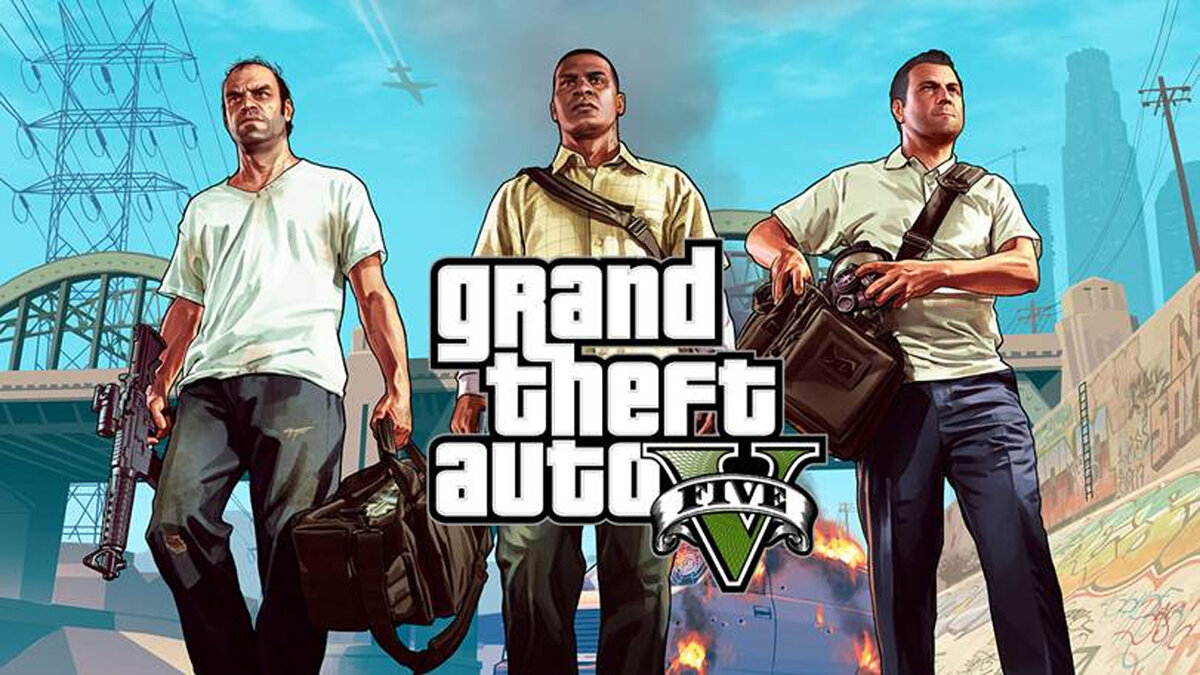
Grand Theft Auto 5 is an action-adventure video game developed by Rockstar North and published by Rockstar Games. It was released in September 2013 for PlayStation 3 and Xbox 360, in November 2014 for PlayStation 4 and Xbox One, and in April 2015 for Microsoft Windows. It is the first main entry in the Grand Theft Auto series since 2008's Grand Theft Auto IV. Set within the fictional state of San Andreas, based on Southern California, the single-player story follows three criminals and their efforts to commit heists while under pressure from a government agency. The open world design lets players freely roam San Andreas' open countryside and the fictional city of Los Santos, based on Los Angeles.
The game is played from either a third-person or first-person perspective and its world is navigated on foot or by vehicle. Players control the three lead protagonists throughout single-player and switch between them both during and outside missions. The story is centred on the heist sequences, and many missions involve shooting and driving gameplay. A "wanted" system governs the aggression of law enforcement response to players who commit crimes. Grand Theft Auto Online, the game's online multiplayer mode, lets up to 30 players engage in a variety of different cooperative and competitive game modes.
The game's development began soon after Grand Theft Auto IV's release and was shared between many of Rockstar's studios worldwide. The development team drew influence from many of their previous projects such as Red Dead Redemption and Max Payne 3 and designed the game around three lead protagonists to innovate on the core structure of its predecessors. Much of the development work constituted the open world's creation, and several team members conducted field research around California to capture footage for the design team. The game's soundtrack features an original score composed by a team of producers who collaborated over several years.
Extensively marketed and widely anticipated, the game broke industry sales records and became the fastest-selling entertainment product in history, earning $800 million in its first day and $1 billion in its first three days. It received widespread critical acclaim, with praise directed at its multiple protagonist design, open world, presentation and gameplay. However, it caused controversies related to its depiction of violence and women. Considered one of seventh and eighth generation console gaming's most significant titles and among the best video games ever made, it won year-end accolades including Game of the Year awards from several gaming publications. It is the third best-selling video game of all time with over 110 million copies shipped and one of the most financially successful entertainment products of all time, with about $6 billion in worldwide revenue.
Gameplay
Grand Theft Auto V is an action-adventure game played from either a third-person or first-person perspective. Players complete missions—linear scenarios with set objectives—to progress through the story. Outside of the missions, players may freely roam the open world. Composed of the San Andreas open countryside area, including the fictional Blaine County, and the fictional city of Los Santos, the world is much larger in area than earlier entries in the series. It may be fully explored after the game's beginning without restriction, although story progress unlocks more gameplay content.
Players may take cover behind objects during firefights to avoid taking damage from enemies.
Players use melee attacks, firearms and explosives to fight enemies, and may run, jump, swim or use vehicles to navigate the world. To accommodate the map's size, the game introduces vehicle types absent in its predecessor Grand Theft Auto IV, such as fixed-wing aircraft. In combat, auto-aim and a cover system may be used as assistance against enemies. Should players take damage, their health meter will gradually regenerate to its halfway point. Players respawn at hospitals when their health depletes. If players commit crimes, law enforcement agencies may respond as indicated by a "wanted" meter in the head-up display (HUD). Stars displayed on the meter indicate the current wanted level (for example, at the maximum five-star level, police helicopters and SWAT teams swarm to lethally dispatch players). Law enforcement officers will search for players who leave the wanted vicinity. The meter enters a cool-down mode and eventually recedes when players are hidden from the officers' line of sight that displays on the mini-map.
The single-player mode lets players control three characters: Michael De Santa, Trevor Philips and Franklin Clinton—criminals whose stories interconnect as they complete missions. Some missions are completed with only one character and others feature two or three. Outside the missions, players may switch between characters at will by a directional compass on the HUD. The game may switch characters automatically during missions to complete certain objectives. A character's compass avatar will flash red if he is in danger and needs help, and flash white if he has a strategic advantage. Though players complete missions as any of the three protagonists, the more difficult heist missions require aid from AI-controlled accomplices with unique skill sets like computer hacking and driving. If an accomplice survives a successful heist, they take a cut from the cash reward and may be available for later missions with improvements to their unique skills. Some heists afford multiple strategies; in a holdup mission, players may either stealthily subdue civilians with an incapacitating agent or conspicuously storm the venue with guns drawn.
Each character has a set of eight skills that represent their ability in certain areas such as shooting and driving. Though skills improve through play, each character has a skill with expertise by default (e.g. Trevor's flying skill). The eighth "special" skill determines the effectiveness in performing an ability that is unique to each respective character. Michael enters bullet time in combat, Franklin slows down time while driving, and Trevor deals twice as much damage to enemies while taking half as much in combat. A meter on each character's HUD depletes when an ability is being used and regenerates when players perform skilful actions (for example, drifting in vehicles as Franklin or performing headshots as Michael).
While free roaming the game world, players may engage in context-specific activities such as scuba diving and BASE jumping. Each character has a smartphone for contacting friends, starting activities and accessing an in-game Internet. The Internet lets players trade in stocks via a stock market. Players may purchase properties such as garages and businesses, upgrade the weapons and vehicles in each character's arsenal. Players may also visit places such as cinemas and strip clubs. Player can also customise their appearance by purchasing outfits, haircuts and tattoos.
Plot
Michael Townley, Trevor Philips, and Brad Snider partake in a botched robbery in Ludendorff, North Yankton. Nine years later, Michael is living under witness protection with his family in Los Santos, under the alias Michael De Santa. Across town, gangbanger Franklin Clinton is working for a corrupt Armenian car salesman and meets Michael while attempting to fraudulently repossess his son's car; the two later become friends. When Michael finds his wife Amanda sleeping with her tennis coach, he and Franklin chase the coach to a mansion, which Michael destroys in anger. The owner turns out to be the girlfriend of Martin Madrazo, a Mexican drug lord who demands compensation to avoid further violence. Michael returns to a life of crime to obtain the money, enlisting Franklin as an accomplice. With the help of Michael's old friend Lester Crest, a disabled hacker, they perform a jewellery shop heist to pay off the debt. Trevor, who now lives in a trailer park on the outskirts of Los Santos, hears of the heist and realises that it was Michael's handiwork; Trevor had believed that Michael was killed in their botched robbery nine years ago. Trevor surprises Michael and reunites with him, after tracking down his home.
As time goes on, the personal lives of the protagonists begin to spiral out of control. Michael's increasingly erratic behaviour prompts his family to leave him. When he becomes a movie producer at film studio Richards Majestic, Michael comes into conflict with Devin Weston, a self-made billionaire venture capitalist and corporate raider, who vows revenge after his attempts to shut down the studio are thwarted by him. Franklin, meanwhile, rescues his friend Lamar Davis from gangster and former friend Harold "Stretch" Joseph, who repeatedly attempts to kill Lamar to prove himself to his new brethren. At the same time, Trevor's reckless efforts to consolidate his control over various black markets in Blaine County see him waging war against The Lost outlaw motorcycle club, several Latin American street gangs, rival meth dealers, hillbillies, private security firm Merryweather, and Triad kingpin Wei Cheng.
Federal Investigation Bureau (FIB) agents Dave Norton and Steve Haines contact Michael and demand that he perform a series of operations to undermine a rival agency, the International Affairs Agency (IAA). Under Steve's direction and with Lester's help, they attack an armoured convoy carrying funds intended for the IAA, and steal an experimental chemical weapon from an IAA-controlled lab. As Steve comes under increasing scrutiny, he forces Michael and Franklin to erase any evidence being used against him from the FIB servers. Michael takes the opportunity to wipe the data on his own activities, destroying Steve's leverage over him.
Eventually, Michael, Trevor, Franklin, and Lester start planning their most daring feat ever: raiding the Union Depository's gold bullion reserve. By this time, Michael reconciles with his family. However, Trevor discovers that Brad was not imprisoned as led to believe, but killed during the Ludendorff heist and buried in the grave marked for Michael. Trevor's feelings of betrayal cause friction within the group and threaten to undermine their Union Depository plans. When Michael and Dave are betrayed by Steve and become caught in a Mexican standoff between the FIB, IAA, and Merryweather, Trevor, feeling that he is the only one that has the right to kill Michael, comes to their aid. Despite not forgiving Michael, Trevor agrees to perform the Union Depository heist and part ways with him afterwards.
The heist is completed successfully, but Franklin is then approached separately by Steve and Dave, who contend that Trevor is a liability, and Devin, who wants retribution for Michael's betrayal. Franklin has three choices: kill Trevor, kill Michael, or attempt to save both in a suicide mission. Should Franklin choose to kill either Michael or Trevor, he ceases contact with the man he spares and returns to his old life. Otherwise, the trio withstands an onslaught from the FIB and Merryweather before going on to kill Steve, Stretch, Wei, and Devin. Michael and Trevor reconcile, and the three cease working together but remain friends.
Crysis 3 is a first-person shooter video game developed by Crytek and published in 2013 by Electronic Arts for Microsoft Windows, PlayStation 3, and Xbox 360. It is the third main installment of the Crysis series, a sequel to the 2011 video game Crysis 2. The multiplayer portion of the game was developed by Crytek UK. Crysis 3's story revolves around Prophet, a Nanosuit holder who is on a quest to take revenge on the Alpha Ceph, the leader of the Ceph alien race. The game's story serves as the end of the Crysis trilogy. Gameplay revolves around the use of the Nanosuit, which grants players a variety of abilities such as being invisible. New features introduced in Crysis 3 include a new Nanosuit ability called "Rip & Throw", a compound bow and the "hacking" feature, which allows players to hack into enemies' equipment, drones, and security defenses.
The game is set in a post-apocalyptic New York City, in an effort to combine the urban landscape of Crysis 2 and the forest setting of the original Crysis. The game introduces the "Seven Wonders", with each wonder having its own unique landscape and tactical layout. Due to complaints about Crysis 2's linearity, the game's levels were opened up so as to grant players more freedom. The development team also put efforts into creating a more emotional story, and the story's protagonist was inspired by the lead character of District 9. The game was developed by a team of 100 people during its 23-month development cycle. Crytek UK developed the game's multiplayer portion.
Officially announced in April 2012, Crysis 3 received positive reviews upon release. Praise was directed at the weapon selection and customization, menus, visuals and multiplayer, while it was criticized for its story, level design, length, and outdated mechanics in comparison to its predecessors. With a budget of $66 million, the game sold 205,000 copies in its debut month, and became a commercial failure for Electronic Arts. The game was later included in The Crysis Trilogy, a bundle released in February 2014.
Gameplay
A gameplay screenshot of the game. The screenshot shows Prophet using his compound bow, which is one of the new weapons introduced in Crysis 3.
Similar to the earlier games in the Crysis series, Crysis 3 is a first-person shooter. Players take control of Prophet as he progresses through New York City to defeat the Ceph, a technologically advanced alien race. Throughout the game, players can slide, sprint, jump and crouch. When encountering enemies, players can defeat them by using guns or a compound bow, utilizing explosives like grenades and C4, or by performing a melee attack. Performing certain movements takes up energy from the Nanosuit, the armor worn by Prophet. Some abilities are not available for players to perform or utilize if the Nanosuit's energy is too low; they must wait until energy is refilled. As a result, players are tasked to manage the use of the energy. The game's artificial intelligence was updated allowing enemies to react more quickly to players' attacks. Enemies can take cover when attacked, and can employ strategy to assist and support each other against attacks.
The Nanosuit allows players to identify the threat level, and the weapons held by enemies. Players can tag enemies and items by enabling visor, and can spot enemies using Nano-Vision, which detects the heat of both enemies and allies. Levels are more open-ended than in Crysis 2. Players are given more freedom, and can choose a gameplay style based on direct confrontation, or a more discreet and stealthy approach, in order to deal with enemies and to complete their objectives. There is no definite way to beat the game's seven levels. Instead, players can take different alternate routes to reach their objectives.
Players can fight against enemies utilizing a wide array of gadgets and weapons, and by using the abilities granted by the Nanosuit. They can utilize an invisibility cloak to evade enemies, prevent themselves from being detected, or to perform silent takedowns. The nanosuit also has an armor mode, which reduces the amount of damage taken, in exchange for slower movement speed. New weapons are introduced in Crysis 3, such as a compound bow. Players can use the bow while in cloak mode. When using other firearms, the cloak is disrupted and can no longer function until it cools down. Arrows can be collected by players after use. Players can hack into enemies' technology, one of the game's new features. In addition, players can hack security codes, weapon boxes, Ceph technology, mines, lasers, and sentry turrets, which can all be used to fight against enemies. Players can also upgrade and customize their weapons and the Nanosuit. They can change the attachment and ammo types for their weapons. For instance, players can change between explosive arrows and electric arrows for their bow.The Nanosuit can be upgraded by collecting different suit upgrade modules scattered across the world. These upgrades can increase the suit's properties, and strengthen or unlock new abilities for players as they progress through the game.
Mass Effect: Andromeda is an action role-playing video game developed by BioWare and published by Electronic Arts. The fourth major entry in the Mass Effect series, it was originally released in March 2017 for Microsoft Windows, PlayStation 4, and Xbox One. The game is set in the Milky Way Galaxy during the 22nd century, where humanity is planning to populate new home worlds in the Andromeda Galaxy as part of a strategy called the Andromeda Initiative. The player assumes the role of either Scott or Sara Ryder, an inexperienced military recruit who joins the Initiative and wakes up in Andromeda following a 634-year journey. Events transpire that result in Ryder becoming humanity's Pathfinder, tasked with finding a new home world for humanity while also dealing with an antagonistic alien race known as the Kett, and uncovering the secrets of a mysterious synthetic race known as the Remnant.
For Mass Effect: Andromeda, BioWare incorporated a lighter tone than previous installments in the series, utilized open world elements, and placed an emphasis on exploration. Many of the series' traditional gameplay elements remained, while others were modified, such as combat, which is less cover-based and more mobile. The game is the largest in the series, and offers the player the freedom to focus on either the main quest or side quests. Its score was composed by John Paesano and aims to match the game's mood by capturing the adventure of space exploration.
In contrast to the original Mass Effect trilogy, which was spearheaded by BioWare's Edmonton studio, Mass Effect: Andromeda was handled by a new team out of Montreal. The game experienced a troubled production cycle that saw many members of its leadership team depart mid-project and numerous changes in creative vision. It was built using the Frostbite 3 engine, which required that BioWare construct all systems, tools, and assets from scratch as the series was previously built in Unreal Engine 3. Following the game's release, BioWare released several patches in response to critical feedback, but decided not to release further single-player downloadable content additions.
Mass Effect: Andromeda was announced in June 2015 and immediately became a highly anticipated game. Upon release, it received generally mixed reviews from critics, who praised the game's improved combat and visuals while criticizing its character animations and technical issues. As of September 2017, the game has shipped over two million copies worldwide.
Gameplay
Mass Effect: Andromeda is an action role-playing game in which the player takes control of either Scott or Sara Ryder from a third-person perspective. Both Ryders' appearances and first names can be determined by the player. The appearance of their father, Alec, is automatically adjusted based on the appearance of the Ryder twins. Upon beating the game, a New Game+ is unlocked, which allows the player to restart the game with certain bonuses and switch to playing as the other Ryder, if desired. Players can also choose to continue playing with their existing character and complete unfinished missions.
Unlike previous installments in the Mass Effect series, where players begin each new game by choosing from six different character classes that each have their own unique set of skills, players instead have free rein to assign any skills that they want and build towards a specialty over the course of the game. For example, if the player chooses to invest solely in biotic skills, Ryder will unlock the Adept profile, which results in bonuses related to that play style. Experience points are earned by completing missions, and there is no cap on the number of points that can be earned. Once enough points are gained, Ryder levels up, which allows for the unlocking and upgrading of skills along a tree. Points assigned to each skill can be constantly reallocated so that players can experiment with multiple gameplay approaches without having to restart their games and build up their skills from scratch again.
Similar to its predecessors, the player can interact with characters in Mass Effect: Andromeda using a radial command menu where the player's dialogue options depend on wheel direction. Around the wheel are four types of responses that shape each conversation: emotional, logical, professional, and casual. In general, conversations are based on agreeing or disagreeing with participants. During some conversations, the player is prompted with an "Impulse Action" that offers an additional choice to what is available on the dialogue wheel. For example, an on-screen prompt to "shoot" might appear and be momentarily selectable. By conversing with non-player characters, Ryder can develop friendships and, in some cases, romantic relationships with them over time. During both dialogue and quest sequences, the player is sometimes tasked with making moral decisions that do not have a clear good/bad distinction but are intended to be more nuanced, marking a departure from the Paragon/Renegade morality system of prior titles in the series.