В сегодняшней публикации мы поговорим о планировании проекта от целеполагания до дизайна плана проекта.
Project planning
It is critical to allocate reasonable amount of time in order to plan your project well.
The first step in any project should be goal setting. There are several key frameworks that you can use when elaborating your goals.
Goal pyramid and goal root
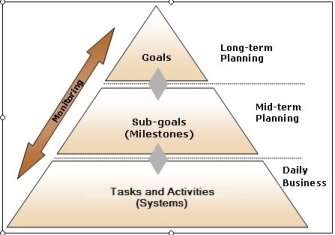
First, of all it is important to structure your ideas when discussing goals for the project in hierarchical way. The goal pyramid helps frame goals, sub-goals as well as tasks and activities. Important to mention, at the level of sub-goals, one should have fixed number of milestones (with specific deadlines) that will help you monitor the dynamics of your project.
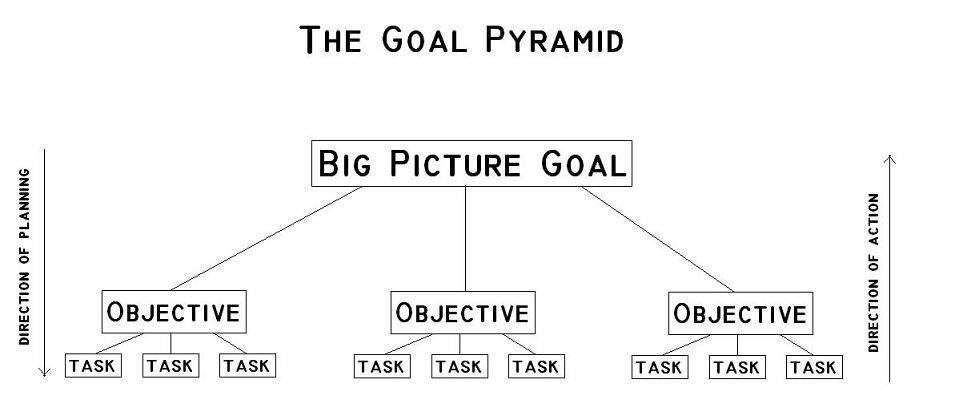
Another way of presenting this framework is by visualizing goals it in the shape of a root – so called ‘goal root’. This framework is useful because it helps to plan top down and then plan your actions bottom up.
When working on a big long lasting project, often internal (not for clients), you will benefit from having additional two layers on top of the goal pyramid – mission and vision. Mission is where we are going in terms of this project and how it fits to the overall company strategy. Vision is how we do it. It is crucial not to forget these two layers in cases when a project team is engaged in a project long enough to start questioning, “Why are we actually doing it? How can it contribute to the firm? Is it an important project?”. By clearly stating mission and vision, you can boost your team morale and motivation and improve sense of importance.
SMART Principle
Second, your goals must comply with a set of criteria and be specific (S), measurable (M), achievable (A), realistic (R), time limited (T). Sometimes, “ER” also complements this model – evaluate (E), reverse (R) meaning that you should revise and adjust goals in some while working on the project.
Task setting
Project team should pay special attention to working through the bottom layer of the pyramid. When setting task, it is critical to consider available resources (people, systems, equipment, other necessary items) as well as plan desired profit (if it is a client project).
Tasks should be very specific. At this level you should have deadlines, volumes, KPI’s and other characteristics that will enable you to measure the results. Try to be realistic and chose moderate scenarios. There is a good saying illustrating this idea - “Underpromise. Overdeliver.”
Identification of underlying issues and potential opportunities
Finally, when setting goals, you must think of potential underlying issues that can hold you from reaching your goals as well as of potential opportunities that you should try realize in order to improve probability of finalizing your project.
One of the frameworks for this is classic SWOT (Strengths, Weaknesses, Opportunities and Threats) analysis.
· Strengths – internal positive factors (e.g. competencies of your team, relevant expertise, access to data, etc.)
· Weaknesses – internal negative factors (e.g. lack of time resource, lack of expertise, etc.)
· Opportunities – external positive factors (friendly supportive client, a lot of relevant data that the client may provide, etc.)
· Threats – external negative factors (e.g. low motivation of the clients, competing company pitching for the same opportunity, etc.)
You should draw a table with four cells and add all the possible strengths, weaknesses, opportunities as well as threats on a list. This will enable you to control your project better and be prepared for force-majeure.
Thus, for each group of negative factors you need to think of concrete actions how to mitigate impact or decrease probability. On the contrary, for each group of positive factors there should be to-do’s how to increase probability or take advantage of them while working on the project.
Assuming alternative scenarios
After having conducted SWOT analysis, you should plan some time for discussing alternative scenarios. Very often, there is high uncertainty in projects. Thus, things may not go the way they were planned. When thinking of your goals and tasks, you need to consider this and brainstorm on potential alternative ways of reaching the final goal. You can even think of a different goal if one of the scenarios implies that you have set a wrong goal.
Project plan. Waterfall and Gantt chart
Next step after designing goal pyramid, breaking it down to tasks, SWOT analysis as well as consideration of alternative scenarios should be drafting a project plan.
There are many approaches in project management how to plan a project. However, the most commonly accepted in consulting is PMBOK approach. It is closely related to waterfall methodology.
Waterfall is a linear, sequential process of project management. You can only start phase two after you have finished phase one. Completion of each phase is terminal, thus you can’t go back to a previous phase. The illustration demonstrates waterfall project plan for a case of software development.
One of the useful tools, when managing a project in this paradigm is a Gantt chart. It enables a project team and a client to have a graphic illustration of a schedule. All the key streams, deadlines as well as deliverables are clearly visible.
The detalisation of a Gantt chart for internal use and for client presentation is often different. If for internal usage project teams make total decomposition of projects tasks and created large A3 format documents, the client would only benefit from seeing the big picture with the key streams and milestones (one slide, A4 format).
However, having only a chart is not enough for effective project management. A project team must prepare a comprehensive document called project plan in order to track progress and manage work. I will define a separate newsletter to designing a project plan because it can also be a very tricky task. For the moment, I am going to share the key principles for the project plan:
· Excel or PM tool. It is convenient to use either Excel or other project management software because it enables to structure information in a format of a table as well as to program status and dependencies monitoring.
· Key deliverables and milestones. You should structure/visualize your plan the way so that it is clear what are the key deliverables and milestones. It shouldn’t be just a list of lines with tasks.
· Deadlines. The project plan should clearly reflect the key deadlines.
· Total decomposition. When designing your project plan, it is better to break down your tasks to the smallest bits of work, especially if your project team is not experienced enough. It will help you have better control over the project execution.
· Responsible team members. Each task in your project plan should have a responsible person. Sometimes it is worth to use RACI model and add those who are responsible (who does the task) and those who are accountable (often manager who is then accountable for the result)
Further reading:
· Project management templates
· Project management templates with informal design