My project is about a new rapid diagnostic method for detecting free-radical pathologies.
The free-radical pathologies including cardiovascular diseases, diabetes and cancer were the leading causes of population mortality in 2014 according to the World Health Organization data.
The level of DNA damage in individual cells can be used as free-radical pathologies indicator. It can be numerically measured as the diffusion of the tail of a comet after single cell electrophoresis. The method is known as comet assay.
Now, this method is limited to fundamental medical research, because of the risk and difficulties in applying gamma radiation. Thus, its wide use in clinical diagnostics is limited by necessity of hi-tech equipment such as gamma radiation sources, availability of specially equipped premises, skilled personnel and advanced protocol of operations with radioactive isotopes. The aim of our project is to find an alternative technology of induced DNA damage which excludes using of radioactive source but gives the same result. This will enable wide application of Comet assay method in clinical screening programs to detect risk groups with free radical pathologies.
Our hypothesis is that ozone can be used as an inductor of DNA damage for Comet assay thus replacing gamma radiation sources.
The goals of our work are:
1) To assess the possibility of using ozone for DNA damage.
2) To evaluate the possibility of new Comet assay application in screening programs to detect risk group with FRP.
During the experiment we used venous blood samples from 8 white healthy non-linear male rats and 16 white non-linear rats which had experimental tumors. The 4 slides were made of each blood sample. One of them was not exposed to ozone. Other three were incubated with 50 ml phosphate buffer solution for 5 minutes.
Preliminary phosphate buffer is barbotaged with ozone-oxygen mix for 10 minutes. The following ozone concentrations were used: 200, 400, 900 μg/l. The 50 “comets” in each slide were analyzed which means that 5000 “comets” were processed.
There are seven stages of our Comet Assay:
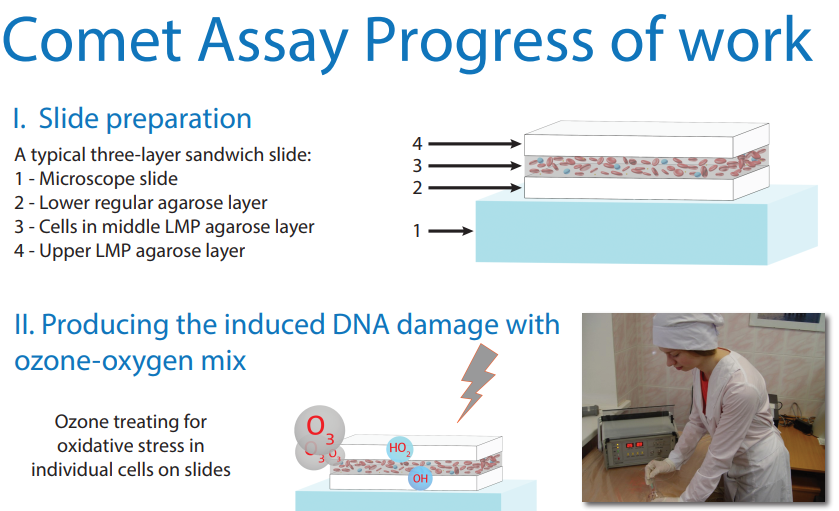
1) Preparation of slides with cells immobilized in agarose;
2) Ozone treating for oxidative stress in individual cells on slides and DNA repair;
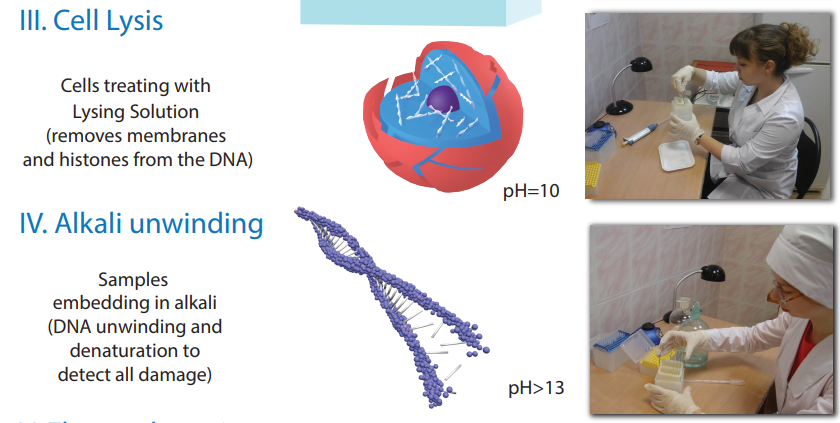
3) Cell lysis;
4) Alkaline unwinding of DNA;
5) Gel Electrophoresis;
6) DNA staining with fluorescent dye (SYBR GREEN I) and “comets” visualization;
7) Analysis of results.
Last step was carried out by means of special software giving us 4 indexes for each image. We found that the most informative one is TDNA% which is the percentage of DNA in a comet’s tail. The results were processed by methods of descriptive statistics.
Data analysis shows that the level of diffusion of DNA comet tails caused by ozone at 900 μg/l for 10 minutes is about 12 % which is comparable with the level of diffusion of DNA comet tails caused by gamma rays of Co-60 at a dose of 3Gy.
Cholangioma PC1 primary tumor strain was transplanted to rats. Experimental data show that the level of diffusion of DNA comet tails of blood cells in animals with advanced tumor is thrice higher that at an early stage of a tumor growth. This proves the thesis that free-radical pathologies level increases with the tumor progress.
Thus, we have reached the following conclusions. We developed a new method of creating DNA damage for comet tests allowing its wide implementation in screening programs to detect risk groups with FRP. Rapid procedure and simplified requirements to the equipment and personnel allow using this method in local hospitals to analyze millions of samples per year.