Thailand's unprecedented revolt pits the people against the King
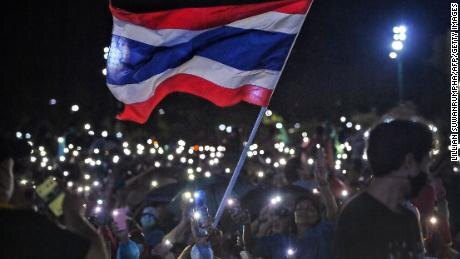
An anti-government protester waves Thailand's national flag as they take part in a pro-democracy rally in Bangkok on September 19, 2020.
Bangkok, Thailand (CNN)Set apart from the frenetic bustle of one of Asia's largest cities and nestled amid the manicured gardens of Bangkok's Dusit Palace, the Amphorn Sathan Residential Hall has served as the official home of Thailand's monarch for more than a century. Its name translates to "royal seat in the sky" but the European-style residence is known as the Ambara Villa.
The royal mansion is where Thailand's King Maha Vajiralongkorn was born and it's where, as Crown Prince, he accepted the formal invitation to the crown in 2016 following the death of his father, King Bhumibol Adulyadej, which was four years ago on Tuesday.
Vajiralongkorn -- who spends much of his time overseas -- returned to Thailand this week for a host of royal duties.
The King's scheduled stay won't just be a run-of-the-mill royal engagement, however. In recent months, the idea of a sacrosanct monarchy and a King shielded from public scrutiny has been torn apart by a new generation of young Thais, who are openly challenging the powerful institution.
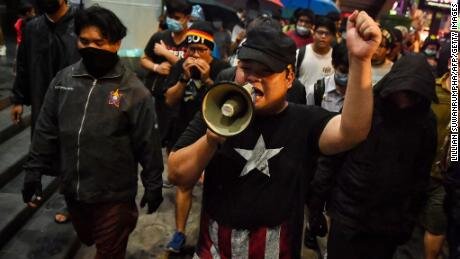
Pro-democracy activist Parit "Penguin" Chiwarak walks with others towards the police headquarters in Bangkok on October 13, 2020.
On Tuesday, scuffles broke out between anti-monarchy protesters and police at Bangkok's Democracy Monument, which has been a meeting place during months of protests. Police said 21 people were arrested.
Demonstrators had partially blocked the road near the monument and set up a barricade, which police attempted to remove.
Later, Vajiralongkorn's convoy drove past protesters for the first time. Demonstrators chanted "release our friends" and held up the three finger salute from the Hunger Games movies -- a popular symbol of the protests.
Deputy Police spokesman, Police Colonel Kissana Phathanacharoen, confirmed that demonstrators had been arrested for holding a protest without permission and detained for violating the "Public Assembly Act."
Protesters plan to gather at the monument and march to the Prime Minister's office on Wednesday and camp out there. If they go ahead they could face confrontation from pro-monarchy groups who have planned counter protests.
Experts say this week could be a watershed moment for the ongoing protest movement, which is calling for a new constitution, the dissolution of parliament and resignation of Prime Minister Prayut Chan-o-cha, as well as an end of intimidation of government critics. Many are also calling for a true constitutional monarchy under a democratic system.
Protest leaders expect a large turnout Wednesday but there are questions over whether they are pushing too hard for reform of the monarchy, and whether people will come out onto the streets during a sensitive time and October downpours. The King is in town, it was the late King's memorial day, and Wednesday marks the anniversary of the 1973 mass uprising against military dictatorship
Thailand's King Maha Vajiralongkorn lights candles as he takes part in a Buddhist ceremony to mark the 2020 Kathina festival at Wat Ratchabophit in Bangkok on October 10, 2020.
"I expect that the government would control this protest very hard," said Punchada Sirivunnabood, associate professor of politics at Mahidol University's Faculty of Social Sciences and Humanities.
Those calling for monarchical reform are risking lengthy prison sentences. Thai citizens are expected to revere the monarch without question and criticizing the King, Queen or heir apparent, is punishable by some of the world's strictest lese mejeste laws.
But those taboos are being broken. What began as anti-government student-led rallies in cities across the country, has since grown into a movement attracting a large cross-section of society. An August 16 protest in Bangkok attracted an estimated 10,000 people and in mid-September thousands came out once again, with protesters laying a plaque near the Grand Palace that read, "Here, the people declare that this place belongs to the people, not the King."
"It is now or never. The root cause of political problems stemmed from this institution, we couldn't just dance around and ignore it anymore more," said Panusaya Sithijirawattanakul, a 21-year-old student who has become a central figure of the new student movement. "Otherwise we are going to end up in the same vicious political cycle again. Coups after coups with endorsement from the King."
Protest leader Panusaya "Rung" Sithijirawattanakul (C) makes the three-fingered Hunger Games salute during a pro-democracy rally in Bangkok on September 20, 2020.
A direct challenge
It was a hot August night when Panusaya, who is known by the nickname Rung, first got up on stage and delivered a 10-point list of demands for reform to the monarchy.
The demands included the King being answerable to the constitution, revoking the laws against defaming the monarchy, a new constitution, abolishing royal offices, ousting the military-led government and disbanding the King's royal guards.
"I almost collapsed many times while reading the statement. I couldn't feel my feet and my hands," she told CNN. "I was afraid about the reaction of the crowd on that night."
But the crowds did not leave. Panusaya had struck a nerve.
Though absolute monarchy rule ended in 1932, Thailand's King still wields considerable political influence. The image of former King Bhumibol was carefully cultivated to present him as a stable father figure who ruled by Buddhist principles throughout decades of political turbulence, and who worked to improve the lives of ordinary Thais with great moral authority.
Panusaya Sithijirawattanakul reads a list of demands including the abolition of the kingdom's draconian royal defamation law during a pro-democracy rally at Thammasat University on August 10, 2020
Thailand's unprecedented revolt pits the people against the King
By Helen Regan and Kocha Olarn, CNNUpdated 0334 GMT (1134 HKT) October 14, 2020
Demonstrators hold portraits of Thailand's King Maha Vajiralongkorn and his late father king Bhumibol Adulyadej during a pro-government and pro-monarchy rally in Bangkok on July 30, 2020.
Last week, Germany's foreign minister said in parliament that Vajiralongkorn should not be conducting politics from the European country.
While Thailand has had success in containing its coronavirus outbreak, the economic impacts have been severe. Protesters, who say the flailing economy offers them little job prospects, have begun to scrutinize the King's immense wealth and power.
Vajiralongkorn has consolidated his power by expanding his own appointed military unit, the King's Guard. He has also vastly increased his personal wealth -- amending the Crown Property Act allowed billions of dollars worth of royal assets held by the Thai Crown to transfer directly into his control, and shares at various Thai conglomerates -- including the Siam Cement Public Company and the Siam Commercial Bank Public Company -- were put into the King's name. The royal budget has also significantly increased.
"He has become the most powerful King, in terms of official power, since 1932," said Pavin Chachavalpongpun, Associate Professor at Kyoto University's Center for Southeast Asian Studies. "Even though his father had immense power, he exercised that power mostly through proxies. What makes (Vajirilongkorn) more powerful is because he exercises his power through himself."
Wider reforms
Reform of the monarchy has become an increasingly central demand but the protests are a rallying point for greater democratic freedoms, including LGBTQ and women's rights, as well as education and economic reform.
Activists say they are fed up with injustices such as the military's continued hold on power through the constitution, the prolonged coronavirus state of emergency -- which they say is being used to stifle political opposition and free speech -- and the disappearance of democracy activists living in exile.
Even high school students have joined the protests, refusing to stand for the national anthem in schools and raising the three finger salute.
Mahidol University's Punchada said it's significant the younger generation are loudly pushing for change as "they don't see their future."
"We've not seen this for 40 years," she said. "They want a say in what's going on in their lives."
Students make the three-fingered salute at Samsen school to demand for less strict school rules, more tolerance and respect during a protest in Bangkok on October 2, 2020.
Thailand's unprecedented revolt pits the people against the King
By Helen Regan and Kocha Olarn, CNNUpdated 0334 GMT (1134 HKT) October 14, 2020
Thailand's monarchy was long considered God-like. But protesters say it's time for change
For Panusaya, a third year student studying sociology and anthropology at Thammasat University, she's still wrapping her head around her new-found notoriety.
"Last year, attention barely shone on me or on our activities. And now, I have become the symbol of this movement," she said.
Her family support her activism, for now, Panusaya said. "My father is so concerned about me. My parents are supporting my decision, but they are worried about my safety."
But Panusaya's protests have attracted worrying attention from authorities and she knows speaking publicly about the monarchy could be dangerous.
"Yes, they have put people in front of my dormitory. I have been followed by unidentified cars or motorcycles," she said.
The Thai Lawyers for Human Rights reported that 62 people have been arrested over the course of three months of protests, with some facing charges of sedition.
Panusaya said she fully acknowledges what can happen if she continues her demands but said the push for reform is too important.
"I know all the possibilities and troubles that could land on me, including my own life," she said. "We are aiming to spread this monarchy reform ideology as far as we can. The demands will remain at this moment."