Today we're starting the advanced block of the blog which is going to be the same thing but the rules will be explained only in English. So we're starting with a pretty simple topic, but the concept behind the topic is a rather high level.
If you're reading this I assume you have learned the basic tenses and you're familiar with the idea behind Present Simple and Present Continuous, along with Present Perfect and Present Perfect Continuous.
English has an interesting concept - state and action verbs. What's that exactly? I mean, aren't all verbs tell us about some action? Well yes, but no. Let's find out what is this rule about.
State verbs
There are verbs in English which show so called 'state matter of things'. They're verbs that describe things that are not subject to a change, such as feelings, thoughts, and so on.
I have a car
I prefer blue colors
Action verbs
On the other hand, action verbs are very much a subject to change, they represent actions in motion.
I eat lunch
They make coffee
Why do I need to know this?
The most important thing to understand here is that state verbs cannot be transformed to Present Continuous and Present Perfect Continuous tenses, because of their state nature. So even when you need Continuous tense to upper, you're going to use Simple and Perfect counterpart.
I have lived here (have been living here) for 10 years
I have (am having) a car now
'Now' and 'for 10 years' suppose to be the indicators of continuous tenses, but state verb rule makes it impossible to use them.
Irregular forms
Of course, it would not be a rule of the English language without some irregularities, oddities, and shenanigans. There are a couple of ways to use state verbs in continuous anyway if you really want to.
The first one is connected with the plane change of meaning of the verb, the best example here is 'have'.
I have a car - state
I'm having a dinner - have = eat - action
So when a verb changes the meaning different rules kick in, state or action is all about the meaning, not a verb itself.
The second way to call state verbs to action is using them as a short term states.
I live with my family - state
I'm living with my family for the next month - action
The second sentence tells the story of a temporary condition, which will be over soon.
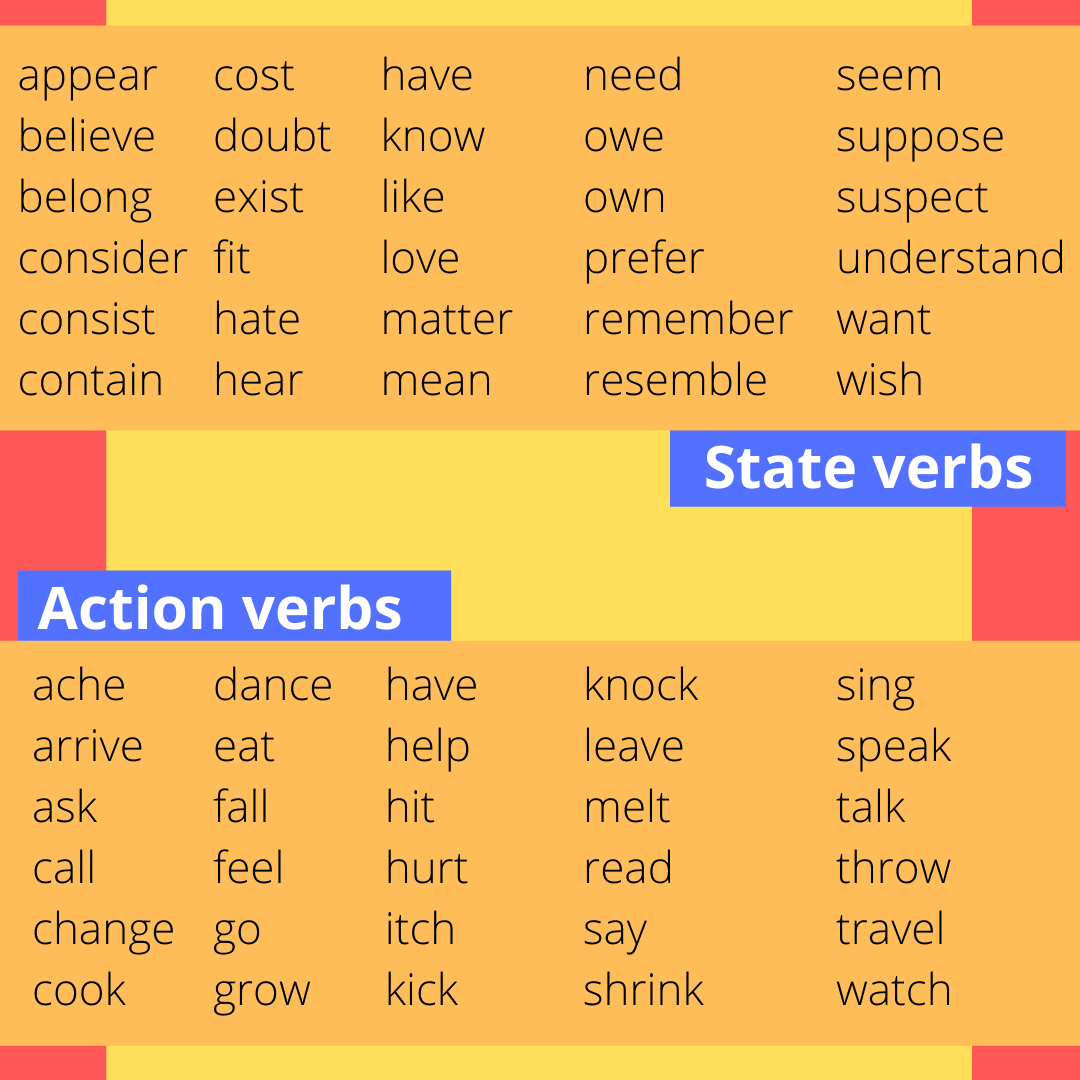
Examples of verbs
The End
If you want to ask an English teacher about anything send me a message!
Like and subscribe if you don't want to miss some interesting stuff. Have a nice day and learn English!