Read this article in Russian: Шесть шагов к пониманию любой культуры. На каком этапе находитесь вы?
The DMIS describes a developmental process of intercultural competence in humans. It is universal, as it does not depend on a concrete culture and could be applied anywhere. According to this model, a man can increase personal sensitivity of cultural differences going through six stages of perceptual organisation.

The first half of this way is ethnocentric, because there an individual has neutral or negative attitude towards other cultures and judges them in comparison to his own that is considered to be the only one right, pure, rational, etc. On these stages, we can see a clear picture of them/us distinction and even aggression towards other cultures or one's own. So a person undergoes: 1) denial of difference, 2) defence against differences, and 3) minimisation of difference. The second half of the DMIS is ethnorelative. From this point of view, cultural diversity is assessed as an opportunity to widen your knowledge about the world, to enrich your own worldview, and to feel free, living in the multicultural environment. On these stages, a person has enough intercultural competence not only to accept others, but also to integrate into different societies with their traditions, customs, and non-verbal language. The steps are following: 1) acceptance of difference, 2) adaptation to difference, and 3) integration of difference.
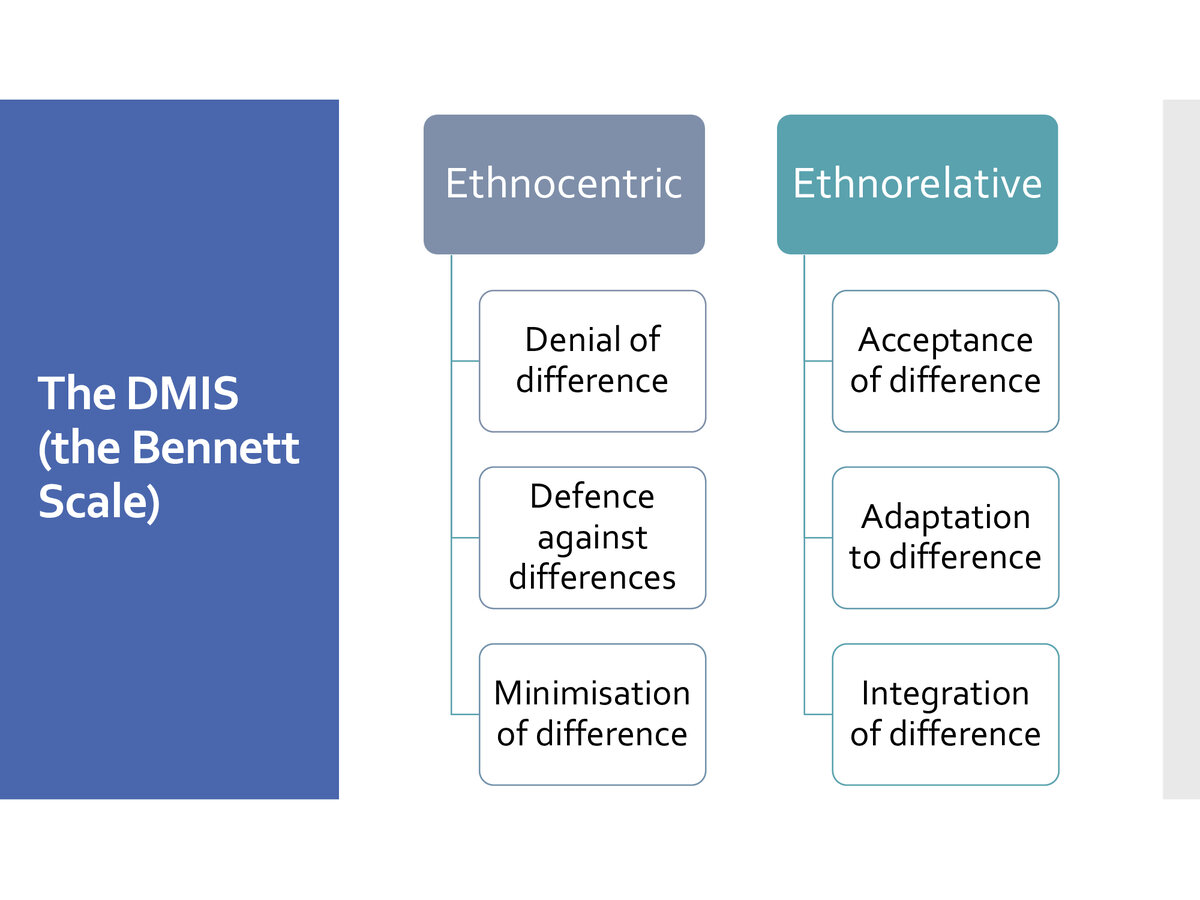
It was Milton Bennett, an American specialist at cross-cultural communication, who described the ways in which people can react to cultural differences, so another name of the DMIS is The Bennet Scale. Bennett revealed his ideas in 1993, in the article "Towards ethnorelativism: A developmental model of intercultural sensitivity". From then on, the DMIS is world-known and frequently applicable by teachers, psychologists, business coaches, and researches of cross-cultural communication.
A review of the Bennett Scale follows.
Denial of Difference
By this experience of cultures, an individual does not differ them and believes that cultural aspects do not affect his life at all. Such people are usually busy with their own everyday lives and are under physical or mental isolation from other cultures. A homogenous group has no opportunity or desire to contact with the others, so there is a lack of cross-cultural experience. An intentional separation worsens the situation. A person shows little tolerance, asking direct (and therefore, rude) questions about life in other cultures, and the goal is not to fulfil a knowledge gap, but to explicit one’s wonder. One could not experience a cultural shock because of being assured he fits in each nation, as all you have to do is to follow political and social laws.
Bennett recommends helping those people to define “culture”. It seems that they deny their own cultural environment too, so it is necessary to describe a culture through fine arts, traditional music, legends, famous personalities, history, etc. An educator have to show high support, referring to learner’s previous experience and may not focus on a concrete nation, but use symbols and abstract concepts. Thus, we build a positive vision of an intercultural communication.
Defence against Difference
This is a radical experience of culture. An individual prefers to polarise people belonging to his own culture and those who are not as “ours” and “aliens”. Therefore, the cultural difference is out of denial, but the way it is considered is not friendly at all. The central metric of the world’s diversity is one’s own culture. It is represented as the only one properly developed or the most convenient for the whole humanity. Questions about worldview may be interpreted as an attack on one’s values, so a person defends his principles and stresses his superior cultural status. What is more, one can judge a whole foreign nation by one representative he knows/is watching and this is the ground for further defamation. Remarkably, that there is another option of Defence experience. It usually occurs among people, who have spent long time abroad or outside the culture, they were born in. It goes about discrimination of one’s native culture. Another culture is assessed as superior and a person expresses desire to rewrite his own background according to his favourite culture.
As Bennett says, to increase intercultural competence of those people one should avoid discussion of the differences in cultures. Instead, an educator helps learners to match similar cultural aspects and cooperate with each other. Stating the same needs and goals leads learners to the idea of common humanity and equal civilisations. It is also recommended to note some historical events that left mark on the cultural world map, so that a learner better understands connection between nations.
Minimisation of Difference
This is the last ethnocentric stage of cultural competence development and that is why some people there feel tolerant, although it is not quite true. According to the Minimisation experience, the whole humanity has significantly greater value than particular cultures. People have same anatomical and psychological configuration, there are same universal values, and from the global point of view, our cultural characteristics do not play a great role. People from the Minimisation category believe that their intuition is enough to communicate effectively and if we were just ourselves, we would definitely see how similar humans are. The thing is that Minimisation of Difference is still based on one’s own worldview. An individual will probably interpret the same gesture across cultures as it could be interpreted in his own and so on. Those universal values are coming from his native culture, whether he admits it or not.
Bennett puts development of cultural self-awareness in the first place while solving this problem. The culture itself should be determined in a more particular way than it was before. An educator should mention such concepts as race, ethnicity, stereotypes, and generalisations. For this purpose, learners can demonstrate authentic cultural materials, think about privileged dominant groups, and contact with ethnorelative resource persons.
Acceptance of Difference
This is the first ethnorelative stage, and the main feature of it is consideration of cultural context. A person is quite tolerant to cultural patterns and alternative worldviews because it is not necessary to adopt foreign values or traditions to get better intercultural experience. It is just a mean to explore the world and increase your competence. There is an understanding of cultural differentiation as an essential humanity state. Besides, a person is ready to learn something new about other cultures and ethical principles, although one could not be sure how to apply this knowledge cross-culturally.
According to Bennett, on this stage an educator should include a values analysis to deepen cultural self-awareness of learners. They compare moral, ethical and cultural relativity. Moreover, learners are welcome to set simple experiments, such as role-plays, homestays, and simulations to improve intercultural empathy.
Adaptation to Difference
In a cross-cultural sense, this is an ability to reorganise one’s behavior depending on cultural context. The shift happens in a natural way, so that a person literally senses, when it is appropriate. Therewith one's values and cultural identity are not threatened. People begin to use different approaches when acting in the host culture and analyse cultural contexts, thus their intercultural empathy is well developed. Furthermore, the developed sensitivity of cultural differences becomes a part of one’s self-awareness, which is the first sign of biculturalism or multiculturalism.
On this stage, Bennett allows learners to practice behaviour in known cultures, as well as interact in unexplored cultural contexts. That stimulates development of cognitive and intuitive empathy and advances opportunities for cultural adaptation.
Integration of Difference
This is the result of cross-cultural competence development. The stage is characterised by flexible behaviour and unlimited perception of the world. The formation of a multicultural personality includes elements of different cultures, each of them can be taken as native. Besides, there is a marginal cultural identity, which meaning is as follows: home is everywhere. We can say that a person becomes fully competent in new cultures. It is not just a feeling of cultural contexts, but also generation of them. People from this group often call themselves mediators between cultures. They are able to build cultural bridges successfully. This state of intercultural competence is influenced by family background, current residence, and some other factors, so it is rarely represented in our society.
As the learners’ intercultural competence is already highly developed on this stage, Bennett recommends them to exchange experience in marginality and to suggest their own ideas or models of multicultural identity construction and ethical development.
The DMIS got its practical use in the Intercultural Development Inventory (IDI) made up by Bennett and Hammer. This test of 50 questions helps to appraise intercultural competence level and one’s attitude to cultural differences. It is widely used at schools, in a business sphere, and experimental cross-cultural researches.
By rhapsodie.inside