The international English language testing system (IELTS) is the world’s most popular English language proficiency test for higher education and global migration, with over 3 million tests taken in the last year.
IELTS assesses all of your English skills — reading, writing, listening and speaking, and is designed to reflect how you will use English at study, at work, and at play, in your new life abroad. For example, it is required for Private Hire driver licensees in London.
The IELTS test is developed by some of the world’s leading experts in language assessment. It has an excellent international reputation, and is accepted by over 10,000 organisations worldwide, including schools, universities, employers, immigration authorities and professional bodies.
IELTS is the most widely accepted English language test that uses a one-on-one speaking test to assess your English communication skills. This means that you are assessed by having a real-life conversation with a real person. This is the most effective and natural way of testing your English conversation skills.
2 types of IELTS test
You can take IELTS Academic or IELTS General Training – depending on the organisation you are applying to and your plans for the future.
Whatever your reason for taking IELTS, make the most of your language skills.
Academic IELTS certificate allows you to:
· study at university at undergraduate or postgraduate level;
· join a professional organisation in an English-speaking country.
General IELTS certificate allows you to:
· train or study at below degree level;
· work or undertake work-related training in an English-speaking country;
· emigrate to an English-speaking country.
Please note, if you need to take IELTS for your UK visa, there is a special IELTS UKVI format. It is specially designed by UK government and Secure English Language Test. In this test there are not only Academic and General nodules available, but also IELTS Life Skills. This test is required for those who want to migrate to United Kingdom, going there with a spouse, attempt to achieve citizenship or anything else with an extended stay period. If you’re applying for a ‘family of a settled person’ visa, extension of a ‘family of a settled person’ visa or for indefinite leave to remain or citizenship, IELTS Life Skills is the test for you.
IELTS results are easy to understand and apply, and you will receive your scores within 13 days of taking the test. Everyone is able to get prepared for the test by themselves, however for those students who need additional support and there are various courses, which help people to hone their grammar skills and understand the exam format.
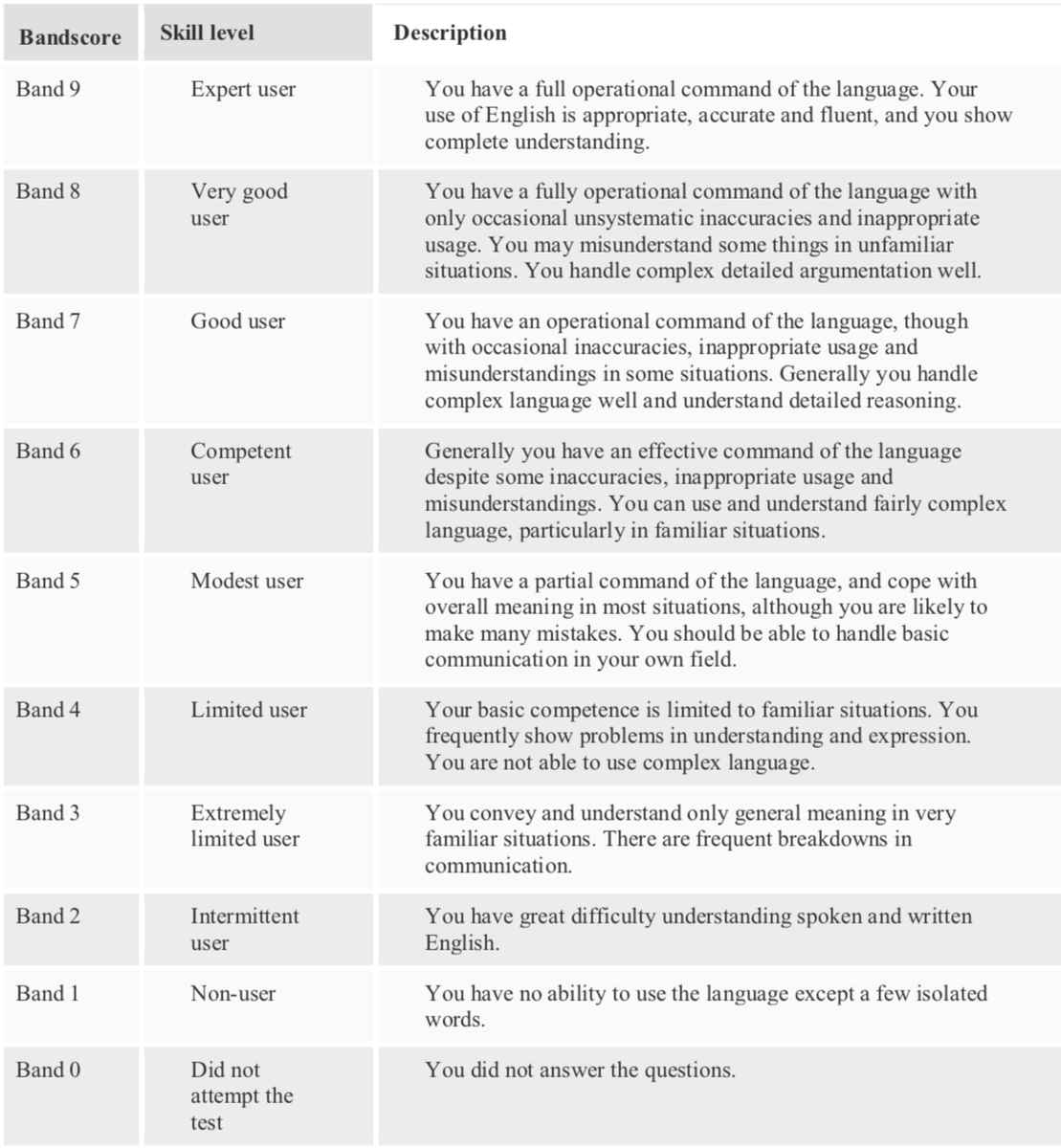
How is IELTS graded?
A unique assessment method (band scores) is used.
What are 4 sections of IELTS?
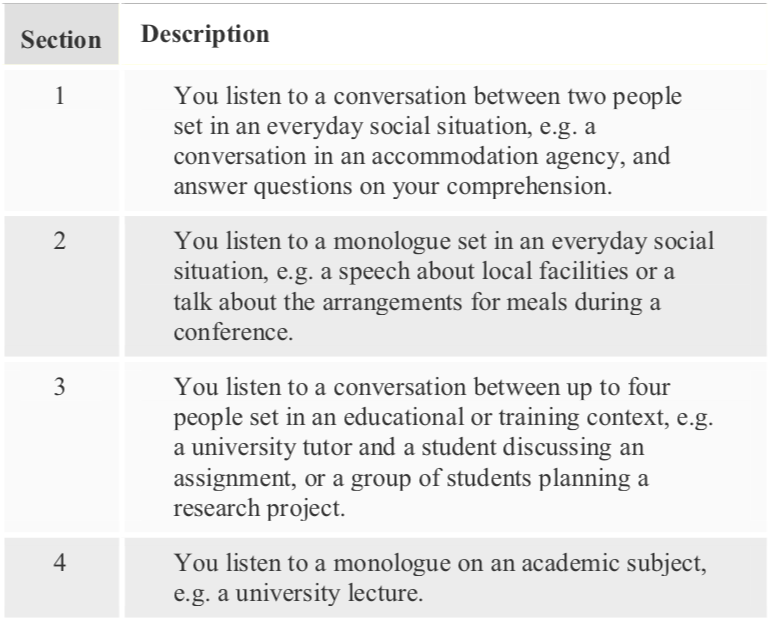
Listening test (30 mins):
Different kinds of people are engaged in preparing the IELTS Listening test, so you might hear Australian, British, New Zealand or North American accents. You will be listening to a pre-recorded audio, and the passages that you hear will increase in difficulty as you go through the test. The content of the Listening test is the same for both IELTS Academic and IELTS General Training tests.
What skills to train for Listening: there will be only 10 mins of additional time to transfer your answers to an answer sheet, so be prepared to simultaneously listen and write. Try to listen more to different accents and to understand spoken language.
Reading test (60 mins):
You will be asked to read three different passages and respond to related questions in your IELTS Reading test.
The content of the Reading test is different for IELTS Academic and IELTS General Training tests. Academic module implies complex texts with wide vocabulary, intended to assess your abilities to read sophisticated texts at university. Each text might be accompanied by diagrams, graphs or illustrations, and you will be expected to show that you understand these too. General one is easier, because texts are more dedicated to daily life abilities and do not involve rare vocabulary. The texts used in each section are taken from notices, advertisements, company handbooks, official documents, books, magazines and newspapers.
You will be given three different passages to read, each with accompanying questions. You can expect to read 2,150 - 2,750 words in total during your test. Sometimes you will need to give one word as your answer, sometimes a short phrase, and sometimes simply a letter, number or symbol.
What skills to train for Reading: grow your vocabulary to the maximum, using any method that you can imagine (reading novels, magazines, listening to podcasts, news). You need to be able to read very quickly and no understand texts without knowing all the words perfectly.
Writing test (60 mins):
The IELTS Writing test is designed to assess a wide range of writing skills, including how well you write a response appropriately, organise ideas, use a range of vocabulary and grammar accurately. This is the case for whichever version of the IELTS test you are taking. The IELTS Writing test takes 60 minutes. Spend 20 minutes on Task 1, and 40 minutes on Task 2. Task 2 is worth twice as much as Task 1 in the IELTS Writing test.
IELTS Academic Writing test. Write in a formal style in the IELTS Academic Writing test. In Task 1 you will be presented with a graph, table, chart or diagram. You will be asked to describe, summarise or explain the information in your own words. This might involve describing and explaining data, describing the stages of a process or how something works, or describing an object or event.
In Task 2 you will be asked to write an essay in response to a point of view, argument or problem. You should find the issues interesting and easy to understand.
IELTS General Training Writing test. The topics used in the IELTS General Training Writing test are of general interest. In Task 1 you will be presented with a situation and asked to write a letter requesting information or explaining the situation. You can write the letter in a personal, semi-formal or formal style.
In Task 2 you will be asked to write an essay in response to a point of view, argument or problem. You can use a fairly personal style.
What skills to train for Writing: you will need to manage your own time, so make sure you move on to Task 2 after 20 minutes. Develop an essay structure, which will be applicable to both tasks in Writing (usually such essays consist of an introduction, several body paragraphs, an optional overview and a conclusion). Learn as many cohesive devices (linking words) as possible in order to make your essay easy to read.
Speaking test (11-15 mins):
The test is interactive and as close to a real-life situation as a test can get. A variety of accents may be used, and the test will be recorded.
The content of the IELTS Speaking test is the same for both the IELTS Academic and IELTS General Training tests. The examiner will want to see how well you can communicate in English; to do this you will need to answer a range of questions, organise your ideas coherently, express and justify your opinions, analyse, discuss and speculate about issues. Make sure that you relax and talk fluently. You will need to speak naturally.
What skills to train for Speaking: make sure you speak at length on a given topic using appropriate language, communicate opinions and information on everyday topics and common experience. Try to speak with your friends, colleagues, relatives, people on the Internet or anybody at your convenience (who speaks English, obviously). There is always a chance to meet an English-speaking person in the world.