Published 2018.08.25
Note: These descriptions of the Russian Aerospace Forces airstrikes at the ISIS terrorist objects (ISIS – organization, prohibited in the Russian Federation) are based on the open sources [2-11] and are very close to reality, but nevertheless they are conditional: conditional dates and times, conditional number of aircrafts, conditional number of missiles per one aircraft, conditional areas of air refueling and launching, conditional lists of terrorist objects and so on. These descriptions include Archimate diagrams illustrating important aspects of combat systems and their actions [1].
One of the main combat missions of the Russian Grouping during its counterterrorism operation in Syria was to destroy elements of terrorists infrastructure of special importance (control and supply systems, military and oil&gas production facilities).
To settle these missions Russian Grouping Command created striking combat systems, which hit important terrorists objects using high-precision weapons.
All strikes were performed against the targets, which had been detected in advance.
Below there is an example of two air striking combat systems, which were created to hit important objects of terrorists in Idlib and Aleppo provinces. These events took place in the first half of the Russian counterterrorism operation in Syria.
The first combat system included a group of two Tu-160 supersonic strategic bombers (Russian airmen nickname of Tu-160 – “White Swan”) with Kh-101 cruise missiles, the second - a group of two Tu-95MS turboprop-powered strategic bombers (NATO reporting name of Tu-95 - “Bear”) with Kh-555 cruise missiles (Figures 1 and 2):
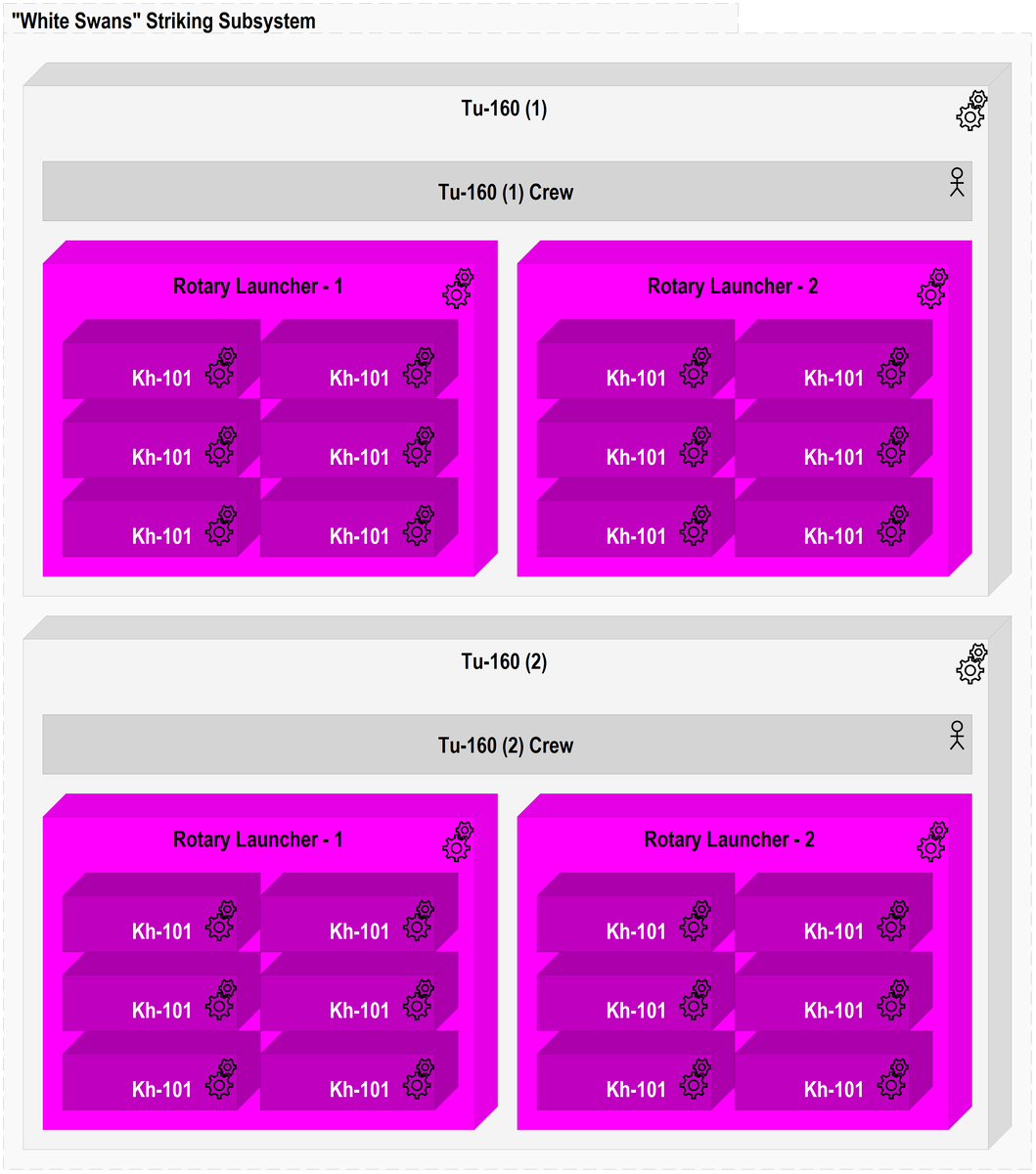
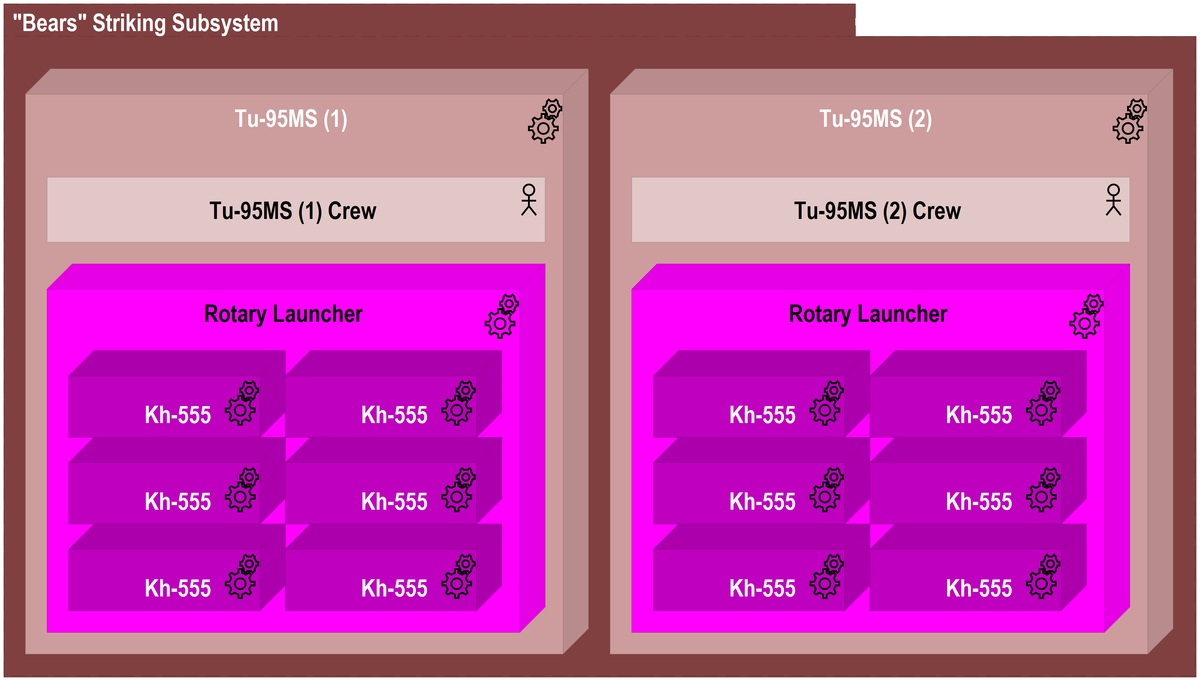
The “White Swans” combat mission was to destroy the following ISIS Objects (ISIS – Organization, prohibited in the Russian Federation) in Aleppo province: Command Center, Large Ammunition and Armament Depot, 2 Factories Manufacturing Rockets and Mines, Workshop Manufacturing and Repairing of Mortars and Terrorist Training Camp (Figure 3):
The “Bears” combat mission was to destroy the following ISIS Objects (ISIS – Organization, prohibited in Russian Federation) in Idlib province: HQ of the ISIS Terrorist Organization (ISIS – Organization, prohibited in Russian Federation), Command Center, 2 Factories Producing Explosives and Unguided Rockets, 3 Large Depots of Ammunition and Other Supplies Located in Protected Shelters and Terrorist Training Camp (Figure 4):
The Russian Defense Ministry informed the US Air Force Command and other coalition countries’ Commands about the airstrikes in advance.
“White Swans” began first.
In the morning group of Tu-160 took off from the Olenya airbase (the territory of the Russian Federation).
They flew over of the Barents Sea, the Norwegian Sea and the Strait of Gibraltar.
Aircrafts flew round Finland, Norway, the United Kingdom, France, Spain, Portugal.
The first air refueling was conducted in the area of Gibraltar.
Then in a specified area of the Mediterranean Sea “White Swans” launched Kh-101 cruise missiles and went on their flight over territories of Iraq and Iran.
They carried out the second air refueling at night over the Caspian Sea and returned to the Engels airbase (the territory of the Russian Federation) (Figure 5 - it contains the diagram wholly) and Figure 5-1, Figure 5-2 - they contain two-part diagram for best looking):
Destruction of objects was confirmed by objective control systems.
“White Swans” were in the air for about 13 hours and their route constituted almost 13000 kilometers (Figure 6):
“Bears” Combat System began its job in several hours after “White Swans” takeoff.
They took off from the Engels airbase, flew over territories of Iran and Iraq and reached Syria.
Over Syria the Su-30SM fighters from the Hmeymim airbase covered the long-range bombers.
In a specified area of Syria “Bears” launched Kh-555 missiles.
“Bears” returned to the Engels airbase by the same route. They carried out one air refueling over the Caspian Sea (Figure 7 - it contains the diagram wholly) and Figure 7-1, Figure 7-2 - they contain two-part diagram for best looking):
The objective monitoring data confirmed that all targets had been destroyed.
“Bears” were in the air for about 9 h 30 min and their route constituted almost 6600 kilometers (Figure 8):
Источники
1) ArchiMate® 3.0.1 Specification, Open Group Standard, 2017, http://pubs.opengroup.org/architecture/archimate3-doc/
2) Ministry of Defence of the Russian Federation, Air Force Group in Syria, http://syria.mil.ru/en/index/syria.htm
3) Департамент информации и массовых коммуникаций МО РФ, «Массированные авиационные удары крылатыми ракетами и авиабомбами по объектам ИГИЛ нанесли самолеты Дальней авиации ВКС России», 17.11.2015, https://function.mil.ru/news_page/country/more.htm?id=12066124@egNews
4) «Полеты за угол с боевым применением», 20.11.2015, https://eagle-rost.livejournal.com/574817.html
5) Р. Пухов, «Российская воздушная кампания в Сирии: первые выводы», 17.02.2016, http://rusila.su/2016/02/16/rossijskaya-vozdushnaya-kampaniya-v-sirii-pervye-vyvody/
6) П. Дейнекин, Интервью РИА Новости, «Операция ВКС в Сирии: Россия обрела стратегию и опыт дистанционной войны», 30.09.2016, https://ria.ru/syria/20160930/1478181962.html
7) И. Макушев, Выступление на круглом столе в рамках форума «Армия-2017», 14.09.2017, https://defence.ru/article/siriiskaya-proverka-boem/
8) В. Герасимов, Выступление на открытом заседании Коллегии Минобороны России 7 ноября 2017 г., 07.11.2017, https://function.mil.ru/news_page/country/more.htm?id=12149743@egNews
9) И. Семенченко, «Ни разу не промазали», Военно-промышленный курьер, №49, 2017
10) К. Сивков, «Фиаско в трех Сириях», Военно-промышленный курьер, №5, 2018
11) К. Сивков, «Сквозь пустыню к победе», Военно-промышленный курьер, №6, 2018
Copyright © Rubenchik A.V. 2018. All rights reserved