Fumed silica, commonly known as "white carbon black," is a nano-scale amorphous silica powder obtained by high-temperature hydrolysis of silicon halides in an oxyhydrogen flame. Inside the reaction furnace, halosilanes hydrolyze into individual silica molecules and rapidly grow into spherical particles of 7-40nm. These particles are the primary particles of fumed silica. In a molten state, primary particles continue to move along with the flame in the reaction furnace and collide with each other, forming three-dimensional branched structures composed of multiple fused spherical particles. These are known as aggregates of fumed silica, typically ranging in size from 100-500nm. As aggregates continue to move and collide with the airflow in the pipeline, they connect through interactions to form a fluffy, flocculent powder, which we call agglomerates of fumed silica. The average size of agglomerates ranges from 1-200μm.
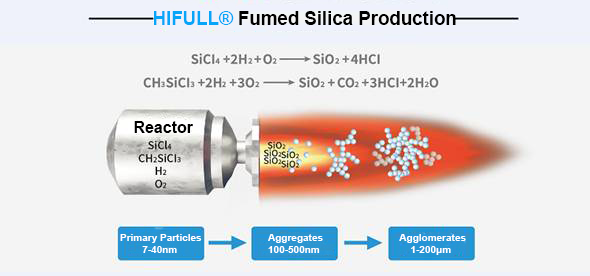
Due to this special preparation process, the structure and characteristics of fumed silica differ from traditional silica. It possesses numerous properties such as nano-scale particle size, high specific surface area, high surface activity, high insulation, high thermal stability, high chemical inertness, and high purity. The surface silanol groups (Si-OH) exhibit high chemical activity and can undergo chemical reactions with organic groups. Furthermore, silanol groups can form three-dimensional network structures through hydrogen bonding. The presence of silanol groups also makes it possible to modify the surface of fumed silica. By grafting functional chemical groups onto the surface, hydrophobic fumed silica with more diverse functions can be obtained.
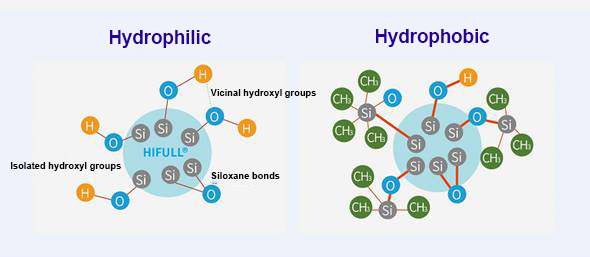
Therefore, fumed silica provides excellent functions such as reinforcement, toughening, thickening and thixotropy, anti-settling, anti-sagging, anti-caking, flow aid, synergistic defoaming, and as a carrier. It is widely used in silicone rubber, elastomers, coatings, inks, adhesives, insulators, composite materials, resins, plastics, colloidal batteries, defoamers, construction materials, agriculture, cosmetics, food, pharmaceuticals, thermal insulation materials, and chemical mechanical polishing.