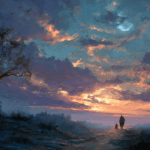
The Sun’s Command: Why Ancient Legends Warned Against Lingering Until Dawn
The Sun’s Command: Why Ancient Legends Warned Against Lingering Until Dawn
There’s a whisper in the oldest stories, a chilling universal truth echoing across cultures: when night falls, the world changes. 🌙
This ancient warning, «never linger past dawn,» isn’t just a quaint superstition; it’s a profound, deeply embedded instruction from a time when darkness held genuine, palpable terrors. Indeed, one might almost say it was the first rule of survival after sunset.
From the mist-shrouded glades of Celtic lands to the hushed forests of Germanic lore, and even in the sun-drenched myths of the Mediterranean, the hours between dusk and first light were often seen as a dangerous interlude. This was a period when the veil separating our mundane world from the supernatural thinned to a mere wisp, allowing all manner of creatures to spill forth. Very often, these entities were not at all benevolent.
Consider the mischievous yet terrifying Fae of Irish and Scottish folklore, or the various forest spirits and vengeful specters of European tales. They roamed freely under the moon’s silvery gaze, enchanting travelers with their otherworldly music or luring the unwary into their hidden realms. It was a common notion, too, that time itself could warp and stretch in these enchanted places; a single night spent dancing with the faeries could, it was said, translate to years, even centuries, in our world.
The consequences for those who failed to heed the sunrise’s call were often dire and irreversible. Some might find themselves trapped forever in the Otherworld, destined to serve the Faerie Queen or hunt eternally as part of the Wild Hunt. Others, perhaps, would return to their villages forever changed, their memories fractured, their souls perhaps a little too cold for human company, or even transformed into something monstrous and unrecognizable. This transformation could also mean losing your very essence, becoming an empty shell.
The breaking of dawn, however, was the great equalizer, the powerful antidote to nocturnal enchantments. As the first rays of the sun pierced the eastern sky, the magic of the night would begin to unravel. Ghosts would retreat to their graves, vampires would seek their coffins, and the capricious Fae would vanish back into their hidden mounds and dells. It was, in effect, a cosmic reset button, a daily reaffirmation of order over chaos.
And so, ancient societies imprinted this critical lesson into their storytelling: be home, safe within your walls, before the sun begins its ascent. This was not merely about avoiding physical dangers, but about preserving one’s sanity, one’s very being, from forces that fundamentally did not belong to the human realm. In some respects, it taught respect for the delicate balance of nature and the unseen.
Even today, a faint echo of these ancient fears persists. We still speak of things that «come alive at night» or the disquieting feeling of being out alone in the darkness. Perhaps it’s a primal memory, a deep-seated respect for the boundaries between worlds that our ancestors understood so intimately.
What ancient warnings do you still feel resonate in your own life? Or have you ever felt the eerie pull of the night, tempting you to linger just a little too long? Share your thoughts! 🌌
For more enchanting tales and mythical explorations, join our community on Telegram: https://t.me/Miphiuy