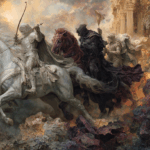
Unveiling the Horsemen of the Apocalypse: What Do These Ancient Symbols Truly Foretell?
Long before recorded history, humanity grappled with the terrifying notion of the end of days. Whispers of divine judgment and ultimate catastrophe permeated ancient cultures, taking shape in prophecies and dire warnings. 📜 Perhaps no vision is quite so chillingly vivid, or as enduringly potent, as that of the Four Horsemen, galloping forth from the pages of the Book of Revelation.
These iconic figures, it’s safe to say, have haunted human imagination for nearly two millennia, becoming powerful archetypes for our deepest fears about global suffering. This sacred text, often attributed to John the Apostle, presents a profound, rather enigmatic tapestry of symbolic visions. It’s a journey into the spiritual realm, a narrative unveiling what Christians, for instance, understand as God’s plan for the future, culminating in a dramatic, world-altering finale.
Let us, then, delve into the identities of these formidable riders, each one a herald of a distinct, quite terrible facet of the coming tribulation.
The First Horseman: Conquest (or Pestilence) 🏹
Emerging on a **pristine white steed**, the first horseman often appears as a figure of deceptive purity. He carries a bow and is given a crown, riding forth «conquering and to conquer.» This enigmatic figure, some might suggest, represents military conquest or imperial expansion, sweeping across nations with irresistible force. Others, though, interpret him as Pestilence, spreading disease and affliction across the globe, an invisible, insidious enemy. Indeed, some scholars even propose that this rider could symbolize the Antichrist, a deceptive leader who initially brings peace but ultimately unleashes chaos, or even Christ himself in a more triumphant light.
The Second Horseman: War ⚔️
Next comes a **fiery red horse**, bearing a rider to whom was given a «great sword.» This rider’s mission, quite plainly, is to «take peace from the earth, and that people should slay one another.» There’s little room for ambiguity here; this horseman is a terrifying embodiment of warfare, conflict, and civil strife, tearing societies apart with brutal force. It’s the stark reality of bloodshed, of families sundered and lands laid waste by the cruel hand of human aggression. This figure, one might say, is the personification of humanity’s destructive impulse, unleashed upon the world.
The Third Horseman: Famine ⚖️
Following the crimson chaos, we behold a **somber black horse**, ridden by a figure holding a pair of scales in his hand. A voice is heard, proclaiming, «A quart of wheat for a denarius, and three quarts of barley for a denarius; and do not harm the oil and the wine.» This chilling pronouncement, frankly, paints a stark picture of severe economic hardship and widespread famine. The scales are a clear symbol of rationing and inflated prices, indicating a time when basic sustenance becomes a precious, almost unattainable commodity. It signifies a profound disruption of the natural order, where even the simplest needs are met with exorbitant costs.
The Fourth Horseman: Death 💀
Finally, completing this quartet of dread, arrives the most universally recognized — and perhaps the most feared — of them all: **Death, riding a pale, sickly greenish-yellow horse**. Hades (often translated as Hell or the Grave) is said to follow closely behind him. To this fearsome duo was given authority «over a fourth of the earth, to kill with sword, with famine, with plague, and by the wild beasts of the earth.» This is the ultimate, inescapable end, a grim reaper figure bringing an indiscriminate cessation of life on an epic scale. It’s the culmination of the previous scourges, drawing together war, famine, and disease into one final, devastating blow.
These symbolic figures, it’s worth noting, are more than just characters in an ancient prophecy; they are enduring metaphors for the pervasive struggles that continue to challenge our world. The specters of war, economic instability, disease, and mortality, after all, remain ever-present in human experience. They serve as a powerful reminder, perhaps, of humanity’s fragility and the cyclical nature of suffering.
The Four Horsemen, in essence, speak to our collective anxieties about the unknown and the potential for catastrophic change. They compel us to ponder not only the fate of the world but also our own actions and responsibilities within it.
If you find yourself drawn to such profound narratives and ancient wisdom, why not join our growing community? We explore myths, legends, and sagas from every corner of the globe. Come delve deeper into these fascinating tales with us at https://t.me/Miphiuy!