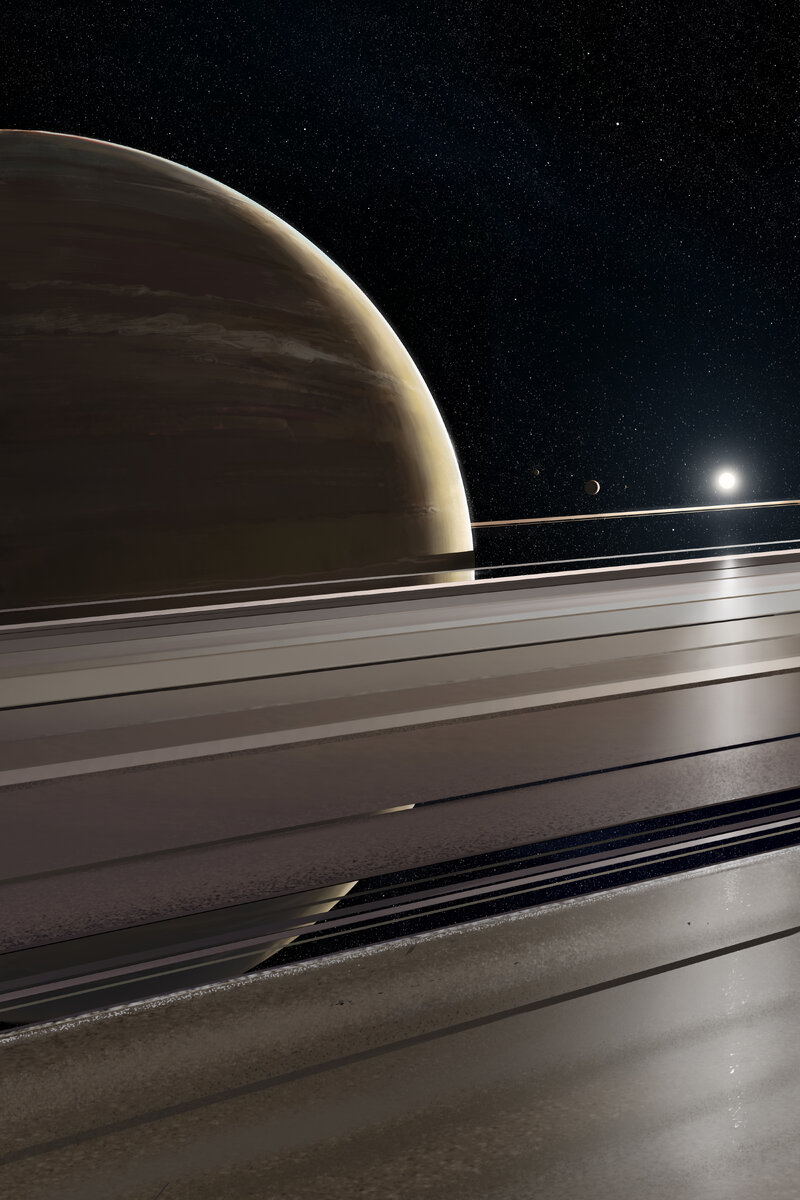
The age of Saturn's rings is a longstanding subject of debate among planetary scientists. Some believe that they were formed along with the giant 4.5 billion years ago from the ice fragments left in orbit after the formation of the solar system. Others say that the rings are very young and that Saturn at some point seized an object from the Kuiper belt or comet and then gradually "crushed" him or her into a cluster of debris in his or her orbit.
Now, this argument is most likely to have a dot in it. Calculations have shown that the mass of Saturn's rings is about 40 percent of the mass of his companion Mimas, which is 2,000 times "lighter" than the Moon. This suggests that the most striking feature of the planetary scale in the solar system emerged less than 100 million years ago, and perhaps even later - only 10 million years ago. The conclusions are based on the connection that scientists had previously established between the mass of the rings and their age. The smaller mass (the Voyager data showed a mass of 0.75 Mimas mass and the modeling of 2.8 Mimas masses) indicates a later formation, as they were initially almost entirely made up of shiny ice particles, but over time were polluted by interplanetary debris and fading. This evolution is key in determining when the rings originated.
Analysis of the data collected in 2017 by the spacecraft "Cassini" during the passage through the rings of Saturn, indicated that they are quite young and formed about 100 million years ago, at a time when the Earth lived dinosaurs. Those conclusions were based on measurements that provided an accurate estimate of the mass of the rings, which were more than 95 per cent water ice and 5 per cent stones, organic material and metals, and how long the "primary" ice in them would have to be exposed to dust and micrometeorites in order to reach current levels of "pollution".
However, in a study by Nature Astronomy, scientists point to a process in which large quantities of dust and organic material are released from the Saturn ring system, indicating a much older age, estimated to be around 4 billion years.
"We cannot directly measure the age of Saturn rings, so we have to use indirect methods to estimate their mass and chemical composition. Previous studies have suggested that the flow of dust into the rings is constant, that their mass is constant, and that they retain all the "contaminants" that are captured. However, there is still a great deal of uncertainty on all of these points, and given the other results of the Cassini mission, there is good reason to believe that the rings are much, much older," says Aurelian Creed, lead author of the study at the Observatoire de la Côte d'Azur (France).
Saturn rings consist of particles ranging in size from a few micrometers to several meters. The interaction between them leads to the rings "spreading" and carrying away the material like a conveyor belt. This results in a loss of mass from their innermost edge, where the particles fall on the planet, to the outer edge, where the material crosses the outer boundary and escapes to the area where the satellites reign.
"From our current understanding of ring physics, the mass measured during the last phase of the Cassini mission fits perfectly with a model that shows that it is several billion years old. It is worth noting that there is nothing to prevent the rings from being formed only recently and having the same mass, remaining almost intact, but that would be a great coincidence," said Aurelian Creed.
The results show that Saturn rings are constantly and naturally cleansing themselves of "contaminants" from the outside. Although the nature of this potential process is still mysterious, the main conclusion of the study is that the "visible" age is not necessarily consistent with the actual age and the ring system may look younger.