Part 2 Continuation
In the spruce forest, young trees (teenagers) of almost all tree species die due to the strong shade. However, the youngest spruce trees themselves have been preserved for a long time, but look miserable. Trees are smaller than human growth. Living branches are quite thin with rare short needles. The stem is like a ski pole. In the deep shade of the tree almost does not produce organic matter, and therefore, can not produce much wood. If you try to determine how old it is, you will be surprised. Such a herringbone can be 40-50 and even 70-80 years old. That's how long the teenagers have been fighting for life in the deep shade of the forest. Amazing survivorship and shade endurance!
Interestingly, the weak umbrella trees have not lost the ability to become real trees. In favorable conditions, they can grow into tall, slender spruce trees. It is only necessary to give the young trees enough light, free them from the shady canopy of the mother canopy.
Spruce is a tree that has lived for quite a long time - a few hundred years. Sometimes you can find old 300-year-old spruce trees in the forest. And in some places in the north of the European part of the country the whole forest areas formed by such long-livers (for example, in the Leningrad and Kostroma regions) are still preserved, sometimes 500-year-old spruce trees are found.
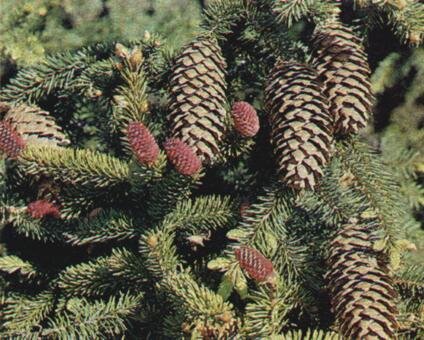
Let us now turn to spruce breeding. In spring, around the time when the cherry blossoms, bright red, thimble-sized female cones sticking out upwards appear at the ends of the spruce branches in the upper part of the crown. This is the "infantile" stage of the very spruce cone, big and brown, which we see in autumn. Each female cone is inside a special kidney until it is born and makes up all its contents. In spring, the kidney increases significantly, swells and finally drops its protective cover - a reddish pointed cap. Only now the female cone is completely free. Its structure, if not to go into botanical details, is simple: in the middle there is a rod, on it sits a lot of delicate scales, resembling the petals of flowers (there are also other scales, smaller). If you carefully break the young cone and consider a separate "petal", then on its inner surface you can see two tiny hillocks in the magnifying glass. These are seeds, which subsequently turn into seeds. In a week and a half or two after the birth of the buds change their position on the branches: they no longer stick out up, but hang down.
Men's cones are smaller than women's, red or greenish-yellow. They also consist of a rod and scales sitting on it, but only scales of another structure: on the outer side of each of them can be seen with a magnifying glass two oblong bags - a pollen reservoir. The crowns of some spruce trees in spring are decorated with many bright red male cones that stand out beautifully among the green needles. Dusty spruce is very abundant. Powder pollen is spread far around, settling on various objects. Look at the leaves of forest herbs - they are "powdered" with spruce pollen on top.
It is difficult to observe male and female cones close up: they are in the top of a tree, high above the ground. However, you can see them very close if you are lucky enough to find an adult spruce tree lying on the ground in spring, fallen by the wind of the previous autumn or winter (it was a fallen tree, not a broken tree at a certain height). Kidneys of this tree blossom normally, and you can easily see the details of the cone of both sexes. Unlike pine trees, spruce cones ripen in the first year. They form small winged seeds that look like pine seeds. Falling out of the cone, they also rotate in the air in the same way as a propeller. Their rotation is very fast, and the fall from this slowed down. If caught in the wind, the seeds can fly away from the mother tree. Seed dispersal occurs at the end of the winter, on dry, sunny days.
Spruce seeds give rise to tiny sprouts similar to pine seedlings. In the forest they are quite rare because of dry fallen needles. But there are a lot of sprouting everywhere that does not accumulate needles. In order to sharply increase the number of spruce shoots under the canopy of the forest, foresters use a special method - "ripping off the litter".
Spruce is widely used in the national economy. Its wood in large quantities is used, for example, for paper making. Nowadays, the need for paper is extremely high and it needs a huge amount. Spruce wood is also used to produce cellulose, artificial silk and much more. It is necessary in construction. Spruce wood is an indispensable material for the production of some musical instruments (it is used, for example, in the upper decks of violins, etc.).
Spruce is also an important supplier of tannins, which are necessary for leather dressing. These substances in our country are obtained mainly from spruce bark.
The continuation should be...