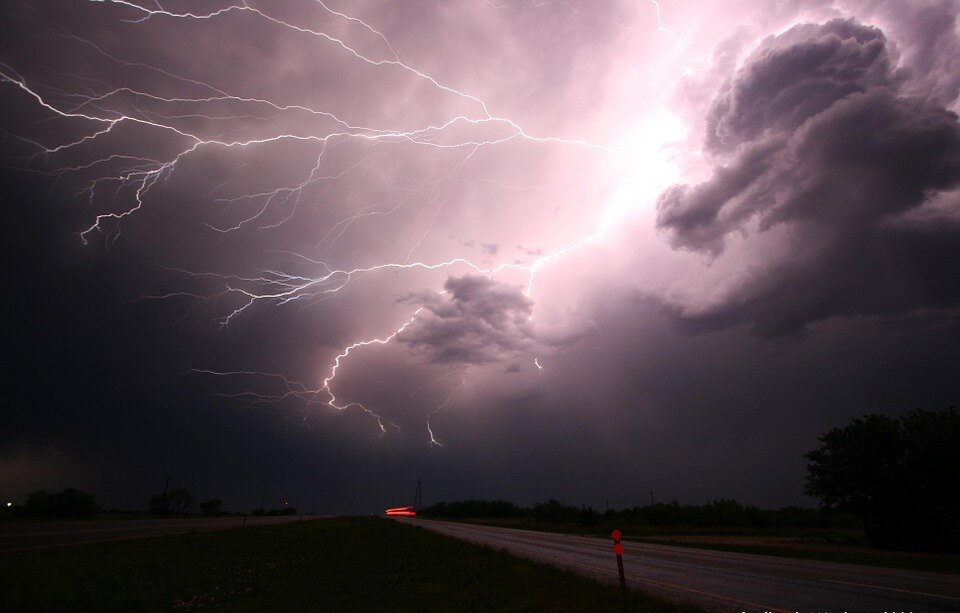
Lightning is one of the most impressive phenomena of nature. In ancient times, people were afraid of lightning and considered it a manifestation of the wrath of the gods.
And what do we know about lightning today?
Why are there lightning bolts? Lightning is an electric shock. And it arises because an electric charge accumulates in a thunderstorm cloud. It is believed that the accumulation of the charge is due to the crushing of rain droplets by rising streams of warm air (which is why there are almost no thunderstorms in winter). Small droplets carried upwards become negative and larger droplets become positive. As a result, between different parts of the cloud, as well as between the cloud and the ground, there is a gigantic tension of several tens or even hundreds of millions of volts, which causes lightning strikes.
Occasionally, lightning strikes in other natural phenomena, not just thunderstorms. For example, during volcanic eruptions, when a lot of ash is thrown out, the particles of ash electrify from the friction of each other and begin to strike lightning from the volcanic cloud.
Lightning in numbers
Of course, all the zippers are different, some approximate characteristics here.
- The typical length of a lightning bolt is a few kilometers. However, sometimes it can be tens or even hundreds of kilometers. For example, once in Japan, lightning struck the beach in clear weather, hitting several people. At the same time, lightning struck a distance of 140 kilometers. The record length of lightning is 321 kilometers.
- The current intensity of lightning strikes is hundreds of thousands of amperes at voltages ranging from tens of millions to billions of volts.
- Air at lightning strikes warms up to 30 thousand degrees (5 times more than the temperature of the surface of the Sun).
- The speed of the main lightning strike is tens of thousands of kilometers per second, and the typical duration of the strike is a few thousandths of a second. However, according to scientists, once a lightning bolt of record duration was recorded over France - more than 7 seconds.
- Despite the very short duration, the average energy released by lightning strike is about 5 billion joules or 1400 kilowatt-hours. Approximately the same amount of energy is released when a ton of TNT explodes.
There are approximately 50 lightning strikes every second on Earth.
Every year 10-20 thousand people die from lightning strikes. Thus from those in whom lightning has struck, more than 70 % all the same survive.
Thunder and lightning
When lightning strikes, there is a sharp expansion of air in the discharge area, which causes a shock wave. Its power quickly fades away from the distance, and at a great distance from the lightning, we hear only thunder rumbles. But at a small distance (measured by meters) the shock wave can stun a person and even knock him down.
Since the speed of sound is much lower than the speed of light, first we see only a flash of lightning, and only then we hear thunder. Since the sound velocity in the air is about 330 m/s, the delay time of the thunderous roll after a lightning flash will be about 3 s for each kilometer of the distance to it.
Destroying and deadly force of lightning
Most lightning bolts don't do much harm. Nevertheless, lightning can cause serious damage. It is not uncommon for lightning to burn down a house or carry a large tree into pieces.And here are other examples that show how dangerous lightning is.
- In 2013, shepherds in the Osh region of Kyrgyzstan grazed sheep. It was cold and the sheep crowded together when lightning struck the herd and killed 335 sheep at once.
- In 2017, a shepherd and 1,408 sheep were killed by lightning in the Kazakh steppe. The lightning strike caused a severe fire, from which the shepherd and the flock could not escape.
- In 1963, in the United States, a lightning strike struck a Boeing 707 landing. The lightning struck the fuel tank and the plane collapsed, killing 81 people.
- One of the biggest catastrophes related to the lightning strike occurred in 1769 in Italy. Then the lightning struck the church of St. Nazareth. The problem was that in cellars of church powder was stored. As a result of a terrible explosion about 200 houses were destroyed and about 3 thousand people were killed. After this incident, all Catholic churches were equipped with lightning rods.
- In general, the damage caused by lightning was quite large. They often cause fires and damage to the electricity system, and lightning strikes regularly burn down electrical appliances. It is estimated that lightning damage in the EU countries amounts to about 300 million euros annually.
Lightning benefit
In addition to the lightning damage, it's also good for you. They form ozone, which makes the air fresh and disinfects it, as well as protecting the planet from ultraviolet radiation. Also, lightning strikes produce nitrogen oxide. Nitrogen is a rather inert gas, which reacts with oxygen only at very high temperatures. At the same time, the enrichment of soil with nitrogen compounds is important for normal plant growth. So lightning bolts can be considered to fertilize the soil.
There are places on the planet where lightning strikes almost every day
In tropical climates, especially in Africa and South America, there are places where there are a lot of lightning and thunderstorms. One of the unique places of this kind is in Venezuela, where the Katatumbo River flows into Lake Maracaibo. Scientists have calculated that lightning is observed here about 297 days a year.
Most of the year the sky in this place is lit by lightning flashes every night, these flashes last for 7-10 hours and occur at intervals of about 2 seconds. Katatumbo lightning can be seen from a distance of 400 km, so during the sailing fleet sailors even used these lightning as a lighthouse.