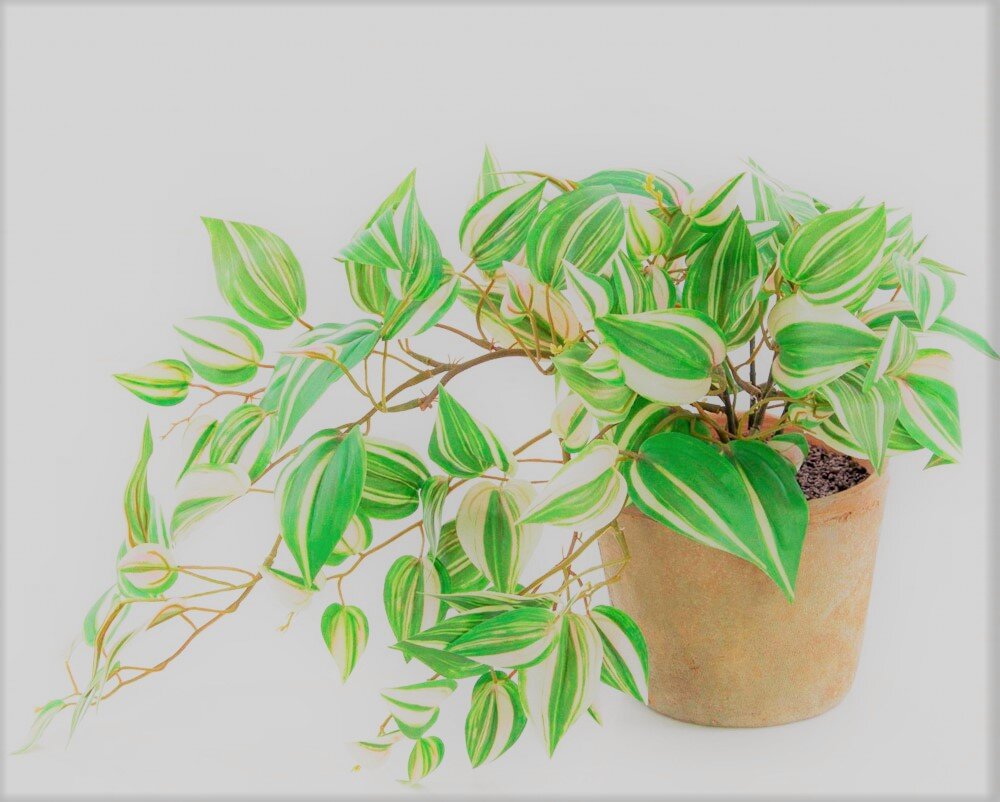
This amazing flower got its name from a traveler, collector, botanist and, finally, a gardener John named Tradescant. In the 17th century, he founded one of the first botanical gardens in England and was the gardener of the Duke of Buckingham. The natural habitat of the plant covers almost the whole of America from Argentina to Canada. Most often it is found in tropical and temperate latitudes, it feels great in a humid climate.
But, in addition to the benefits for the atmosphere and health, the home tradescantia simply pleases with its appearance! This ampelous plant forms straight, or lodging shoots with pointed leaves. The abundance of colors allows you to choose a flower to your taste! Which color do you like more - green, or lilac, white, or pink?
This genus has about 100 species, almost all of which bloom, forming small inflorescences similar in size and shape to chlorophytum flowers. By the way, many varieties are grown in the garden, in the open field, but most tradescantia still prefer to grow at home. Recently, another variegated flower, rheo, has been attributed to the genus of tradescantia.
White-flowered tradescantia is the most frequent “guest” of apartments! This species has subspecies with green, almost white and striped white-green leaves. Her flowers are white, or white-pink in color.
Tradescantia zebrina, or striped, is loved by flower growers for an unusual bright color. Its leaves are lilac on the lower side, “decorated” with lilac and silver longitudinal stripes on top. In the sun, this natural pattern glistens, and during flowering the "fashionista" is covered with small flowers to match!
Tradescantia violet will appeal to lovers of this color; during flowering, its rich purple leaves are highlighted by delicate pink flowers. Just a sight for sore eyes!
The leaves of the Blossfeld tradescantia are slightly pubescent, they are green above, and lilac below. Flowers have an unusually beautiful lilac-blue color.
Tradescantia pubescence boasts even greater “fluffiness”, its striped or plain leaves are covered with villi, and the flowers are mostly pink.
Naval-shaped tradescantia, probably the most unusual in the family! Its leaves in shape and really look like a boat and form erect shoots.
Tradescantia is a riverine or myrtle leaf plant with delicate lodging shoots, blooming with white flowers. It can be found near ponds in tropical latitudes.
Care Rules
Tradescantia potato is considered a relatively unpretentious plant, however, so that it does not lose its decorative effect, some conditions are necessary.
Temperature and lighting
Light requirements depend on the type of flower! So, green tradescantia are not so in need of lighting, as variegated forms. The second with a lack of sunlight pale. However, direct sun, as for all plants, is not desirable, under its influence, the leaves can get burned. And yet, even green varieties are not suitable for growing in the shade, in this case the shoots become elongated, thinner and the flower looks unhealthy.
This resident of the apartment will not refuse to spend the summer on the balcony! The temperature regime does not play a big role, loach easily tolerates minor differences. Comfortable is a temperature above 10-12 degrees, and in a hot period up to 25-30. Of course, during flowering, it is advisable to choose the brightest room with a stable temperature!
Watering and humidity
Tradescantia at home requires regular moderate watering. It is advisable that the soil is always slightly moist (but not wet!), Even in winter. However, it’s okay if the top layer dries between waterings. It is worth considering that the intensity of irrigation depends on the temperature. During the heat, when the soil quickly evaporates moisture, you need to replenish its reserves on time. If the temperature is low, the need for water is reduced!
In conditions of increased air dryness, the tradescantia is exposed to diseases and becomes vulnerable to pests. But keep in mind that species with pubescent leaves are advisable not to wet! A fine pulverizer can help, which atomizes the water, turning it into dust.
Fertilizers and fertilizing
Fertilize the tradescantia room with great care. With excessive and too frequent top dressing, bright leaves lose their color and can be deformed. Therefore, they begin to fertilize in March, using half the dosage from that indicated in the instructions. Suitable as complex fertilizers for decorative and deciduous crops, and organic fertilizing. Only not more than 1 time in 2-3 weeks and no overdoses!
Reproduction and transplantation
Propagating tradescantia is as easy as shelling pears! To do this, pinch the stems and root in the water. Moreover, pinching the plant is vital! Regular pinching promotes the growth of new shoots, the appearance of fresh leaves, rejuvenates the plant! By the way, at a warm temperature, it is able to increase the crown all year round! And yet, it occurs much more intensively in the spring and summer, when the flower has enough light. This beauty does not have special soil requirements, she loves nutritious, but at the same time loose soil. Ready peat substrates will quite suit her! If you want to make the soil yourself, mix garden soil, humus and peat in a ratio of 2: 1: 1. You can slightly dilute the mixture with expanded clay.