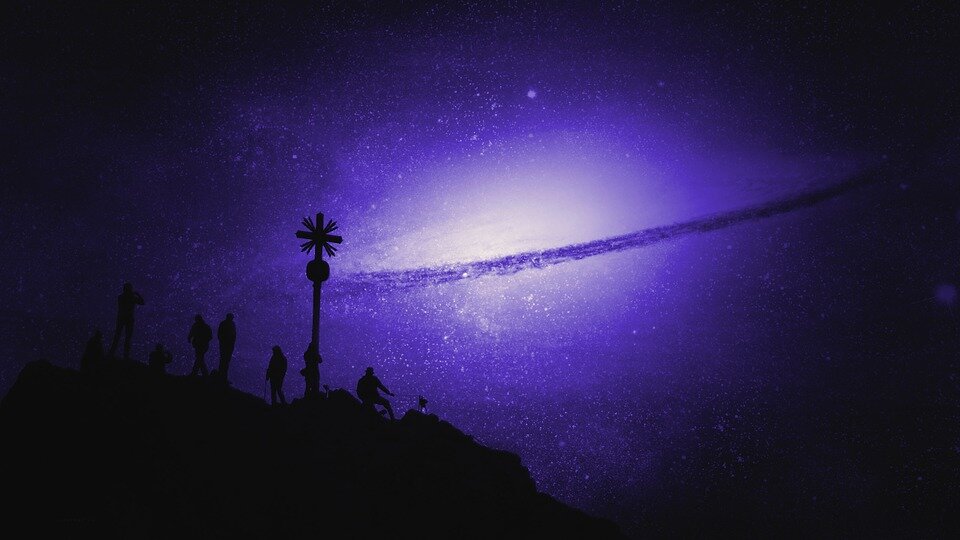
When one thinks of space and the universe, one probably thinks of what the eyes can see. But the image to which human eyes are sensitive is only the beginning. The light of the universe is much wider.
Electromagnetic spectrum is a term used by scientists to describe the entire spectrum that exists. From radio waves to the gamma rays, it is also the light of the universe, most of which is invisible to us with the naked eye! And even glaucoma has nothing to do with the eyes.
The nature of visible light in the universe
Light represents the wave process of alternating fields of electric and magnetic fields. Propagation is not very different from sea or ocean surface oscillations. Like any other physical quantity, it has several basic properties that describe it.
The main characteristic is the frequency measured in hertz, which counts the number of oscillations that pass by a point in one second. Another characteristic of wavelength is the distance from the peak of one to the peak of the next. These two attributes are linked back together. The higher the frequency, the shorter the wavelength and vice versa.
Electromagnetic waves that detect the eyes - visible light - oscillate between 400 and 790 terahertz (THz). This is several hundred trillion times per second of change. Wavelength, roughly the size of a large virus: 390 - 750 nanometres (1 nanometre = 1 billion metre). The human brain interprets different wavelengths as different colors. When people look at the sun's rays through the prism, they see that they actually consist of many lengths. The prism creates a "rainbow" by redirecting each wavelength at a slightly different angle. Red has a longer wavelength than purple.
But the light does not end in red or purple. As well as some sounds that we cannot hear (but some animals can), there is also a huge range that human eyes cannot detect.
Astronomers use the entire electromagnetic spectrum to observe various phenomena. There are modern telescopes used to compare the structure of our galaxy.
Infrared telescopes
The light of the Universe reaches the Earth not only in the visible part of the spectrum, but also in the invisible infrared. Infrared telescopes find dim stars and even measure the temperatures of planets in other solar systems.
The wavelengths of infrared light in space travel through clouds that would block the visible light of the galaxy.
With the help of large infrared telescopes, astronomers were able to look through the dust of the Milky Way band into the core of our galaxy and see the light of the universe.
The Milky Way, as we would have seen if our eyes could see infrared energy. The image shows massive stars clusters and spun gas clouds.
Most stars emit most of their electromagnetic energy as visible light from space, the tiny part of the spectrum to which our eyes are sensitive. Since the length of the oscillations correlates with the energy, it is possible to determine the temperature: red stars are cold, blue stars are hot. Cold stars emit barely visible light from space and can only be seen with infrared telescopes.
Ultraviolet telescopes
Space also emits ultraviolet waves. Shorter purple color is ultraviolet or UV light, which is invisible to human eyes.
UV is known for its ability to receive sunburns.
Astronomers use UV to hunt the most energetic stars and stars recently born. When viewing distant galaxies with UV telescopes, most stars and gas disappear, forming clusters of young stars.
X-rays and gamma rays of the universe
In addition to the UV from space, there are fluctuations in the electromagnetic spectrum: X-rays and gamma rays of space. Our atmosphere blocks these radiations, so astronomers must rely on telescopes in space to see the X-rays and gamma rays of the universe.
X-rays are emitted from exotic neutron stars, from the spiral material around a black hole, or from a diffuse gas cloud in galactic clusters that are heated to many millions of degrees. Meanwhile, gamma rays have short waves and are fatal to humans. Gamma bursts - the brief flickering of gamma rays from distant galaxies when a star explodes and creates a black hole - are among the most energetic single events in the universe.
If people could see X-rays over long distances, they would see nebulae around the PSR B1509-58 pulsar. This is an image of the Chandra Space X-ray Observatory of the remaining supernovae pulsar, located at a distance of 17,000 light-years.
The electromagnetic spectrum describes all wavelengths - visible and invisible and spread with different properties. The shorter the wavelength, the greater the frequency.
With the help of telescopes sensitive to a number of different wavelengths of the spectrum, astronomers have the opportunity to look into a wide range of objects and phenomena in the universe and see not only the night sky.