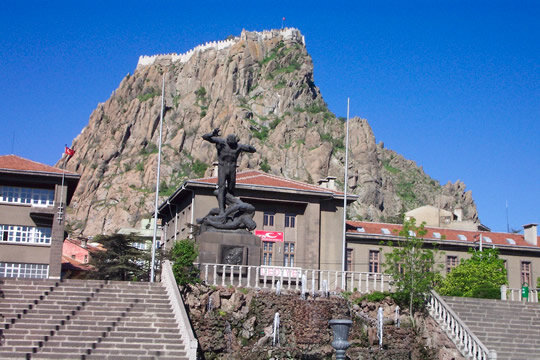
226 m between the mountains with volcanic features in the city center. altitude, rugged, and a high Conical Hill called the Castle attracted the attention of people from the Hittites to the present the defense and although suitable for lower, middle and upper wall Sur cevrelener favorable to the defense, including three times more were brought to the location.
Because of this feature, Hittites; HAPANUVA, Romans and Byzantines AKROINON, Seljuks, principalities and Ottomans karahisar-IDEVLE, KARAHISAR-I Sahib gave the name.
In the city center and within the borders of the Province M.He. II. is named after Afyon because the word Afyon is called Afion in the sense of SAP derived from the poppy plant, which has been grown as a source of people's livelihood from the century to the present day.
The name of our city has become Afyonkarahisar. 17 for the first time.century.it is known in court records that this name was given.
Because the region is known for its Phrygian culture, it was named Phrygian SALUTARIS (healing Phrygian) after Phrygian, especially because of the hot waters of Phrygian during the Roman and Byzantine periods.
1-Prehistoric Afyonkarahisar :
We do not know when the first human communities were found in the territory of Afyonkarahisar, but excavations in the surrounding provinces indicate that there will also be settlements in Afyonkarahisar in prehistoric times.
M.He.There are settlements, which have been concentrated since 3000 years. The most important of these is Yözüm Höyük. This period is the “Bronze Age”, when the mine was first worked and bronze was used. With the mine, pots and pans, cutting, striking, piercing, polishing, rope spinning and weaving tools made of materials such as stone, clay, bone, bronze, and life and death related items were found for use and need. These periods are well known for the excavations of Kuzey, Kaklık, and Karaoğlan.
2-Afyonkarahisar In History :
A) the Hittites (m.He. 1800-1200) :
M.He. After 1800, the Hittite Kingdom of Afyonkarahisar was established in Anatolia. This first period of the Hittite State was influenced by a culture of Indo-European origin. However, Hatti's religious and cultural characteristics have not been destroyed. The old Hittite Cube cemetery was unearthed by the excavation carried out in the Yanar locality of the town of Seydilar from this period. Hittites, M.He. Around 1380, they organized an expedition on Arzava, put these principalities under their control and opened the longest trade route of that period (Boğazköy-Apassa[Ephesus]) to Hittite trade. This road, which will later be named “King Road", reaches the Aegean via Hisarköy, Bolvadin, and Dinar.
M.He. The 2000sHe. 8 yy.la this period dates back to the Assyrian trade Colony period in Anatolia, the old Hittite, Hittite Empire and the late Hittite periods. The presence of these periods was also determined in our province. Seals of the colonial era and cemeteries; the cemeteries of the old Hittite period, axes, pottery, and an Imperial Seal, hammer, bronze figurine, Hieroglyph castle walls with steel; if it belongs to late Hittite period, embossed steel are among the important finds.
B) Phrygians (m.He. 1200-546) :
M.He. Phrygians, who began to spread to Anatolia since 1200 years, M.He.IX.since the century, they established political dominance between the Kızılırmak kavisi and Sakarya rivers and made Gordion a political center and Pessinus a religious center. M.He. The Phrygian domination, which was destroyed by the attack of the Kimmers from the Northeast in 660, was re-established around Yazılıkaya (the city of Midas) and Ihsaniye, a rocky and wooded region between the provinces of Afyonkarahisar and Eskişehir, and spread to Altintaş and dinar, and even to Elmalı (Antalya) according to the results of recent excavations. Although the Phrygian rule was destroyed by the Persian period, it is known that the Phrygian religion, culture, and language adopted in the region maintained its existence under the name of the Phrygian region, even during the Byzantines period, within the borders of our province. Especially in the borders of Ihsaniye aslankaya, Kapıkayalar, Göynüş Valley, Aslantaş, Serpentaş, Maltaş and Kumcabogaz, such as lion or kilim patterns carved into the rock monuments have survived to the present day. These rock monuments, which are not found elsewhere, are only within the borders of our province.