Instructions for submission
Assess the ways a child’s developing theory of mind resembles how scientists create, refine, and use theories in their work. In other words,would it be appropriate to think of children as informal scientists in their development of social understanding? Differentiate betweenInfancy, preschool, childhood, middle childhood and adolescent in your understanding of this development.
The paper must be 3-4 pages in length, double-spaced, exclusive of the reference page and cite at least 2 outside sources. Citations must bein APA format. Check all content for grammar, spelling and be sure that you have properly cited all resources.
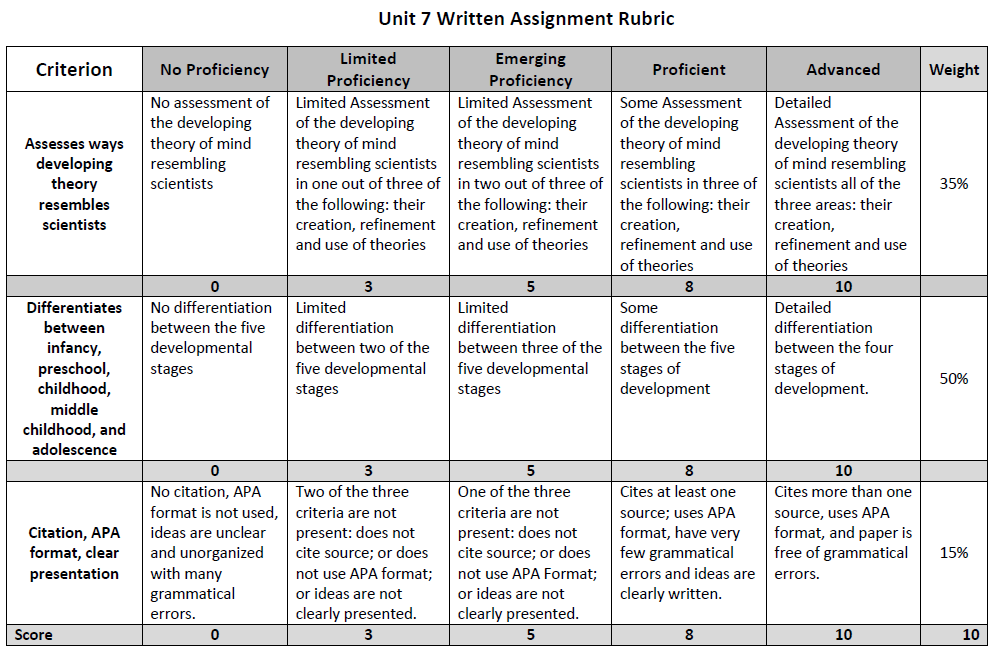
This unit will be peer-assessed using this
Unit 7 Written Assignment rubric
Child Development - AY2024-T2 Education Department, University of the People EDUC 5410-01 Writing Assignment Unit 7 Dr. Sushma Murthy January 2, 2024
Stages of Psychosocial Identity Development according to Erikson's 8 Stages include ( Openstax Content, n.d.) :
Hope: Trust vs. Mistrust (Infancy, 0-2 years) Existential Question: Can I Trust the World?
Will: Autonomy vs. Shame and Doubt (Early Childhood, 2-4 years) Existential Question: Is It Okay to Be Me?
Purpose: Initiative vs. Guilt (Preschool, 4-5 years) Existential Question: Is it Okay for Me to Do, Move, and Act?
Competence: Industry vs. Inferiority (School Age, 5-12 Years) Existential Question: Can I Make it in the World of People and Things?
Fidelity: Identity vs. Role Confusion (Adolescence, 13-19 Years) Existential Question: Who Am I and What Can I Be?
Love: Intimacy vs. Isolation (Early Adulthood, 20-39 years) Existential Question: Can I Love?
Care: Generativity vs. Stagnation (Adulthood, 40-64 years) Existential Question: Can I Make My Life Count?
Wisdom: Ego Integrity vs. Despair (Maturity, 65-Death) Existential Question: Is it Okay to Have Been Me?
Psychologists view development as a lifelong process that can be studied scientifically across three developmental domains— physical, cognitive, and psychosocial development (Thompson, 2018).
Physical development involves growth and changes in the body and brain, the senses, motor skills, andhealth and wellness (Thompson, 2018).
Cognitive development involves learning, attention, memory, language,thinking, reasoning, and creativity(Thompson, 2018).
Psychosocial development involves emotions, personality, andsocial relationships (Thompson, 2018).
Across these three domains—physical, cognitive, and psychosocial—the normative approach to development is also discussed. This approach asks, “What is normal development?” In the early decades of the 20th century, normative psychologists studied large numbers of children at variousages to determine norms (i.e., average ages) of when most children reach specific developmental milestones in each of the three domains. Although children develop at slightly different rates, they can be used to compare children with same-age peers to determine the approximate agesthey should reach specific normative events called developmental milestones (e.g., crawling,walking, writing, dressing, naming colors, speaking in sentences, and starting puberty) (Thompson, 2018).
To answer the question of the extent to which children can be considered informal scientists in their development of social understanding, consider the 7 qualities of a professional scientist (editorru, 2019) and the presence of them in the average child:
Keep up to date
A good scientist never stops learning. Science is constantly changing and it is imperative to keep up with the times. This involves hard work, as scientists have to constantly learn about their fields in order to keep researching.
The average child tries to explore the world around them every day by being inquisitive, curious and obsessive. Children are always noticing many details that elude adults, from smells to the position of things in space.
Being organised
Scientists must not only follow the scientific method, but also find their own ways to maximise their research and work plans. They are usually anticipatory, determined, and efficient workers.
The average child is always trying to achieve a goal. In the author's practice, there is a story of a six-year-old child putting three chairs on top of each other to get a box of chocolates from the cupboard. The main problem of the situation was that the cupboard was on the balcony.
Being sceptical
Curiosity leads scientists to question not only what they observe, but also what they already know. A good scientist may be willing to dismiss their own ideas if something doesn't look obvious. Being open-minded should be the first rule for scientists.
Here, when comparing to the average child, we can think of the famous question of all children "Why?". And very often the question is asked repeatedly to get more information about the subject of research.
Taking risks
In order to find new ways, methods and areas of research, some risks should be taken. Researchers must be willing to change all their paradigms and pursue new directions if the findings lead to it.
The most difficult task for parents and educators is the need to keep children away from risky situations. From situations where they could get hurt or life threatening. A prime example is the story described by Stuart Lester and Wendy Russell (Navidi, 2016) about children and the water tower structure.
Playing by the rules
To be a great scientist, one must act like a scientist and engage in all the envisaged research processes. This includes describing as well as presenting research and findings, which many researchers sometimes find a difficult and tedious task.
Any word combined with 'play' creates a keen interest in any child, and rules are always an integral part of play.
Co-operate and work in groups
Science benefits from the diversity of perspectives, cultures and assumptions offered by researchers. Communication and collaboration are really important for many reasons, and that is why scientists should not be lone workers. To succeed in a research career, it is important to collaborate with peers.
Peer relationships are a key, life-forming factor in a child's developmental journey (Thompson, 2018). when he or she seeks out friends for social development, play, building relationships, etc.
Act with integrity
Academic misconduct and professional behaviour are incompatible. A professional scientist should always work for the good of science, not just to make a name for themselves. Even though some scientists are involved in cases of corruption and professional misconduct, many scientists still fight every day to demonstrate the value of their work and the integrity of their profession.
Surprisingly, honesty is at the core of a child's existence in infancy as they learn to express their desires. Honesty guides every teenager who chooses his or her path. Honesty is a natural need, despite the abundance of fantasy, the tendency to exaggerate or understate and many other distortions of reality.
In conclusion, children are not like scientists in their development, but scientists use their skills learnt while growing up to create, refine and use theories .
Reference
editorru (2019). 7 qualities of a professional scientist. [online] Академия Enago. Available at: https://www.enago.com/academy/ru/7-traits-of-a-professional-scientist/ [Accessed 2 Jan. 2024].
Openstax Content. (n.d.). Chapter 9. Lifespan development. In Openstax: Psychology . https://openstax.org/books/psychology-2e/pages/9-1-what-is-lifespan-development#0#0 Navidi, U. (2016).
The role of play in children’s health and development. MDPI, pp. 3-114. http://www.mdpi.com/books/pdfview/book/179 licensed under CC BY-NC-ND 4.0.
Thompson, R. (2018). Social and personality development in childhood. NOBA. https://nobaproject.com/modules/social-and-personality-development-in-childhood#abstract
Zhou, M. & Brown, D. (Spring 2015). Educational learning theories. Educational Psychology Commons. https://oer.galileo.usg.edu/cgi/viewcontent.cgi?article=1000&context=education-textbooks
Tomlinson, C. A., & Murphy, M. (2018, March). The empathetic school. Educational Leadership, 75 (6), 20-27. http://www.ascd.org/publications/educational-leadership/mar18/vol75/num06/The-Empath etic-School.aspx